


JAKARTA - Center for Strategic and International Studies (CSIS) said that Indonesia has great potential to become one of the green cement producers in Southeast Asia.
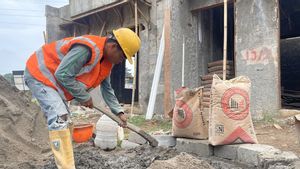
Research Associate Climate Policy Research Unit CSIS Indonesia, Via Azlia, at the launch of the 2025 Indonesia Sustainable Trade and Investment Report released by CSIS in Jakarta, Friday, explained that Indonesia is one of the largest cement producing countries in the region, with a capacity of more than 100 million tons per year.
This potential can be optimized as an effort to decarbonize the national industry as well as open up great opportunities in the global market that is increasingly demanding sustainable products.
Via added that the cement and fertilizer sector, along with iron and steel, accounts for nearly 82 percent of the total emissions from the industrial sector and consumes up to 85 percent of coal.
Pioneer Of Green Cement
Currently, PT Semen Indonesia has become the pioneer and main producer in the production of green cement in Indonesia.
"As the main regional producer, Indonesia has the opportunity to become a pioneer in the development of competitive green cement (green cement), as well as to encourage industrial transitions in a sustainable and inclusive manner," CSIS reports.
"For this reason, approaches and efforts such as the use of alternative fuels, reducing the use of klinkers97, increasing energy efficiency, adoption of CCS technology, as well as developing labels and green cement certification for product emission transparency are relevant for Indonesia in the future," the report said.
In addition to cement, the fertilizer industry is also starting to show a similar direction. The CSIS report states that the production of green ammonia by PT Pupuk Indonesia is a concrete example that this sector has great potential to transform its production system to be more sustainable.
Indonesia is one of the largest urea fertilizer producing countries in Southeast Asia, although it still relies on imports for other types of fertilizer.
SEE ALSO:

The CSIS report identifies that the main challenge for the fertilizer industry going forward is to reduce its emission intensity in line with the increasing global demand for low-carbon products. In this context, the green ammonia is starting to be positioned as a world's strategic commodity, not only as environmentally friendly fertilizer, but also as an alternative fuel, especially in the electricity and maritime sectors.
A number of countries such as Japan, South Korea, and several countries in the European Union have included a green ammonia in their energy decarbonization strategy.
The report also found that Indonesia has great potential to enter the global green ammonia supply chain, given its abundant renewable energy reserves and experience in low-carbon fertilizer production.
In COP29 of 2024, Indonesia has launched the GAIA (Green busyia Initiative from Aceh) initiative by PT Pupuk Indonesia, which is the world's first hybrid facility to combine renewable and conventional energy in green ammonia production.
The English, Chinese, Japanese, Arabic, and French versions are automatically generated by the AI. So there may still be inaccuracies in translating, please always see Indonesian as our main language. (system supported by DigitalSiber.id)


