
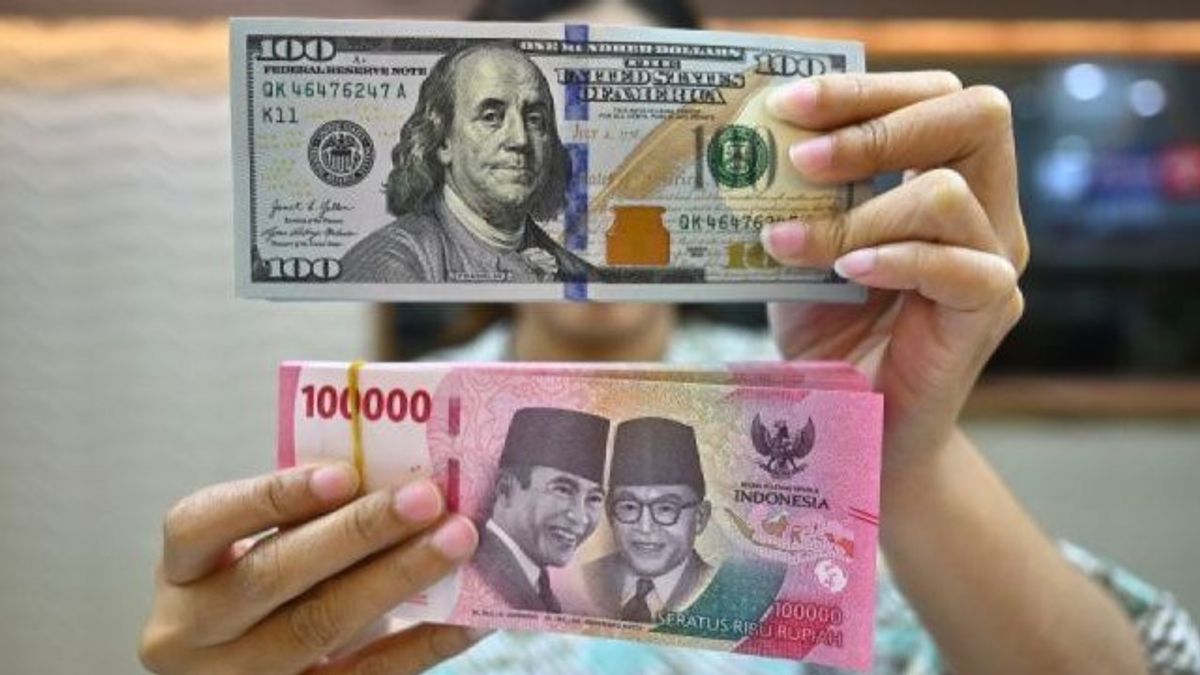


JAKARTA - Investment Specialist of PT Manulife Aset Manajemen Indonesia (MAMI) Dimas Ardhinugraha conveyed that the stability of the rupiah exchange rate against the United States (US) dollar and easing liquidity is the key to restoring the sentiment of the Indonesian stock market.
Historically, the Indonesian stock market tends to record positive performance when the rupiah exchange rate is stable or stronger, and liquidity conditions relax.
"We hope this can happen after the dust settlements when the imposition of US tariffs is clearer, especially if it is also assisted by improving domestic economic growth," said Dimas in Jakarta, quoted by Antara, Wednesday, March 12.
Since January 2025, he explained that market unrest has continued to increase amid a large amount of information regarding the incomplete and changing US tariff policy.
It was noted that the trading policy uncertainty index in February 2025 shot to its second highest level since its rise in the 2018 tariff war era.
"We hope that after there is clarity and detailed information regarding tariffs, the market can review the risks and opportunities that exist, so that market volatility can subside," said Dimas.
Meanwhile, from a global monetary perspective, the latest comments by Fed chairman Jerome Powell indicate that the current direction of monetary policy tends not to rush to lower interest rates.
In addition to the tariff policy uncertainty factor, other considerations are inflation, which even though it has fallen far away, still has not reached the target of 2 percent, and the labor sector is still strong.
On the other hand, the Fed indirectly also indicates the potential for more aggressive pruning can occur if economic indicators show weakening.
"So far, market expectations for this year's FFR cuts are still quite in line with the projection of the Fed itself, which is 50 basis points," said Dimas.
SEE ALSO:
-
 | EKONOMI
Ini Penyebab Dolar Perkasa di Negara Berkembang tapi Lemah di Negara Maju
23 Juni 2023, 19:02 -
 | EKONOMI
Paris Summit 2023 Ungkap Belum Ada Investasi Ideal dalam Transisi Energi
23 Juni 2023, 17:19

For Indonesia, according to him, the risk of imposition of resipprocal tariffs tends to be limited because the average rate between Indonesia and the current US is equivalent to around 4 percent, although it still has to wait to see if the resipprocal rates to be implemented refer to the average rate between the two countries, or per category of goods.
Meanwhile, for the imposition of 25 percent tariffs for steel, it was recorded that steel exports to the US in 2023 were only worth 199 million US dollars, equivalent to 0.07 percent of the total exports of all Indonesian commodities worth 264 billion US dollars, so the impact was quite minimal.
The English, Chinese, Japanese, Arabic, and French versions are automatically generated by the AI. So there may still be inaccuracies in translating, please always see Indonesian as our main language. (system supported by DigitalSiber.id)
Most Popular Tags
#Prabowo Subianto #donald trump #2026 World Cup #Febrie Adriansyah #8791Popular


