
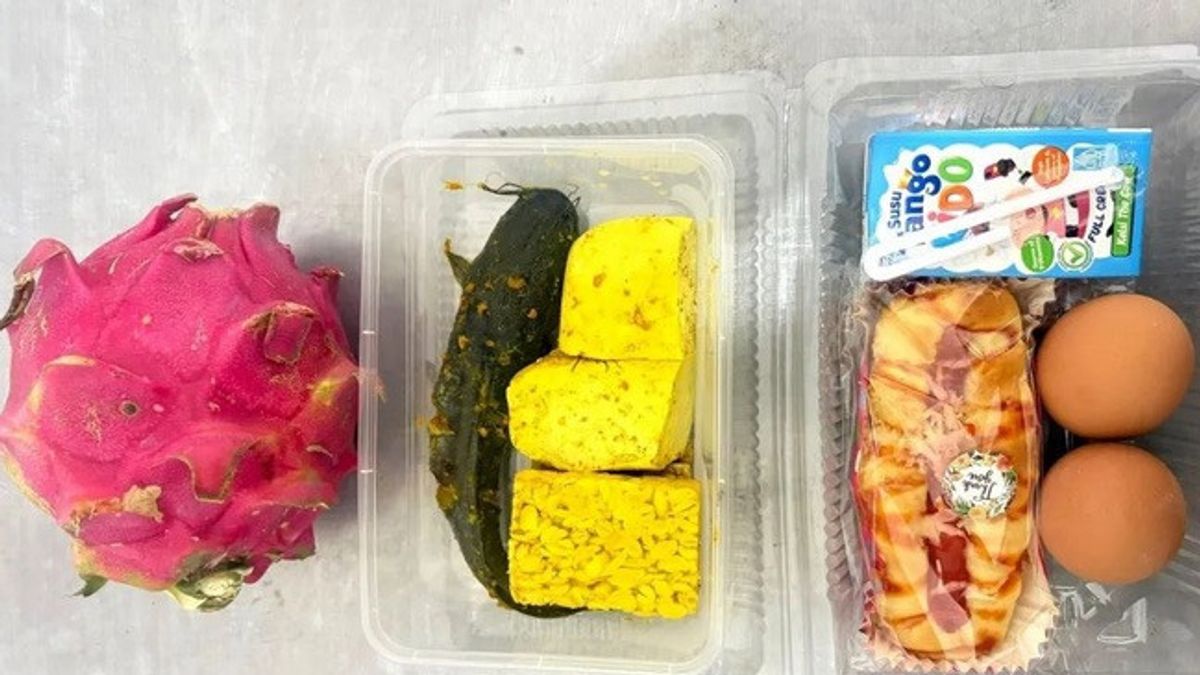


JAKARTA - Poor families have a right to Rp5.2 million per month from the allocation of the Free Nutritious Meal or MBG budget of Rp335 trillion.
The coalition of civil society organizations that are members of MBG Watch filed a material test or judicial review of Law Number 17 of 2025 concerning the State Budget to the Constitutional Court (MK).
The budget for the MBG program is the focus of the lawsuit, because it is considered to trigger the risk of misuse of the budget because it appears without a clear legal basis. In addition to causing fiscal arbitrariness, disrupting the priorities of education and health, and potentially harming the poor.
"This program has so far created what we call fiscal arbitrariness. In the midst of difficult economic conditions, MBG is still forced to run," said Jaya Darmawan, representative of MBG Watch, when registering a request at the MK Building, Central Jakarta, Tuesday (10/3/2026) afternoon.
Meanwhile, an individual applicant, Busyro Muqoddas, emphasized that the judicial review was filed based on concerns over the widespread impact of MBG governance which was increasingly out of control.
"What motivates us to register JR is the tragedy due to the increasingly uncontrolled MBG governance. We have felt the destructive impact that has afflicted the community widely," said Busyro.
The MBG Watch coalition consists of organizations such as the Center of Economic and Law Studies (CELIOS), Unitrend, Transparency International, Lapor Sehat, LBH Jakarta, Bareng Warga, ASPPUK, Indonesian Mothers Alliance, Sajogyo Institute, Themis Indonesia, and the Indonesian Women's Coalition.
Bureaucratic AuthoritarianismMBG is the flagship program of President Prabowo Subianto and his deputy, Gibran Rakabuming Raka. The program has been running since January 2025, with a budget of Rp. 70 trillion in the first year.
Despite receiving a lot of criticism from a number of circles, the MBG program continues. In fact, the MBG budget in the second year has increased almost five times compared to before. Prabowo's priority program has swallowed state funds of Rp. 335 trillion for 2026. The budget comes from the National Nutrition Agency, special allocation funds, and education funds.
The allocation of the budget follows the target for the distribution of the MBG program, which will target 82.9 million recipients by 2026.
The application for this material test was filed by the MBG Watch Coalition as a constitutional effort to stop the practice of state financial management which is considered arbitrary, not transparent, not accountable, and not in line with the principles of state financial management as mandated by the constitution.
The coalition tested Article 8 paragraph (5), Article 9 paragraph (4), Article 11 paragraph (2), Article 13 paragraph (4), Article 14 paragraph (1), Article 20 paragraph (1), and Article 29 paragraph (1) of Law Number 17 of 2025 concerning the 2026 Budget APBN Law.
Busyro Muqoddas said the MBG program showed symptoms of bureaucratic authoritarianism because it did not go through the public participation process. That is why this material test is a torch of democracy to bring transparency and accountability in the management of state budgets.
"MBG describes bureaucratic authoritarianism that is increasingly anti-democratic. If it is allowed, the people as the highest sovereign will be harmed," he said.
Jaya Darmawan added that the MBG program has the potential for arbitrariness in fiscal management amid global economic pressures. He referred to the continued weakening of the rupiah exchange rate against the US dollar, as well as only oil per barrel that has reached 104 US dollars per barrel. Although in the 2026 APBN simulation, only oil per barrel is 70 US dollars.
"With a fiscal deficit condition that has the potential to be up to three percent more, and our fiscal space is tight, I think this forced MBG that continues to run is an arbitrary behavior," continued Jaya.
Not Effective for Poor PeopleFrom an economic perspective, the Director of Fiscal Justice of CELIOS Media Wahyudi Askar emphasized that the allocation of the MBG budget, which reached Rp. 335 trillion, actually had the potential to be ineffective in helping the poor, contrary to the government's assumptions.
With a budget allocation of Rp335 trillion per year, said Media, if divided equally to all residents, everyone will get Rp361 thousand per month.
"If the budget is directly divided into poor families, each family can receive Rp. 66 million per family per year, or one family can receive around Rp. 5.2 million per month," said Media.
"But how much rupiah do poor people receive? Only around Rp200 thousand from their right of Rp5.2 million per family per month," he continued.
The media continued, instead of being enjoyed by poor families, the trillion-dollar MBG budget actually ran into rent, to large vendors, large logistics. MBG, he continued, is only a populist political program that is actually only shared with the ruling cronies.
Media also estimates that the potential loss due to wasted food could reach IDR 1.2 trillion per week. "The state budget is the people's money. When the economic conditions are difficult, the budget must be used as effectively as possible for the community," he said.
Meanwhile, the representative of the Indonesian Mothers' Alliance, Annette said, the MBG program has an extraordinary destructive power, which if continued could actually pull Indonesia into a dangerous condition.
For this reason, he urged the government to stop the MBG program. According to him, the people need more jobs, qualified education and health facilities, rather than free meals.
"This program is clear and real, it does not bring any real benefits, in reducing stunting cases, in increasing prosperity or the economic power of the community," said Annette.
In the midst of the current unstable geopolitical conditions, Annette also encourages the state apparatus to return to its original duties, and no longer to be involved in the MBG program.
"The TNI and the Police do not handle food, they should handle the security of the country at home and abroad," he said.
The English, Chinese, Japanese, Arabic, and French versions are automatically generated by the AI. So there may still be inaccuracies in translating, please always see Indonesian as our main language. (system supported by DigitalSiber.id)
Most Popular Tags
#Prabowo Subianto #donald trump #earthquake #independence day #8791 #hut riPopular


