
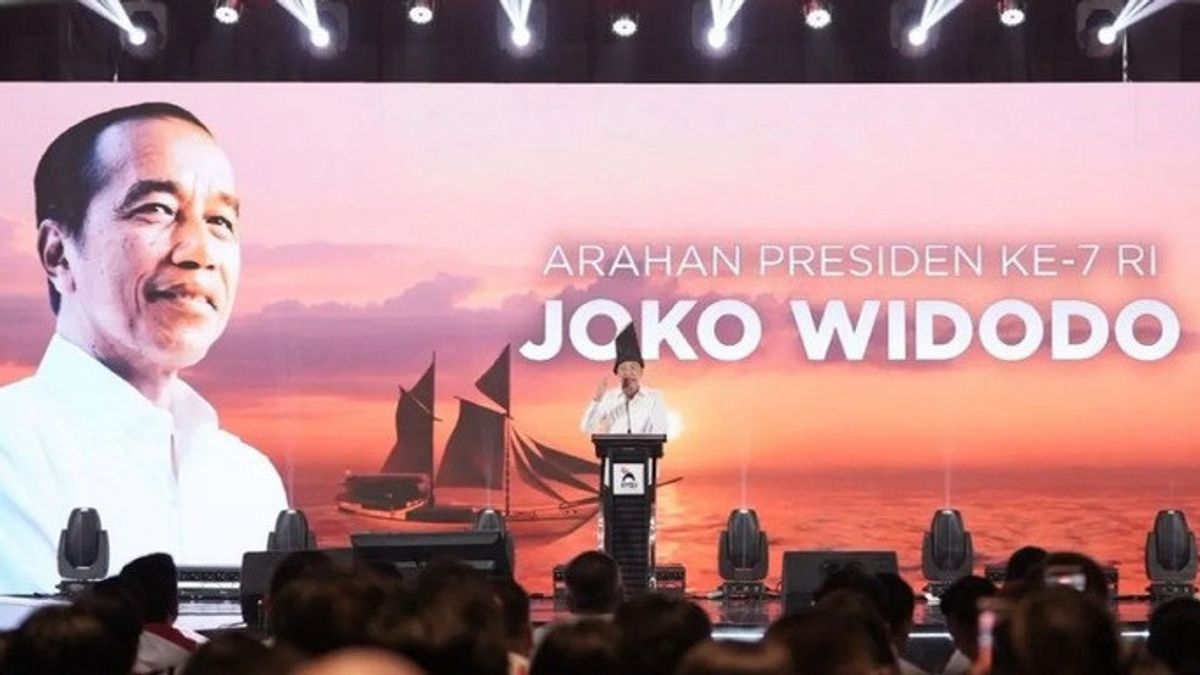


JAKARTA - The seventh President of Indonesia, Joko Widodo (Jokowi), took to the field during the Indonesian Solidarity Party (PSI) National Congress in Makassar. He emphasized that his target is for PSI to pass to Senayan in 2029.
Jokowi received a warm welcome from thousands of PSI cadres, Saturday (31/1/2026). In his speech, the former Solo Mayor emphasized that PSI must strengthen its online and offline networks, in order to get closer to the community. In the virtual world, he said the party must greet netizens and expand its reach. But no less important is the effort to meet the community directly.
"We need a big machine because the PSI target is a big target. The target is high, so the machine must be big," said Jokowi.
The Dean of the Faculty of Social and Political Sciences at Hasanuddin University, Sukri Tamma, said Jokowi's presence at the PSI National Congress in Makassar showed the position of a politician who had stepped down directly.
New EnergyIn a question and answer session, Jokowi explained the importance of the role of the party machine, from the grassroots level to the bottom. However, he ensured that this target could be completed by the end of 2026.
Raja Juli Antoni, Secretary General of the PSI, said Jokowi's presence was a new energy, pumping up the spirit, and thickening the belief in winning the dominant seat in 2029.
As a party that is only a few years old, Jokowi's presence in the PSI National Congress has at least attracted the attention of the public. How far does Jokowi's influence on the political stage of the country after he no longer serves as president?
Previously, PSI often made surprises to get into parliament in the 2024 election. PSI recruited Kaesang Pangarep, Jokowi's youngest son, as a party member on September 23, 2023. Two days later, Kaesang was appointed as the General Chairman of PSI.
The presence of Kaesang at that time was expected to have a big effect. However, the Head of the Political and Social Change Department of the Centre for Strategic and International Studies (CSIS) Arya Fernandes said the effect was not too massive.
The appointment of Kaesang as the head of PSI at that time was only a few months before the election. With limited time, Arya said it was not easy for PSI to carry out socialization and mobilization.
"Moreover, the level of public recognition of PSI is not yet large," he said.
Another impact is felt by PSI legislative candidates, who have never had direct competition experience in elections. Therefore, when faced with incumbents it is considered heavy.
No More EmbarrassmentThe 2029 election is still three years away, but PSI has been warming up its political machine from now on. A series of consolidations were held, while launching a "elephant cage" strategy in a number of regions.
What caught the public's attention this time was how Jokowi looked fiery in delivering his speech at the PSI National Congress some time ago.
Jokowi's presence, said Sukri, shows the position of a politician who is now directly off the field. If previously Jokowi seemed shy in giving support, this time he directly proclaimed himself as someone who is in the PSI line.
As a new party and failed to enter parliament in its debut election two years ago, PSI needs high bargaining power. So far, said Sukri, Jokowi has been more behind the scenes. However, the changing situation makes him have to be present in full in a political party.
For now, PSI is the main vehicle because there is no other political party that has the opportunity to enter it. Therefore, his presence is a straightforward statement in the political world, even though his health condition is not as before.
"As a message to the internal that 'I am present and we have to work hard together'. Meanwhile, for the outside parties, this is a statement that Jokowi is still there and is able to fight," he said.
Not Dependent on PopularityThe Executive Director of the Indonesian Political Parameters (PPI) Adi Prayitno also highlighted Jokowi's presence in the PSI National Congress. He also assessed that there were two beliefs that were developing in the public.
First, Jokowi still has political magic power to pass the PSI into parliament. Second, Jokowi has lost influence because he no longer holds formal power.
"When Jokowi is ready to expand PSI, it is a kind of readiness to test Jokowi's power after he is no longer president and not the PDI Perjuangan. If PSI passes, someone will say Jokowi is still powerful, if it doesn't pass, it will certainly receive criticism," said Adi.
Adi added that Jokowi's success in boosting PSI's votes does not solely depend on popularity. The determining factor lies in the party's actual work, because politics is basically about convincing the people below.
"PSI has a shot in the arm because Jokowi will fight to win PSI. It remains to be tested whether Jokowi is still powerful or not after he is no longer president and breaks up the share with the PDI Perjuangan. The key is field work," he explained.
Furthermore, Adi emphasized that the struggle for voter votes depends heavily on a direct approach to grassroots communities. So far, PSI has been more synonymous with urban voters.
"Until now, PSI is synonymous with urban voters. The biggest PR is, how does PSI penetrate into rural voters who are the majority," Adi concluded.
The English, Chinese, Japanese, Arabic, and French versions are automatically generated by the AI. So there may still be inaccuracies in translating, please always see Indonesian as our main language. (system supported by DigitalSiber.id)
Most Popular Tags
#Prabowo Subianto #donald trump #firearm #8791 #giias 2026Popular


