
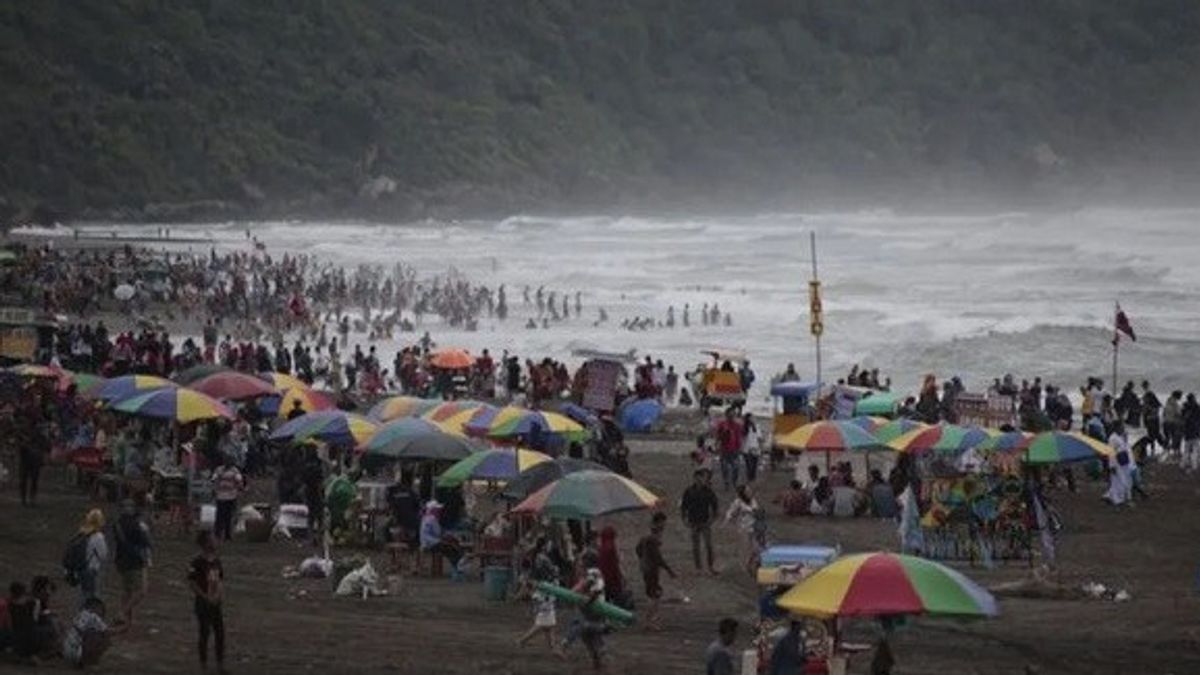


JAKARTA - The purchasing power of residents who have been depressed for the past few years is reflected in the decision to go on vacation at the end of the year. According to a Kompas survey, residents with low incomes have to save longer to go on vacation.
Kompas polling survey for the period of 10-13 November 2025 showed that almost 40 percent of 503 respondents said they would not go on vacation this year.
The survey found that almost 50 percent of respondents stated that financial problems or expensive holiday costs were an obstacle. In addition, 23 percent of respondents did not go on vacation because they were worried about traffic jams at the end of the year, and 20 percent cited work reasons.
The lower the economic class, the larger the proportion of residents who do not go on vacation. As many as 71 percent of the lower class residents stated that they did not go on vacation, and only 24 percent of the upper class residents revealed that they did not go on vacation.
Tourism is not a basic needThe average growth of Indonesian citizens' salaries has tended to slow down over the past 15 years. At the same time, purchasing power is depressed. This is shown by the decline in citizens' spending.
According to data from the Central Statistics Agency (BPS) in 2010, the average growth in citizens' salaries was 6.7 percent per year. But in 2024, salary growth was only 2.8 percent per year.
Meanwhile, spending still grew 12.6 percent in the 2010-2014 period. However, in the last five years it has slowed down 5.2 percent.
There are several non-food expenditures whose value has decreased. One of them is the purchase of various goods and services, including entertainment, transportation, and accommodation services. In 2015, the proportion of spending on this component was 25.1 percent but in 2024 it fell to 24.1 percent.
The decline in public interest in vacationing at the end of the year has at least an impact on the tourism sector, as acknowledged by the Secretary General of the Indonesian Hotel and Restaurant Association (PHRI) Maulana Yusran. He said, traveling is not considered a major need, so the tightening of spending that residents carry out during the Christmas and New Year holidays does have an impact on the tourism sector.
"People's tourism spending is getting smaller, maybe even none. In the end, they only travel short distances within the city for culinary or to see attractions in the city," he said.
High Transportation CostsEven on vacation, residents generally reduce their spending budget. The majority of respondents (36 percent) went on vacation with a cost of less than IDR 1 million and 36.6 percent with a cost of IDR 1 million to IDR 3 million.
Reducing the budget is one of the solutions for residents to still go on vacation. Almost 70 percent of respondents said they had reduced the cost of their vacation.
Of the 70 percent of respondents, as many as 18.8 percent reduced the budget for tourist packages or recreational services. Then 14.4 percent cut the budget for souvenirs, 11.4 percent cut the accommodation budget, and 7.9 percent reduced transportation funds.
Tourism researcher at Gadjah Mada University (UGM) Mohammad Yusuf explained that transportation costs are one of the largest components in tourism spending.
"The further the tourists travel, the greater the transportation costs," said Yusuf.
Yusuf observed that in recent years the increase in transportation costs has been very high. One of the causes is the high fuel and aircraft parts tax. This makes the cost of domestic flights very expensive and has an impact on the soaring transportation costs.
Quoting Kompas, the proportion of transportation costs is around 75.6 percent to 81.9 percent of the total cost of tourism. This is because the choice of affordable transportation modes, especially between islands using aircraft, is not as much as the choice of accommodation, tour packages, food costs, to souvenirs at tourist destinations. That's why it's hard for tourists to choose cheaper air transport modes unless at discounted prices.
Backpacking-style tourismIn early October 2025, Kompas collected data through the travel sites Traveloka, RedBus, KAI, and Pelni, with a scenario of a one-person trip for two days and one night in December 2025.
The cost of intercity transportation going back and forth from the origin area to the destination is calculated separately to show the influence of distance and mode of transportation on the total travel cost.
From there, it was found that the cost of alabackpacker holidays in 14 districts/cities of favorite destinations showed a wide range. For a two-day one-night trip, the lowest cost is in Denpasar City with Rp884,635 per person, while the highest cost is in Raja Ampat at Rp 2.8 million per person. This cost includes simple accommodation, meals, local transportation, and tourist activities in the destination area. This calculation does not include the cost of intercity transportation from the origin area.
The figure will be more expensive if tourists stay in hotels with three stars or more or use a tour package. The range of alabackpacker tourism costs is in the range of IDR 1.07 million per person in Denpasar City to IDR 4.57 million per person in Raja Ampat, with the components of accommodation costs, meals, local transportation, and tourist activities.
The high cost of this holiday also makes parabackpacker, need to save longer to be able to go on vacation. Residents with a minimum provincial wage (UMP) earn an average of 1.7 years or 20 months.
For example, the savings portion of 10 percent of the UMP, Jakarta residents with a UMP of Rp5.3 million in 2025 can go on vacation the fastest with a savings period of only six months, while other residents living in a number of other provinces must save more than two years, such as East Nusa Tenggara (NTT), Maluku, West Sulawesi, West Papua, to Central Papua.
The English, Chinese, Japanese, Arabic, and French versions are automatically generated by the AI. So there may still be inaccuracies in translating, please always see Indonesian as our main language. (system supported by DigitalSiber.id)
Most Popular Tags
#Prabowo Subianto #donald trump #Febrie Adriansyah #8791 #giias 2026Popular


