
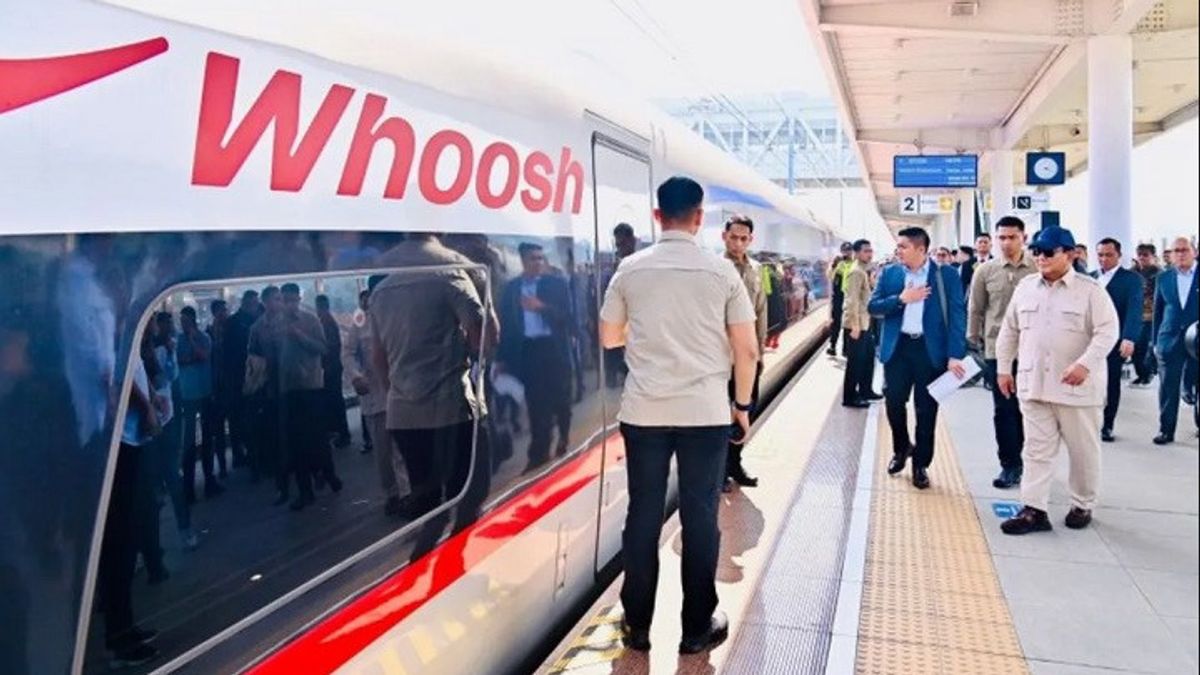


JAKARTA - The public is asked not to worry about God's debt, because President Prabowo Subianto is ready to take responsibility. However, until now, it is not known where the money will be used to cover the debt.
"Don't worry, what's a fuss over your debt? I've studied the problem, there's no problem. I'm responsible for everything later. Indonesia is not just a country," said President Prabowo Subianto.
Prabowo expressed this statement during the inauguration of the new face of Tanah Abang Baru Station in Central Jakarta, Tuesday (4/11/2025). Prabowo also boasted that he would pay IDR 1.2 trillion per year to China to cover the debt of financing the Jakarta-Bandung high-speed rail project.
This statement by the former Indonesian Minister of Defense was to answer a polemic about the debt of the Rights project which was busy in various media and became a public conversation.
In the past few weeks, the issue of trustsh's debt has indeed become a public conversation. The Jakarta-Bandung High Speed Rail (KCJB) project is known to have debts of up to IDR 116 trillion.
One of the reasons for the swelling of thections project is because the expected number of passengers is far below expectations. On the other hand, high operational costs must continue.
In the midst of this chaotic chaotic debt, Danantara Chief Operating Officer (COO) Dony Oskaria offered the government an offer to settle the KCJB project debt. He asked the government to increase capital participation to PT Kereta Api Indonesia as the leader of the fast train consortium, and instead the government took over the infrastructure of the project.
However, Danantara's idea was rejected by the Minister of Finance, Purbaya Yudhi Sadive. According to him, Danantara, who received dividends from BUMN should be able to handle the debt problem without involving the state budget.
In the midst of a polemic about God's debt, the Seventh President of the Republic of Indonesia Joko Widodo (Jokowi) said that even the success of mass transportation was not measured by profit, but from social returns on investment.
Then in the midst of Jokowi's pros and cons, Prabowo again made a statement that seemed to want to end the fuss over God's debt. He emphasized that the results of calculations on KCJB project debt financing did not encounter problems. He also assessed that the debt caused was still reasonable and Indonesia was able to pay for it.
Although he did not mention the source of funding to be used, Prabowo promised to pay Rp1.2 trillion per year to China. Shakesh, he said, has a myriad of benefits, including reducing traffic jams, pollution, and accelerating travel.
Therefore, the president asked KAI or the public not to worry about the debt incurred as a result of the project. Prabowo also asked parties not to normalize the polemic of her debt because it caused anxiety among the public.
Prabowo said that theASH project should not be seen solely in terms of profit and loss. This is because all public transportation in the world, including in Indonesia, is built with the principle of public service obligation or public service obligation. Therefore, the state must be present to ensure access to transportation for the people.
Muhammad Akbar, a transportation observer, said that the existence ofASH marks a new chapter in Indonesia's transportation history. The 142-kilometer-long trajectory cut the travel time to 45 minutes, at speeds of up to 350 km per hour.
However, behind this prestige, there is one basic question, can high speed lead to something more important and sustainable?
Not only about technology toughness, but also its economic benefits and social reach for the community. This is because world-class infrastructure only means when it is truly connected to the real needs of its citizens," Akbar said in a statement received by VOI.
If traced further, said Akbar, from the start the presence ofminish is more reflected in symbolic ambitions than the urgent need for mobility. He appeared not because of the Jakarta-Bandung transportation crisis, but from the urge to prove that Indonesia is equivalent to developed nations that own the high-speed train.
"The technological achievements should be appreciated. But without a complete understanding of people's travel habits, this fantastic speed has the potential to be in vain," he said.
As a result, the growth of passengers has been slow. This is an irony that actually contradicts the spirit of acceleration carried out. Where is the prospective passenger who is not interested in thisASH?
Whereash, according to Akbar, comes with a clear segmentation, not for all groups. The premium rate and location of the station are far from the city center, plus limited intermodal integration, making it more suitable for certain segments. No wonder the daily racers remain loyal to travel or shuttle, as well as intercity buses.
"The reason is simple: apart from being more affordable, the choice of mode offers flexibility in the door-to-door service and schedule that provides practicality that is difficult to replace," said Akbar.
Back to the issue ofPORTsh debt, which is trillions. Prabowo's statement that he will be responsible is a question for many parties. Where did the money come from?
Executive Director of the Center of Economic and Law Studies (CELIOS) Bhima Yudhistira calledPORTh's debt a complex problem, because Danatara as a state-owned investment management agency should be able to overcome its own problems, including hersh debt. This is exactly what Finance Minister Purbaya Yudhi Sadive said when rejecting Donny Oskaria's offer.
Bhima refers to the revision of the 2025 BUMN Law that, it is clear that there is separation of state assets and state-owned assets.
"It's as if Danantara wants to be delicious, that's right, said Minister of Finance Purbaya. BUMN dividends want to go to Danantara, but it's your turn to have a problem, it's your turn to have the APBN problem included. In this case, I agree with Purbaya, not to involve the state budget either in terms of capital participation or as collateral or collateral," said Bhima when contacted by VOI.
Bhima continued, there was indeed wrong logic from the start, and if forced to use the state budget, it would actually encourage widening the deficit or increasing the debt imposed on the state budget.
The impact is that those who do not use the high-speed train must pay with taxes.
SEE ALSO:
-
 | BERNAS
Soeharto Pahlawan, Reformasi Gagal: Indonesia Masih Mengagungkan Pemerintahan Otoriter
07 November 2025, 12:00 -
 | BERNAS
Annus Horribilis, Kasus Pangeran Andrew adalah Malapetaka bagi Kerajaan Inggris
06 November 2025, 16:00 -
 | BERNAS
OTT Gubernur Riau: Biaya Politik Tingggi, Kepala Daerah Berulang Kali Terjerat Korupsi
04 November 2025, 19:30

"This is unfair. So the tax payer must bear the fast train debt even though they don't enjoy it, or if they want to enjoy having to pay for the fast train, while the high-speed train is transportation for the upper middle class, there is confusion here," he said.
Meanwhile, the state's capital participation in the train, Bhima emphasized, should support regular trains, instead ofASHes.
"Even now, there is still a shortage of development funds, especially outside Java for trains. Why are the train subsidies for the upper middle class?" Bhima emphasized.
The English, Chinese, Japanese, Arabic, and French versions are automatically generated by the AI. So there may still be inaccuracies in translating, please always see Indonesian as our main language. (system supported by DigitalSiber.id)
Most Popular Tags
#Prabowo Subianto #donald trump #firearm #8791 #giias 2026Popular


