
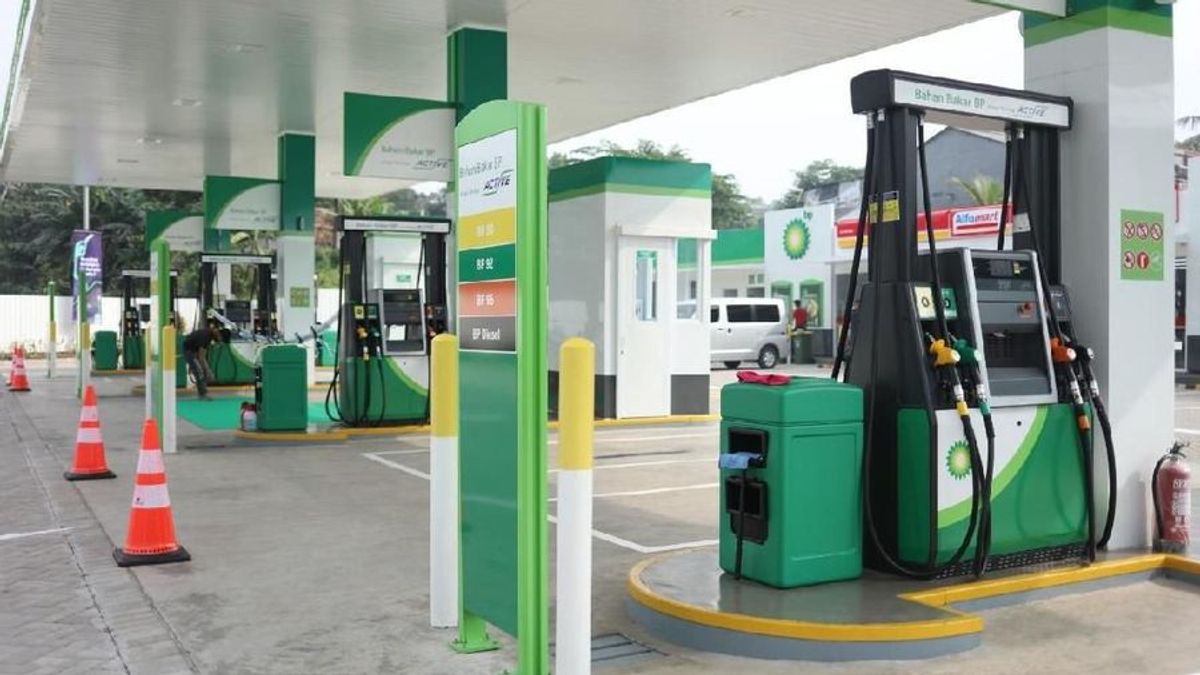


The scarcity of fuel at private gas stations in Indonesia in recent months is still interesting to discuss. Premium products disappeared from private refueling stations and long queues at Pertamina gas stations frustrated drivers. Even in some areas, complaints about the quality of fuel from Pertamina continue to emerge.
For ordinary consumers, the fuel problem is never isolated because it quickly affects transportation, logistics, and daily expenses. The government provides a cepan solution, by suggesting private retailers buy their fuel supply from Pertamina. At first glance, this seems like a normal rescue measure. But in reality, it shows an evil agenda: strengthening the government's monopoly on fuel.
Analysis from the Center for Indonesian Policy Studies (CPIS) reveals the troubling reality behind the scarcity.
"Import permits under the Commodity Balance system together with stricter state control efforts through state-owned enterprises (BUMN), have combined to create market distortions that ultimately harm consumers," wrote Andree Surianta and Hasran, two senior government policy specialist researchers from CPIS.
The Commodity Balance is a new quota system in the Indonesian trade bureaucracy that uses bid forecasts and demand to determine how many companies are allowed to import or export each year. This system was introduced to stabilize key commodities such as fuel, salt, garlic, rice, sugar, and corn by matching supply and demand through quotas.
In theory, imports will be allowed as long as the anticipated demand exceeds domestic supply forecasts. Once imports are approved, quotas and import permits will be valid for one year. This annual quota aims to provide business certainty for companies that depend on imports of raw materials.
Companies no longer need to repeatedly apply for permits throughout the year, thereby reducing their administrative burdens. Even though this year's quota system is a step forward, its practice is often less satisfactory because actual demand can exceed government projections. Companies can request additional quotas, but in the commodity balance system, the revised process is met with uncertainty, both in terms of time and amount that will eventually be approved.
This uncertainty depends on when the technical ministry decides to process the company's petition, which can take more than two months. And not necessarily the coordinating ministry chooses to approve the revision of the quota. This means that the urgency of the revision is higher than the initial quota offering process.
In the case of fuel imports, the Ministry of Energy and Mineral Resources (ESDM) shortened the quota period in early 2025 from one year to six months. The goal is possible to increase the response to market changes. But accidentally, the Ministry of Energy and Mineral Resources shrinks import quotas in every cycle of approval.
This means that when consumer demand soars, supply shortages may be inevitable. In this situation, private companies are required to apply for a quota revision to the Ministry of Energy and Mineral Resources. However, based on the commodity balance system, the ministry has full authority over whether the request will be processed and approved or not.
In practice, the ministry is reluctant to process this revision because the main goal is to encourage private retailers to get fuel from Pertamina, Andree added in his writing.
Another problem is that government supply data is too common to be matched with industrial demand data. Although industrial demand data is detailed into the Harmonization System Code (Hamonized System Code) an international trade classification system that details goods up to the level and use of government supply data is not.
This often creates a hidden shortage situation. Domestic supplies are abundant, but the types are not appropriate for industrial purposes. Although premium fuel is a recent case, other commodity balance commodities such as corn and rice are also experiencing this problem. Domestically grown corn is only suitable for direct consumption, not for industrial purposes.
So, corn production may be statistically sufficient, but the processed food industry is still facing a shortage of industrial-class corn. This detailed mismatch makes it difficult for businesses to secure the input they need on time.
SEE ALSO:
-
 | BERNAS
OTT Gubernur Riau: Biaya Politik Tingggi, Kepala Daerah Berulang Kali Terjerat Korupsi
04 November 2025, 19:30 -
 | BERNAS
Dinamika Politik 2029 dan Elektabilitas Menkeu Purbaya Yudhi Sadewa yang Melejit
03 November 2025, 16:00

At the consumer level, the perception of scarcity can encourage hoarding, which exacerbates shortages and increases prices. However, even when production is abundant and quality mismatch is not a problem, the Commodity Balance still does not address distribution problems.
This phenomenon can be seen clearly from the increase in rice prices due to the mandate of hoarding by Bulog, even though Indonesia is currently harvesting. These weaknesses have made the Commodity Balance an ineffective instrument to ensure availability and stabilize prices. However, when this inflexible system is combined with BUMN behavior, the resulting distortions directly hit the community.
The ongoing corruption investigation at Pertamina underscores the risk of being too dependent on the monopoly of SOEs. The Attorney General's Office estimates that state losses due to Pertamina's alleged corruption imports of fuel oil (BBM) between 2013 and 2018 will reach around US$12 billion, or more than Rp200 trillion!
Pertamina executives are accused of misappropriation of prices, improper imports, and selling low-quality fuel as high-octane products or what has recently been shocked as a case of 'pollosan gas'. This disclosure has undermined public trust.
Many consumers are skeptical of the quality of Pertamina's fuel switching to the private sector. However, because the Commodity Balance quota does not anticipate a significant shift in demand due to the loss of trust, private retailers run out of stock much earlier than they thought.
The government's solution by asking private retailers to refill stock from Pertamina does not make sense in a policy manner. Why should it encourage consumers to return to suppliers whose credibility is doubtful?
Given the widespread public doubts about Pertamina, the plan to make it a single fuel import gate can increase the public's perception that policymakers are less sensitive. The Commodity Balance and SOEs should protect Indonesians from volatility or turmoil.
But on the contrary, SOEs actually exacerbated it. The role of BUMN doubles as competitors as well as suppliers distort competition, hinder private investment, and make consumers bear their burdens.
First, the Commodity Balance must switch from a rigid quota system to a supply database that corrects information asymmetries. Instead of using it as a tool to control imports, the Commodity Balance must be a tool for companies to find and obtain domestic supplies when needed.
Second, the dual role of SOEs needs to be limited. Pertamina and Bulog must act primarily as managers of strategic reserves, not as suppliers of the raw market. Danantara as the holding company of SOEs, must provide a clear mandate to their business to be a market catalyst for wider private involvement, rather than as a substitute.
Third, transparency and accountability must be increased. Continuing a corruption investigation involving SOEs, and publicizing open Commodity Balance data, will be the key to restoring public trust. Finally, investment in logistics and distribution must be a priority. Abundant production means nothing if goods cannot reach consumers on time and efficiently.
Quota and SOEs provide an illusion of control, but bring hidden costs in the form of scarcity, inflation, and consumer frustration. Policymakers must be very careful not to make policies that are considered to support the growth of SOEs at the expense of freedom of choice for the community.
The choice for policymakers is clear: it only continues to fill the problem with a temporary solution, or design a flexible, transparent, and truly protecting system. Before the right policy arrives, the Indonesian people will continue to bear the distortions created by the state.
The English, Chinese, Japanese, Arabic, and French versions are automatically generated by the AI. So there may still be inaccuracies in translating, please always see Indonesian as our main language. (system supported by DigitalSiber.id)


