


JAKARTA President Prabowo Subianto's plan to have a national car in the next three years is considered ambitious and at high risk, said an automotive observer.
President Prabowo has again launched his ambitious project after one year leading Indonesia. This time he emphasized his desire to have a national car.
He targets three years from now for Indonesia to be able to produce fully domestically made passenger cars. This target is referred to as part of an effort to build the independence of the domestic industry.
"We will have a car made in Indonesia in the next three years," Prabowo said in a plenary cabinet session attended by all levels of the Red and White Cabinet, Monday (20/10/2025).
To realize this wish, the Minister of Industry Agus Gumiwang Kartasasmita said that his party had proposed a national car to become a National Strategic Project (PSN).
"We certainly support it, and we have proposed a national car program to become PSN, a National Strategic Project. We have signed the proposal," said Agus.
Automotive observer and industrial product designer at the Bandung Institute of Technology (ITB) Yannes Martinus Pasaribu said Prabowo's plans included ambitious and high-risk projects.
However, he assessed that the national car could be successful, with several notes. Yannes hopes that the electric vehicle (EV)-based national car will start with public transportation. The project is continued with the strengthening of the tierga and two industry cooperation massively built domestically.
This needs to be done because the principal never wants to open the slot to competitors. For this reason, Indonesia needs to develop its own ecosystem by cooperating with world-class partners who are not under contract with brand-holding agents (APM) who make Indonesia just a market.
"Indonesia can compete with the focus on the market niche controlled by the government starting from the EV fleet for official vehicles of state agencies from the regions, strengthening the TKDN (domestic component level) policy of 40 percent must be applied to all producers, which gradually increases to more than 80 percent," Yannes told VOI.
In addition, another requirement that must be considered so that the national car has greater potential for success is not to present a rebadging car or car that only changes brands.
"Indonesia has real potential for success with EV-based national cars, as long as it focuses on its comparative-competitive advantages," he said.
"Ready to build a factory in Indonesia with the concept of increasing TKDN, in order to avoid WTO and rebadging violations. The key is collaboration with world big players who want to transfer their core technology to Indonesia," said Yennes again.
Meanwhile, the target of owning a national car, according to automotive observer Bebin Djuana, cannot be seen as an urgency in the industrial sector, but rather leads to the pride of a nation.
"There is no urgency of a country having a national car, but it is a matter of pride. If only a nation had its own vehicles would be very proud," said Bebin.
To achieve that, consistency and support from all parties, from society to entrepreneurs are needed. The biggest challenge facing this new industry, said Bebin, is how to achieve world standards, adopt the latest technology, and have a cutting-edge design. And, of course, the most crucial is the competitive price.
"Is it enough time to build the automotive industry in five years? The president replaces it, the policy changes. This will fail again. It takes consistency, even though the president changes, the successor must take care of that dream," said Bebin.
When the time comes ready to be marketed, the design of interest has changed, technology is more advanced. That's the challenge you have to face," he added.
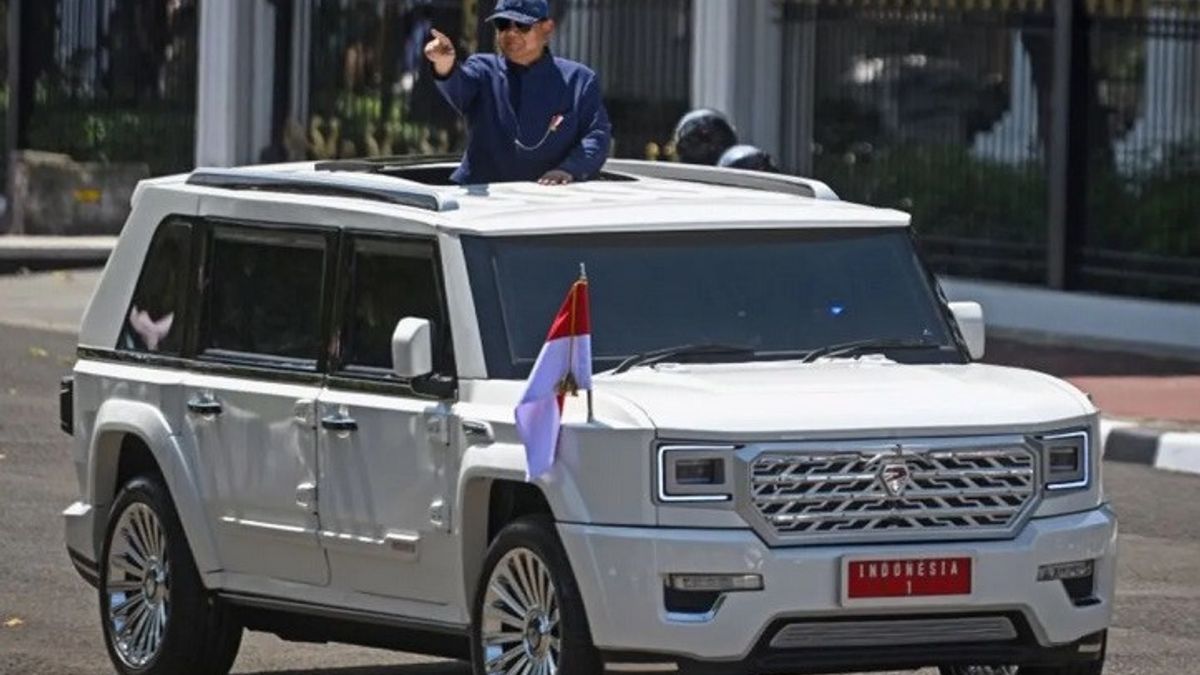
Prabowo expressed the ambition of the national car during the presidential candidate campaign in 2024. The former Minister of Defense even boarded the white Maung Garuda SUV with the Indonesian plate 1 to the State Palace after being inaugurated by the president at the MPR.
Efforts to own a national car have started in the 1970s, when the government issued a policy banning imports of intact vehicles.
Starting from this policy, the birth of the Indonesian People's Car or Morina, whose local content value reaches 60 percent. But Morina's age is not long, which is only five years before it ran aground.
The national car project was revived in the 1990s. Unmitigated there were three national car projects at that time. The first was the Maleo Project in 1996. BJ Habibie, who at that time served as Minister of Research and Technology, went down the mountain to witness the project. This car is said to be using 80 percent of local components. Unfortunately, Maleo's mass production plan was canceled.
The government has instead transferred the project funds to another national car project, namely People's Car Industry Technology or better known as Timor. It is Hutomo Mandala Putra or Tommy, the youngest son of President Suharto, who worked on the project through PT Timor Putra Nasional.
SEE ALSO:
-
 | BERNAS
Satu Tahun Prabowo Subianto: Reshuffle Kabinet Harus Objektif, Bukan Karena Balas Budi
23 Oktober 2025, 08:00 -
 | BERNAS
Satu Tahun Pemerintahan Prabowo Subianto: Sektor Pendidikan Masih Centang-Perenang
21 Oktober 2025, 09:00
At almost the same time, Suharto's other son, Bambang Trihatmodjo, collaborated with Hyundai to become a competitor to Timor to present a national car. He launched Bimantara Neggala and Bimantara Cakra, whose figures are the same as Hyundai Elantra and Hyundai Accent.
However, when the New Order collapsed in 1998 and added to the modern crisis, the national car construction plan also collapsed. Yannes Martinus said the Timor program failed because Suharto violated the WTO non-discrimination principle through exclusive incentives.
"Timor failed due to lack of local content. The supply chain is still 90 percent of component imports," he said. In addition, the government, which at that time acted as the owner of the project, made such a tough dependence.
It was only in 2012 that the national car was heard again. Joko Widodo, who at that time served as Mayor of Solo, used the official car Kiat Esemka. According to Jokowi, this car is the result of collaboration and the student learning process at 33 vocational schools throughout Indonesia since 2009, with local content reaching 80 percent.
The English, Chinese, Japanese, Arabic, and French versions are automatically generated by the AI. So there may still be inaccuracies in translating, please always see Indonesian as our main language. (system supported by DigitalSiber.id)
Most Popular Tags
#Prabowo Subianto #donald trump #firearm #8791 #giias 2026Popular


