
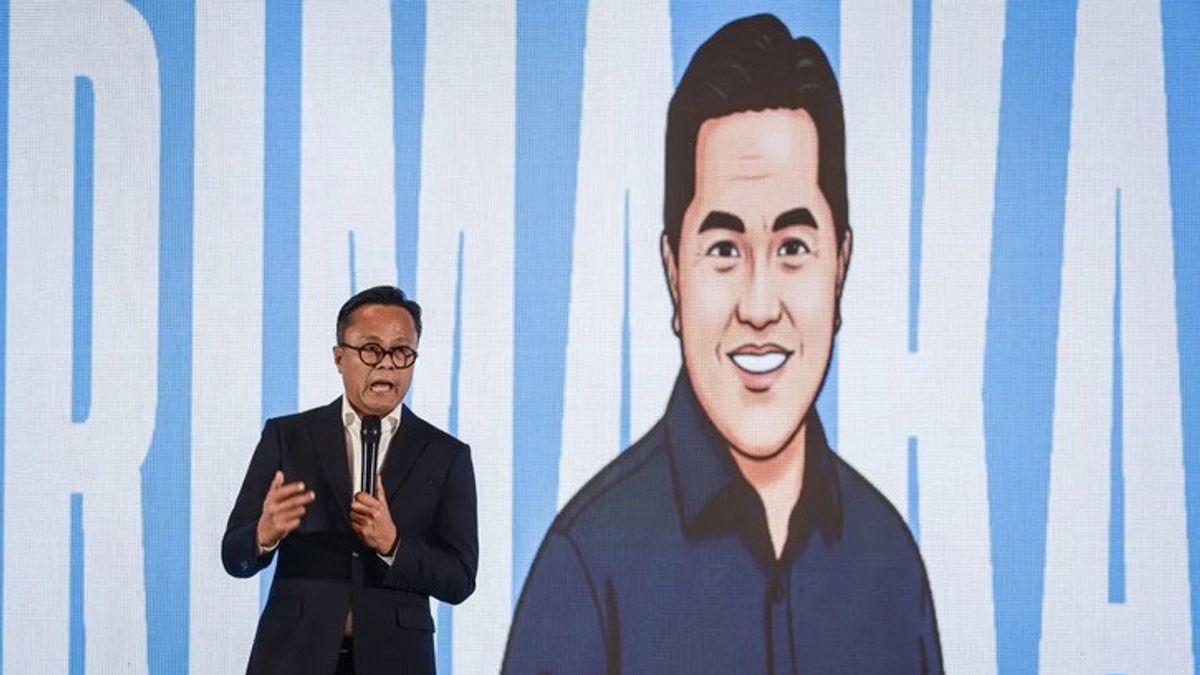


The Ministry of State-Owned Enterprises (BUMN) is now the management agency at the ministry level. The existence of the Danantara Investment Management Agency (BPI) of Danantara is now in full control of the management of SOEs.
Rumors about the future of BUMN have finally been answered, after the position of Minister of SOEs was vacant after Erick Thohir was appointed as Minister of Youth and Sports in the Red and White Cabinet reshuffle some time ago.
The vacant chair was finally filled by the Deputy Minister of SOEs and the Chief Operating Officer of BPI Danantara Dony Oskaria as the executor of the task.
Then, the DPR ratified the fourth amendment to Law Number 19 of 2003 concerning SOEs in the 6th Plenary Meeting of the First Session Period of the 2025-2026 Session Year in Jakarta, Thursday (2/10/2025).
With this revision, the leadership of the state-owned management agency is no longer held by the minister, but the Head of the Regulation Agency appointed by President Prabowo Subianto.
"The position of the Head of BP BUMN depends on the President, who is appointed. That is the authority of the President, just wait for the President," said Deputy Chairman of Commission VI of the DPR Andre Rosiade, adding that the position of Head of BP BUMN would be equal to the minister.
"This institution is also still at the ministerial level. He is under the President," Andre continued. He also said that BUMN employees would remain civil servants.
The status of the Ministry of SOEs, which is now downgrading, has become a management body, which has attracted the attention of a number of circles. Director of Economics Center of Economic and Law Studies (CELIOS) Nailul Huda assessed that the role of the Ministry of SOEs has indeed been getting eroded since BPI Danantara was formed.
The government inaugurated Danantara on February 24, 2025 to consolidate government assets through long-term investments whose profits or dividends can be used to fund development programs.
As an investment management agency, Danantara will manage state assets to finance sustainable projects in various strategic sectors such as renewable energy, develop the manufacturing industry, downstream natural resources, and food security.
However, the formation of Danantara raises concerns about the fate of SOEs. Both are considered to have overlapping functions. On one occasion, the Executive Director of CelIOS Bhima Yudhistira said the Ministry of SOEs was one that might have been reshuffled, because his duties had been taken over by Danantara.
Similarly, the Director of Economics CelIOS Nailul Huda assessed that the role of the Ministry of SOEs has been eroded since the launch of Danantara seven months ago.
However, Huda thinks that the Ministry of SOEs still has an important role as a government representative who holds Series A Dwiwarna shares.
SEE ALSO:
-
 | BERNAS
Menjaga Euforia Sirkuit Mandalika di Tengah Minimnya Promosi MotoGP Indonesia
07 Oktober 2025, 14:00 -
 | BERNAS
Syarat Capres dan Cawapres Minimal Lulus SMA Tidak Salah, tapi Mengkhawatirkan
06 Oktober 2025, 22:00 -
 | BERNAS
Iming-iming Insentif Rp100 Ribu dalam Program MBG dan Eksploitasi Guru Honorer
06 Oktober 2025, 19:00 -
 | BERNAS
Global Sumud Flotilla, Misi Maritim Terbesar dengan Ambisi Menembus Gaza
05 Oktober 2025, 21:45 -
 | BERNAS
Batuk Pilek Marak Terjadi, Kenali Perbedaan Influenza dan Common Cold
04 Oktober 2025, 19:15
For this reason, Huda questioned when the Ministry of SOEs transformed into an agency whether later the Dwiwarna series A shares would be given to the agency or transferred to BPI Danantara.
"Meanwhile, Danantara does not have the authority in terms of SOE regulations," said Huda.
Furthermore, according to Huda, the status of this agency is still strategic if it is directly responsible under the president. It would be different if this agency would be responsible to BPI Danantara or other Ministries.
"But I think the authority will be full to the Danantara. With full authority, the Danantara should be able to act as a more professional institution," he said.
Minister of State Secretary Prasetyo Hadi said that the revision of the BUMN Law was carried out to answer public anxiety. He said, there were a number of adjustments that required a revision of the BUMN Law.
President Prabowo sent a Presidential Letter to the House of Representatives for the discussion of the revision of the BUMN Law to be rolled out immediately. One of the points underlined in the revised proposal is related to the status of the Ministry of SOEs which will be lowered to the BUMN Organizing Body.
"To optimize SOE management, institutional transformation is needed to contribute to the development of the national economy. Therefore, this policy can only be carried out by making changes to the BUMN Law," said Prasetyo.
State-owned companies have continued to be in the spotlight for at least the past year. Starting from a number of losses suffered by state-owned companies, to the practice of concurrently serving as commissioners with deputy ministers who received criticism from various parties.
Bhima Yudhistira said that state-owned companies are currently stuck in incompetency and politics. Instead of being the driving force of the economy, SOEs are at risk of turning into a state burden due to poor governance, appointment of commissioners by ignoring meritocracy, and concurrent positions of state officials.
This condition, said Bhima, not only has the potential to cause waste, but also erode public trust and investors in BUMN professionalism.
"This will all lead to what is called BUMNfailure. The failure of SOEs that should be leverate economy, but instead become a burden, is a waste," said Bhima.
The position of commissioner who should be a strategic supervisor and provide technical input, is actually occupied by political volunteers or former presidential assistants who are considered to have no competence in the related sector. This results in a blunt supervisory function and is unable to provide long-term business direction.
The recapitulation of positions is also increasingly damaging to the meritocracy of SOEs, while there are still 1.4 million applicants who have to compete fiercely for 2,000 positions. The chair of commissioners is easily filled by people with political closeness. This condition, according to him, causes job demoralization, decides career path, and reduces productivity.
"Those who have entered the BUMN see why work are tired, technical commissioners are appointed based on political pointsee. The effect is demoralization and decreased productivity," explained Bhima.
Based on BELIOS records, the practice of concurrent positions of 35 ministers and deputy ministers is estimated to cause a waste of up to IDR 2.1 trillion per year. The funds should be allocated to expand labor absorption or even strengthen the slumping processing industry.
The English, Chinese, Japanese, Arabic, and French versions are automatically generated by the AI. So there may still be inaccuracies in translating, please always see Indonesian as our main language. (system supported by DigitalSiber.id)
Most Popular Tags
#Prabowo Subianto #donald trump #Febrie Adriansyah #8791 #giias 2026Popular


