
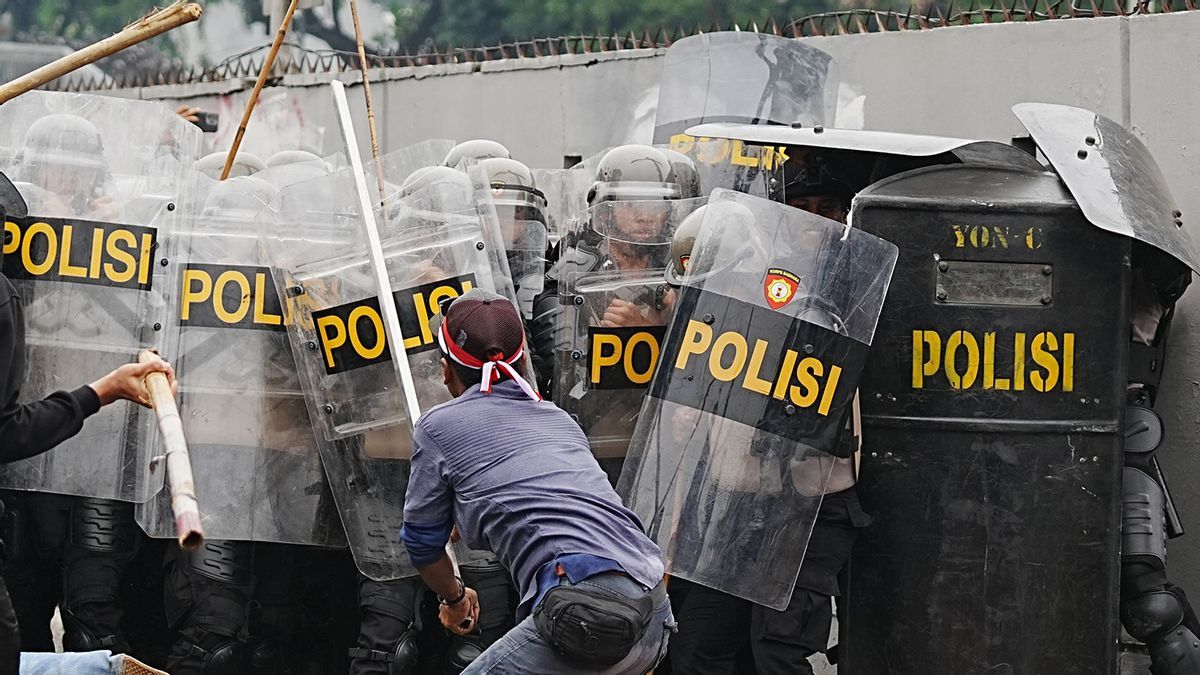


JAKARTA The formation of the Police Reform Transformation Team deserves appreciation, but on the other hand it must be seen as skeptical. Because it contains only the names of high-ranking officers who are all from the police, it is difficult to expect the Polri Reform agenda to have great meaning for the community.
The pressure for the National Police Reform has strengthened recently, after a massive demonstration in a number of regions in Indonesia at the end of August. At that time, the demands for National Police Chief General Listyo Sigit Prabowo to resign echoed after the death of online motorcycle taxi driver Affan Kurniawan as a result of being run over by a Brimob tactical vehicle.
Responding to public demands, President Prabowo Subianto also revealed plans to form a team or police reform commission. As a first step, Prabowo inaugurated retired Deputy Chief of Police Ahmad Dofiri as Special Advisor to the President for Public Security and Order and Police Reform on September 17.
However, what is of broad concern now is the steps taken by the National Police Chief Listyo to form the Police Reform Transformation Team which was announced earlier than the police reform plan that is being prepared by President Prabowo.
This decision sparked widespread debate in the public sphere. They questioned the coordination, policy direction, and potential political dynamics behind it. Not even a few said that the steps taken by the National Police Chief to form the Reform Transformation Team were actions that took the president.
The instructions for the formation of the National Police Reform Transformation Team formed by the National Police Chief General Listyo Sigit Prabowo contain 52 police officers, consisting of 47 high-ranking officers and five middle-ranking officers. Listyo was appointed as a protector, while Deputy Chief of Police Commissioner General Dedi Prasetyo was an advisor. The head of this team was carried by Komjen Chryshanda Dwilaksana. This three-star Polri officer serves as the Head of the Police Education and Training Institute.
Through this warrant, the National Police Chief assigned the personnel in it to carry out the best possible coordination and cooperation with related elements in the context of smooth implementation of tasks as a Police Reform Transformation Team. The team was also asked to prepare a plan for the activities and budget needs needed and carry out orders from the National Police Chief carefully and with a full sense of responsibility.
Police observer from the Institute for Security and Strategic Studies (ISESS) Bambang Rukminto assessed that the formation of the Police Reform Transformation Team deserves support, but it must also be seen with skepticism.
He also warned that the formation of this team should not be limited to playing games over public pressure on police institutions. The reason is, similar teams have often been formed by the Police, but rarely have finally met the expectations of the community.
"As an effort to improve, it deserves to be supported. But still, as a society, we must certainly look at it skeptically," said Bambang.
Bambang also questioned the use of transform' and reformation' istilants simultaneously in the team name. According to him, the two words have different meanings. Transformation means fundamental change, while reform is only limited to improvement.
"This is the task team to carry out transformation or reform?" he said.
Furthermore, Bambang questioned the effectiveness of the internal team in fixing the Police. Although it means good, this team also has the potential to encounter problems with subjectivity and conflicts of interest considering that all team members come from the Polri environment itself.
"The analogy is that it is impossible for doctors to carry out their own operations. There are problems with the subjectivity and bias of internal interests, not to mention the resistance of the pro-state quo group. Is it possible for the internal team to map out their own illness?" said Bambang.
With such obstacles, it is natural that the public is then skeptical. The formation of this internal team seems only a gimmick to divert public pressure.
If the Police Reform Transformation Team is not right according to the expectations of the community, the risk will be blunders, even additional legitimacy to accelerate the change of the National Police Chief, Bambang continued.
Meanwhile, Public Virtue Research Institute (PVRI) researcher Muhammad Naziful Haq views the formation of the Police Reform Transformation Team, all of whose members are based on police, not only in problems, but also in conflicts of interest.
According to him, there should be background diversity in this team, for example involving academics, civil society representatives, or figures with integrity. Thus, this effort brings structural or cultural refreshment.
"The Police's reforms should not only lead to an agenda for strengthening accountability, transparency, or improving the structure and culture within the Police. But also within the decision-making environment as well as public policy. We can see this commitment from how open the government and also the ranks of the National Police are for public input," said Nazif.
Police reform, Nazif added, is also measured by whether there is a change in government and police policies that are demanded independently. This seriousness is not only lies in the jargon or massive social media campaign through raising support from certain groups.
SEE ALSO:
-
 | BERNAS
Penayangan Video Presiden Prabowo Subianto di Bioskop, Bentuk Propaganda atau Komunikasi Publik?
17 September 2025, 08:15 -
 | BERNAS
Menelaah Istilah Nepo Baby, Kelompok yang Bikin Murka Gen Z di Nepal
13 September 2025, 20:50 -
 | BERNAS
Memahami Kemarahan Gen Z yang Berujung Demonstrasi Besar-besaran di Nepal
12 September 2025, 07:00 -
 | BERNAS
Retorika Antek Asing Presiden Prabowo Subianto Bisa Picu Kemarahan Publik
05 September 2025, 12:00
"The task of the state is to serve civil rights and the socio-economy of the people. If state officials only serve the elite, then it is impossible for the Police to really protect and protect the people. Police reform must involve the community if they want to have a positive impact on democracy," he continued.
Similarly, Director of Amnesty International Indonesia Usman Hamid said that public participation must be put forward in the Polri reform policy which is now being discussed by the government, including by the ranks of the National Police through the formation of the Police Reform Transformation Team.
If the team is only filled with the names of high-ranking officers who are all from the police, it is difficult to hope that the Polri reform agenda will have great meaning for the community. Moreover, the root of the problem within the police is actually sourced from government policies, which in the eyes of the community is considered unfair.
The English, Chinese, Japanese, Arabic, and French versions are automatically generated by the AI. So there may still be inaccuracies in translating, please always see Indonesian as our main language. (system supported by DigitalSiber.id)


