
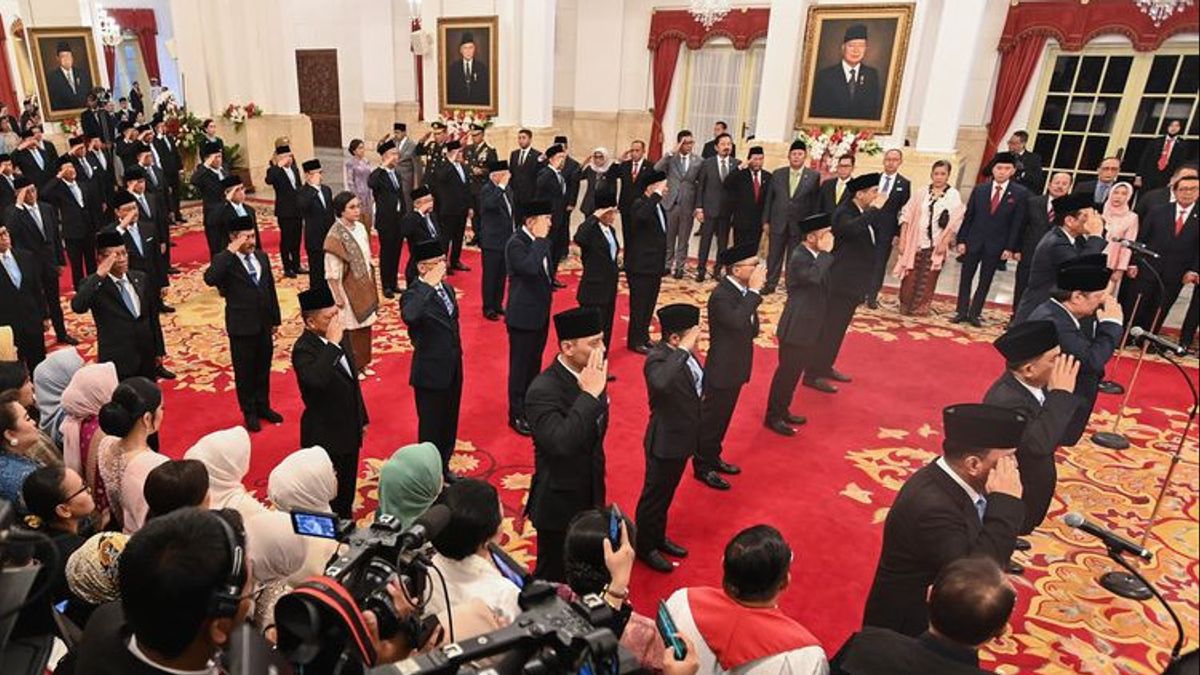


JAKARTA "Reshuffle or cabinet reshuffle is not a safe choice for President Prabowo Subianto," according to political observer Ray Rangkuti.
Rumors of Prabowo's Red and White Cabinet (KMP) reshuffle have resurfaced amid various national issues. Recently, the Executive Director of the Center of Economic and Law Studies (CELIOS) assessed that Finance Minister Sri Mulyani Indrawati needed to be reshuffled.
Previously, when the Prabowo government was running for 100 days, CelIOS also gave a red report card to four ministers at KMP. Human Rights Minister Natalius Pigai at that time got Celios' worst score with 113 points. Then, Minister of Cooperatives Budi Arie got a score of -61 points, Minister of Energy and Mineral Resources Bahlil Lahadalia with a value of -41 points, and Minister of Forestry Raja Juli with a value of -36 points.
Although until now a number of ministers are considered not to show their best performance, Lingkar Madani Executive Director Ray Rangkuti predicts that there will be no reshufflekabinet until at least 2025 ends.
President Prabowo Subianto reshuffled the composition of the Red and White Cabinet for the first time on February 19. In the reshuffle, Prabowo replaced the Minister of Higher Education, Science and Technology (Mendikti Santek) Satryo Soemantri Brodjonegoro. His position was replaced by Brian Yuliarto, who at that time served as Deputy Chancellor of the Bandung Institute of Technology's Research and Innovation Midwives (ITB).
Before being reshuffled, Satryo's name had received public attention due to a number of controversies. He was demonstrated by hundreds of state civil servants (ASN) of the Ministry of Education and Technology, Saintek, because of his attitude towards employees in mid-January 2025.
In addition, Satryo also mentioned that the budget efficiency policy would increase student tuition fees. this is because the State University Operational Assistance (BOPTN), which was originally Rp6.018 trillion, was cut by 50 percent by the Directorate General of Budget (DJA).
After that, until now there are still a number of KMP ministers who are considered not performing. Minister of Cooperatives Budi Arie Setiadi, Minister of Human Rights Natalius Pigai, Minister of Housing and Settlements Maruar Sirait, and Minister of Finance Sri Mulyani are also said to deserve to be reshuffled.
The cabinet reshuffle, said Ray Rangkuti, was not something Prabowo Subianto could avoid, but this might have been done solely because of political needs. According to him, the President chose to maintain political stability rather than to trigger a commotion in the midst of the many challenges facing the country.
Prabowo must carry out continuous negotiations from time to time, year to year. Until 2025 there may not be a reshuffle. Even if there is, maybe 2026 is just a reshuffle," Ray Rangkuti told VOI.
SEE ALSO:
-
 | BERNAS
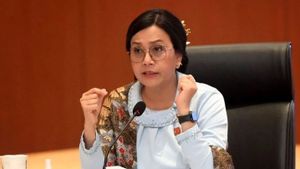
Menkeu Sri Mulyani Kehilangan Sentuhan Teknokrat, Cenderung Mengikuti Program Politik
26 Agustus 2025, 12:00
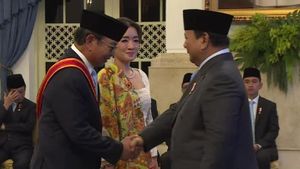
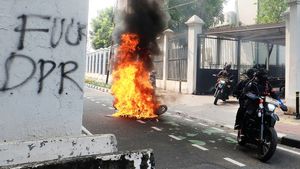

However, as mentioned earlier, the cabinet reshuffle that Prabowo may have carried out will be more influenced by political factors, instead of considering the performance of his ministers.
It is not impossible, called Ray Rangkuti, Prabowo will waste certain strengths and encourage other forces to maintain his chances by 2029.
"If you consider performance, it should be in October when the cabinet is exactly one year old (reshuffle)," he continued.
However, if you look at Prabowo's political needs, then the reshufflekabinet is actually not an option that is safe for him, according to Ray Rangkuti. instead of a cabinet reshuffle that has the potential to create internal tension and wild issues among the community, cabinet downsizing is actually considered safer.
Last year, President Prabowo Subianto inaugurated 48 ministers, 56 deputy ministers, five special officials at ministerial level, and special ministerial officials at the KMP. This number is referred to as the fattest cabinet from the New Order to reforms.
Several ministries or institutions were divided in the Prabowo era, such as the Ministry of Education, Culture, Research, and Technology (Kemenbudristek) which was broken down into three ministries, namely the Ministry of Basic and Secondary Education (Kemendikdasmen) led by Abdul Mu'ti. Then, the Ministry of Higher Education, Science and Technology (Kemendikti Saintek) led by Satryo Soemantri Brodjonegoro, now by Brian Yulianto, and the Ministry of Culture led by Fadli Zon.
Another example of the Ministry of Cooperatives and SMEs in the era of President Jokowi led by Teten Masduki was also divided into two ministries, namely the Ministry of Cooperatives under Budi Arie Setiadi alias Muni and the Ministry of MSMEs led by Golkar politician Maman Abdurrahman.
Prabowo Subianto at that time assessed that his fat cabinet was needed to build a strong government. He also said that Indonesia was big and needed a large cabinet. However, a number of observers said the formation of a fat cabinet was carried out to accommodate those who helped him during the 2025 Presidential Election.
For Ray Rangkuti, instead of 'throw away' people by reshuffling the cabinet, reducing the KMP is actually safer to maintain political stability. Instead of being reshuffled, it is safer to redesign the cabinet and minimize it. This choice is politically more profitable, as it at least reduces chaos," he concluded.
The English, Chinese, Japanese, Arabic, and French versions are automatically generated by the AI. So there may still be inaccuracies in translating, please always see Indonesian as our main language. (system supported by DigitalSiber.id)
Popular


