
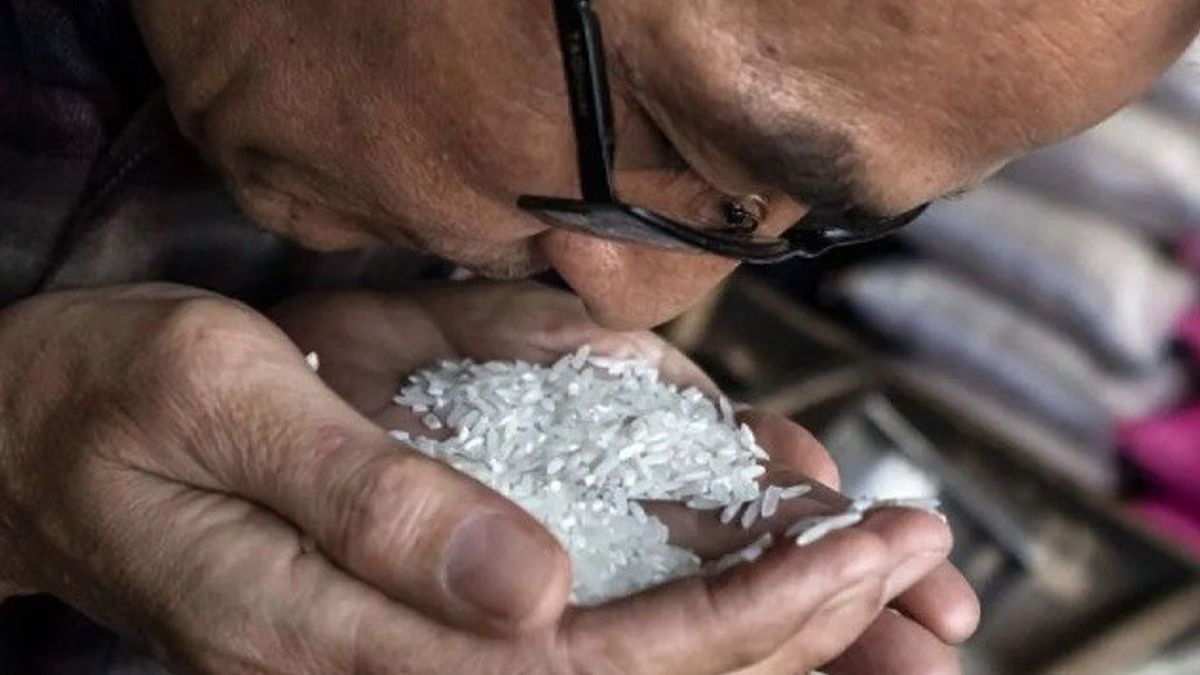


JAKARTA The practice of mixed rice is commonplace in the national expansion industry. The government should straighten out the turmoil in the findings of mixed rice which has made people restless.
The issue of mixed rice was first conveyed by Minister of Agriculture Andi Amran Sulaiman on June 30, 2025. In a press conference at the Ministry of Agriculture, Amran explained that the Stability of Supply and Food Price (SPHP) rice circulating in the market was the result of mixed rice. The government's rice program, said Amran, was mixed into premium rice.
He also admitted that he received reports that about 80 percent of SPHP rice was mixed, and only 20 percent were displayed according to the rules. On the same occasion, the government also announced that 212 rice producers were suspected of selling rice not according to applicable quality standards.
The violation in question is the weight of rice that does not match the packaging, the quality that is not appropriate, and sells rice above the Highest Retail Price (HET).
Amran's statement clearly caused a commotion, especially among consumers. In some areas, consumers even stop buying branded rice that is usually eaten by their families.
For consumers, news about mixed rice makes them worry about health. Because there is a narrative that adulterated rice can have a long impact on health. Meanwhile, from the side of traders, some of them stopped selling branded rice because they were restless and worried about being blamed.
The word oplosan edung has a negative meaning that makes people restless. In fact, the practice of mixing rice is commonplace in the national expansion industry.
"It's just that, the word 'oplos' is already negative and bad. In fact, oplos is the same as mixing. Mixing activity does not only occur in rice, but also in coffee and tea, for example," said agricultural observer Khudori.
"Barista, for example, must mix a mixture of coffee to get a certain taste, aroma, and sensation. The same thing happens to tea," he added.
Activist of the Indonesian Political Economy Association (AEPI) as well as the Agricultural Empowerment Committee, Khudori emphasized that the practice of the expansion, mixing or mixing industry is part of the legal process and is needed in production standards.
When the rice is produced from the milling process, the output consists of whole grains, fractures, menir, and husks and dedak. To achieve certain quality standards, both medium and premium, producers conduct mixing in accordance with the provisions stipulated in the regulations.
According to Khudori, as long as the mixing is carried out transparently and according to quality standards, it cannot be called a violation.
"In fact, this practice helps maintain product quality consistently, because milled unhulled grain does not always produce uniform quality," Khudori said in a statement received by VOI.
Back to the three problems mentioned by Minister of Agriculture Amran, namely the weight of rice that does not match the packaging, the quality that is not appropriate, and selling rice above the HET.
Khudori urged the government to explain the purpose of the mixing, whether there is a mixture of SPHP rice in it or only inappropriate quality findings. In addition, the matter of reducing the scales also needs to be clarified what it means.
"Is the rice written on the label weighing 5 kg and it contains 4,980 grams, aka less than 0.3 percent, classified as 'reducing the scales'?" said Khudori.
He also explained that rice according to regulations includes Fresh Products from Plantation (PSAT). During storage, water levels can be reduced which will reduce the net weight of rice. Each weighing tool also has calibration tolerance that needs to be considered.
Mixing or mixing is prohibited, said Khudori, is the goal of fraud. He gave an example of a seller mixing 70 percent of Cianjur rice with 30 percent of Ciherang rice which was later claimed to be 100 percent Cianjur rice and sold at Cianjur rice prices, which was indeed more expensive than Ciherang.
Or mix rice with unusual or damaged materials and then re-filtrated or polished to make it look good again, even though the quality has decreased. It can also mix with dangerous preservatives.
"These can all be subject to fraud offenses," he said.
In order to defuse the noise that has already occurred in the community, according to Khudori, the public needs a complete understanding of the oplos-poison of rice. There are technical aspects that are not understood by the general public.
Being negative in oplos has caused unrest, especially the consumer community. The producer was also the target of shooting," Khudori explained.
Regulators must also educate the public to restore trust. At the same time, regulators need to socialize to foreign stakeholders, including the Consumer Content Act.
"So that all parties get better information and can act according to their rights and obligations," he said.
SEE ALSO:





In this case, the role of the government should be more emphasized on consumer education and the development of business actors, not on a mere repressive approach. According to Khudori, the involvement of the apparatus in economic technical matters like this does not solve the root of the problem.
"It is better if the government does not attract the Food Task Force to become an economic police officer. This security approach has been carried out since the 1950s and has not succeeded," he said.
Finally, Khudori assessed that the recovery of confidence in the national food sector could only be achieved through transparent and educational policies. Consumers need to be given an understanding of the rice industry process, quality standards, and distribution mechanisms, so that they are not easily influenced by terms that are not properly explained.
The English, Chinese, Japanese, Arabic, and French versions are automatically generated by the AI. So there may still be inaccuracies in translating, please always see Indonesian as our main language. (system supported by DigitalSiber.id)
Most Popular Tags
#Prabowo Subianto #donald trump #firearm #8791 #giias 2026Popular


