
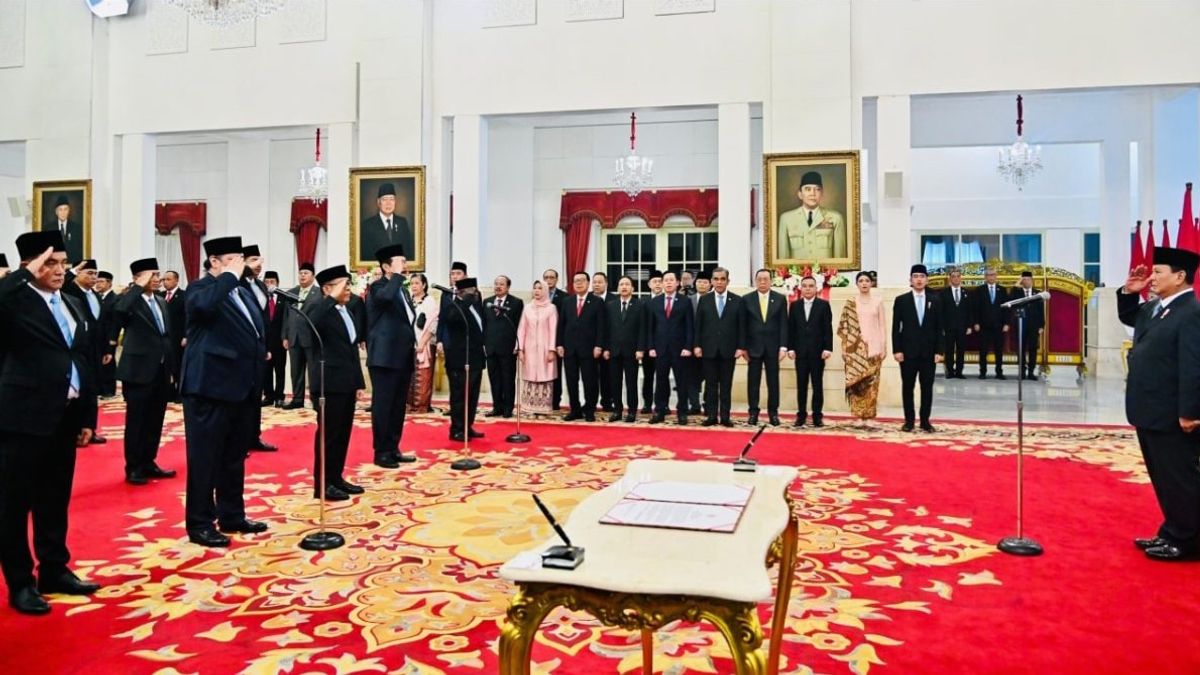


JAKARTA - When state finances are not managed wisely, there will be a deficit that will swell, according to economist from the Center of Economic and Law Studies (CELIOS) Nailul Huda.
President Prabowo Subianto instructed his staff to carry out budget efficiency to finance priority programs. This wish is contained in Presidential Instruction Number 1 of 2025 which was issued on January 22.
In the Presidential Instruction, President Prabowo targets budget savings, both at the central and regional levels by 2025, to reach around IDR 306.6 trillion.
Prabowo ordered to limit spending on ceremonial activities, studies, comparative studies, the public, and seminars or focus groups discussions.
But not even a year after, a number of ministers and heads of institutions have proposed an increase in the budget. Even though state revenues are not doing well.
Several ministries and institutions from the Red and White Cabinet have proposed an additional budget for 2026 because they think that the government's indicative ceiling is inadequate.
This request for additional budget was conveyed in a working meeting between ministries and related institutions with the Budget Agency (Banggar) and commissions in the DPR.
CelIOS economist Nailul Huda predicts that next year's state revenue will still experience shortfall, like this year. This year's low state revenue cannot be raised optimally if you look at the existing conditions.
"The purchasing power is still weak, investment is also dragged, layoffs are everywhere, which makes state revenues not significantly lifted," Huda told VOI.
In the Macroeconomic Framework and the Principles of Fiscal Policy (KEM-PPKF), said Huda, state revenues are projected to still weaken. This has an impact on spending postures that are not very optimistic.
Nailul Huda regretted that many ministries and institutions do not understand this condition.
"They still propose an additional budget for next year. In fact, next year's policy will still be the same, namely efficiency," he continued.
Huda added that the understanding of the minister who proposed this additional budget was different from President Prabowo's own understanding of the use of the budget.
"This condition is dangerous if it causes state financial management to become arbitrary and unprivate," said Huda.
In 2025, Huda explained, the ratio of the APBN deficit to Gross Domestic Product (GDP) is predicted to swell.
"In the KEM-PPKF document, the upper limit for the APBN deficit to GDP is only 2.53 percent. When there are many additional budgets, the ratio can increase to 2.83 percent," he explained.
From a political perspective, the steps taken by ministries and institutions requesting additional budgets can be read as an inconsistency or paradox from the government of President Prabowo Subianto.
Executive Director of the Center for Indonesian Governance and Development Policy Cusdiawan said the public would question the alignment of the efficiency discourse between Prabowo and his staff in the Red and White Cabinet.
"The public will also ask, to what extent is the discourse on efficiency in Pak Prabowo's head as head of government in line with the heads of his staff," said Cusdiawan.
"Don't let the public's perception that the discourse on presidential efficiency that has implications for budget cuts actually causes dissatisfaction for its staff," he added.
SEE ALSO:
According to Cusdiawan, this phenomenon can create a negative impression for the Prabowo government, especially since the public continues to highlight one of the current leadership weaknesses, namely the matter of communication and coordination patterns.
He also highlighted the need for transparency behind the budget request. The public, said Cusdiawan, deserves to question the extent to which demand for an increase in the budget has gone through careful technocratic planning and is in line with development plans, including Prabowo's priority programs.
"This request for an increase in the budget was born from narrow interests, such as the egos of each ministry or institution. Considering that it is already 'naluriah' is also in the midst of limited resources, each ministry or institution will try to maximize these limited resources, especially regarding the allocation," said Cusdiawan.
The English, Chinese, Japanese, Arabic, and French versions are automatically generated by the AI. So there may still be inaccuracies in translating, please always see Indonesian as our main language. (system supported by DigitalSiber.id)
Most Popular Tags
#Prabowo Subianto #donald trump #2026 World Cup #venezuela #konflik timur tengahPopular


