


JAKARTA Middle class is said to have difficulty buying a house because the price is getting out of reach. The 18 square meter subsidized house that is being discussed by the government has so far not attracted public interest.
Subsidized houses measuring 18 square meters became a public discussion after the Minister of Housing and Settlement Areas Maruarar Sirait issued the discourse.
According to the man who is familiarly called Ara, the discourse was conveyed as a housing solution in urban areas. According to him, the younger generation wants a house close to their workplace or in the middle of the city.
The discourse on reducing the area of subsidized houses is stated in the draft Decree of the Minister of Housing and Settlement Area Nomoe/KPTS/M/2025. In the draft it is explained that the land area is reduced to 25 square meters, while the building area is at least 18 square meters.
Whereas in the Decree of the Minister of Public Works and Public Housing Number 689/KPTS/M/2023, it was determined that the area of the subsidized landed house was at least 60 square meters and a maximum of 200 square meters. Meanwhile, the building area is set at least 21 square meters to 36 square meters.
SEE ALSO:
-
 | BERNAS
Potensi Siklus Kemiskinan Baru dengan Rumah Subsidi Seluas 18 Meter Persegi
20 Juni 2025, 12:00 -
 | BERNAS
Mengungkap Alasan Israel Serang Iran, Selamatkan Karier Benjamin Netanyahu?
18 Juni 2025, 12:15 -
 | BERNAS
Hati-hati, Konsisten Memberikan Hadiah kepada Anak Bisa Menjadi Jebakan
15 Juni 2025, 08:45
The new draft rules regarding the area of subsidized houses are still in the process of being discussed and tested by the public. However, the people rejected the idea.
Moreover, in the midst of the process of the Ministry of Housing and Settlement Areas working on the new rules, Lippo Group issued an example of a 14 square meter subsidy house.
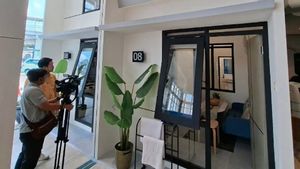
The visual representation or print-up concept has even been exhibited in the lobby of Nobu Bank, Plaza Semanggi, Jakarta. James Riady as CEO of Lippo Group said that the one-room house is priced at IDR 100 million, it can be approved for entering a subsidy scheme. Consumers are said to be able to pay IDR 600 thousand per month with interest rates.
This subsidized house exhibition has indeed succeeded in attracting the attention of many people. But based on reactions on social media, many have complained about it. With a building area of only 14 square meters, the interior of the house is minimalist.
There are two main rooms separated by walls, namely bedrooms and multipurpose rooms. At the exhibition, this multipurpose room contains sofas and tables, electric stoves, washing machines, refrigerators, and a place to wash dishes. So small the house, netizens call subsidized houses like Barbie's house.
This 2,6 meter wide, example house received a negative reaction from netizens. Moreover, the location of the tiny house is less likely to be in the city of Jakarta. In fact, Generation Z and the millennial generation expect this affordable price house to be built in Jakarta. One of the reasons is not to run out of energy because they have to travel all the way from house to office, which is usually in the city of Jakarta.
So far, there is no definite information on where this tiny house will be built. However, the Director General of Urban Housing at the Ministry of Housing and Settlement Areas, Sri Haryati, said that it was unlikely that the residence would be located in Jakarta.
"Maybe it's close to the outskirts of Jakarta, so the price is still coming in," said Sri.
So far, many subsidized houses have been built outside Jakarta, such as Tangerang and Bekasi, because the price of the land is still relatively affordable.
"With the price we said yesterday, it is in the eastern corridor, Cikampek, Purwakarta. In Bogor, maybe in the regency area. In the Tangerang areas," said Head of Project Management of PT Lippo Karawaci Fritz Atmodjo, quoting Antara.
Cikal bakal program rumah subsidi dimulai pada 1974, saat pemerintahan Presiden Suharto memasukkan penyediaan rumah sederhana dalam rencana pembangunan lima tahun (Repellita) II.
The subsidized housing program continued until the era of President Joko Widodo in 2015 with the title Program of One Million Houses. This means that the government has a target of building one million subsidized residences every year.
As of October 2024, this program is claimed to have succeeded in building 9,872,741 housing units. President Prabowo Subianto also continued this program after. The target is to build three million houses.
Despite changing governments, the main focus of this program has always been to provide affordable housing for low-income people or MBR.
However, MBR's income limit, which has the right to buy subsidized houses, has also become a polemic. According to the Regulation of the Minister of PKP Number 5 of 2025, the maximum limit for MBR's income is different depending on regional zones throughout Indonesia.
The Jabodetabek area, for example, the maximum income limit for people who do not marry is Rp. 12 million per month, and is married to one Tapera participant (Public Housing Savings) of Rp. 14 million per month.
However, according to economist from the Center of Economic and Law Studies Bhima Yudhistira, this maximum income limit only helps low-income people. Those who are middle class are not eligible to buy subsidized houses. This, said Bhma, shows that the government has forgotten the upper class.
"Considering that as long as they work, they are not unemployed, why do they help the government?" said Bhima.
"So the policy is 'classy in the middle'. Even though there is economic growth, the middle class does not enjoy it," he added.
The English, Chinese, Japanese, Arabic, and French versions are automatically generated by the AI. So there may still be inaccuracies in translating, please always see Indonesian as our main language. (system supported by DigitalSiber.id)
Most Popular Tags
#Prabowo Subianto #donald trump #firearm #8791 #giias 2026Popular


