
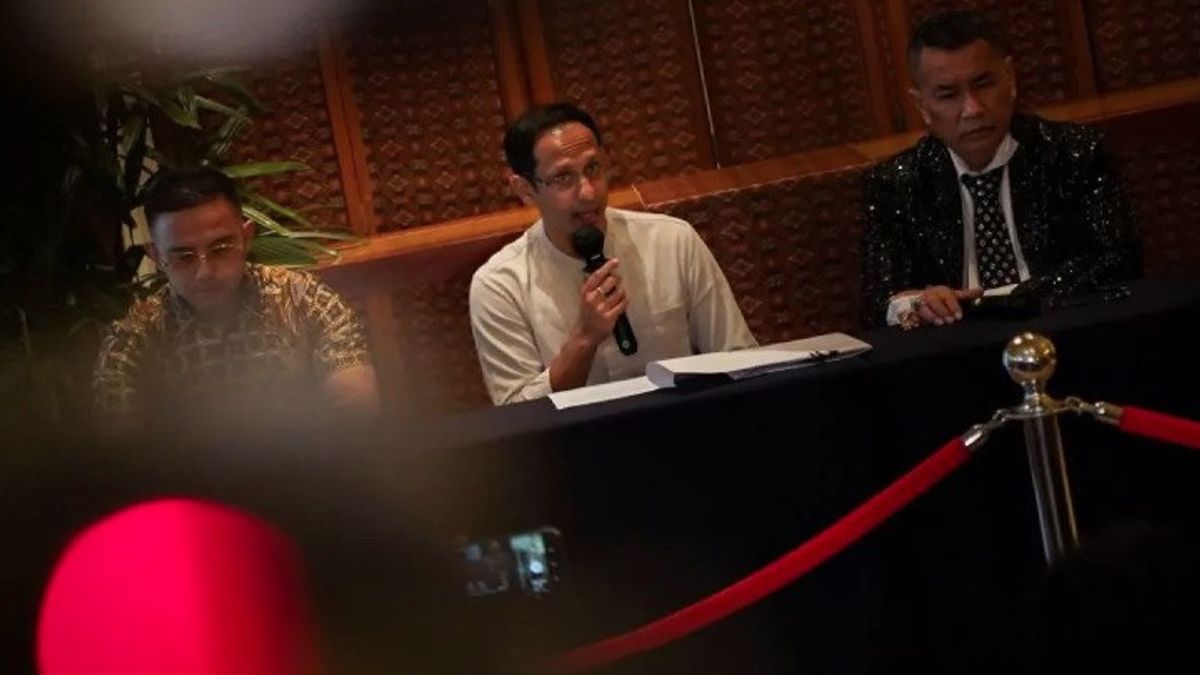


The Attorney General's Office (AGO) is investigating allegations of corruption in the procurement of Chrome OS or Chromebook-based laptops worth Rp9.9 trillion which was carried out by the Ministry of Education, Culture, Research and Technology (Kemendikbud Ristek) for the 2019-2023 period, which at that time was still led by Nadiem Makarim.
The AGO has summoned three former Nadiem special staff in the alleged corruption in the procurement of Chromebook laptops which are deemed incompatible with the needs of schools in remote areas with minimal internet networks.
The three are Jurist Tan, lost Handayani, and Ibrahim Arif. The first two names are the special staff of the Minister of Education, Culture, Research and Technology for the 2019-2024 period Nadiem Makarim. Meanwhile, Ibrahim Arif, according to the prosecutor, served as the special staff envoy of the Minister of Education.
The prosecutor summoned them as witnesses to the corruption case in the procurement of Chromebook laptops worth Rp9.9 trillion in the education digitization program for the 2020-2022 period. Until now, only two people have fulfilled the summons, namelytuhan Handayani and Ibrahim Arif.
The alleged corruption case in the procurement of Chromebook laptops in the Nadiem Makarim era has been in the spotlight recently, after the AGO summoned three of its former staff members.
Head of the Legal Information Center of the Attorney General's Office, Harli Siregang, said that the three of them allegedly played an active role in the policy of changing laptop specifications so that they did not match school needs.
Nadiem himself held a press conference on Tuesday (10/6), accompanied by his attorney, Hotman Paris. He said the procurement of Chromebook laptops was a mitigation measure to reduce the risk of marketing loss or loss of learning in the era of the COVID-19 pandemic.
The government announced plans to procure a Chromebook laptop through the Coordinating Minister for Maritime Affairs and Investment at that time, Luhut Binsar Pandjaitan, virtually in July 2021. Minister of Education and Technology Nadiem Makarim was also present. In the announcement, the budget prepared for 2021 reached IDR 3.7 trillion.
From the start, the procurement of this laptop was suspected to be problematic. The procurement of Chromebooks was made as if it were made to support the needs of educational technology. Whereas in 2019, the Education Information and Communication Technology Center (Pustekkom) of the Ministry of Education and Culture, Research and Technology has conducted a trial of 1,000 Chromebooks. The results of these monitoring concluded that the use of Chromebooks was ineffective.
From this observation, many obstacles were obtained at recipient schools when using Chromebooks, including all software on this laptop that cannot be used when not connected to the internet.
In addition, Chromebooks also cannot be used to support computer-based national exams because they are not compatible with the Exambro application. That way, Pustekkom's report concluded, the level of utilization of Chromebooks in recipient schools is low.
The technical team at the ministry then recommended the Windows operating system, but the Ministry of Education and Culture did not carry out recommendations and chose to make a new study that supports the use of Chromebooks.
According to the AGO's investigation, the procurement of this Chromebook spent a budget of up to Rp9.9 trillion. The funds were taken from the Education Unit Fund (DSP) and the Special Allocation Fund (DAK), each worth Rp3.5 trillion and Rp6.39 trillion.
Procurement of Chromebooks at the Ministry of Education and Culture, Research and Technology in the era of Nadiem Makarim received the attention of many parties, including the Indonesia Corruption Watch (ICW) and the Legislative Monitoring Committee (KOPEL). This alleged corruption also extends corruption cases in the education sector.
In its report, ICW said that education was included in the corruption-prone sector, at least from 2016 to 2021. During that period, ICW found 240 corruption cases that cost the state Rp1.605 trillion.
If withdrawn from 2006 to September 2021, the number of cases is more, namely 665 cases of education corruption, which law enforcement officers take action with state losses of Rp. 2.5 trillion.
SEE ALSO:


Based on ICW's findings, corruption in the education sector is not far from the use of School Operational Assistance (BOS) funds with 52 cases or 21.7 percent of the total.
One of the corruption in BOS funds occurred at SMP Negeri 1 Reok, Manggarai in 2020. Corruption is suspected to have occurred from 2017 to 2020 with a total state loss of Rp. 839.4 million or 40 percent of BOS funds received by schools.
"The method is that schools make fictitious activities or activities that are not supported by evidence of accountability and mark up for the use of the activity budget," ICW reports, adding that BOS funds are allegedly divided among teachers and employees.
Coordinator of the Indonesian Education Monitoring Network (JPPI) Ubaid Matraji said corruption in the education sector was due to weak governance, including monitoring and transparency mechanisms.
On the other hand, the money budgeted for education is not small. From 2020 to 2025, said Ubaid, the education budget from the central government has always increased.
This year alone, although the government is promoting budget efficiency in ABPN, the Ministry of Finance has allocated IDR 724.3 trillion for education. This figure is up from IDR 665 trillion last year.
However, Ubaid regretted that the hundreds of trillions of money were not properly regulated, and was not intended for actual benefits.
He also added that corrupt practices in the education sector often occur in areas that are clearly visible to the eyes, such as illegal levies to closed spaces that can only be explored by interested parties.
For this reason, according to Ubaid, the main thing that can be done is to develop an accountable and transparent system.
"For example, all financing in the government and schools must be accessed by the public in real time and easily. If they do not publish it, they will be given sanctions," Ubaid explained.
Ubaid believes that law enforcement in the education sector will have an impact on strengthening better education systems and ecosystems. If there is not strong enough law enforcement in the education sector, then it could justify what was released by the KPK, that education is one of the worst sectors in Indonesia.
"Because we have bad precedents, the education sector is still one of the most corrupt sectors in Indonesia. So law enforcement efforts in the education sector should not be seen as negative," Ubaid said in his statement.
The English, Chinese, Japanese, Arabic, and French versions are automatically generated by the AI. So there may still be inaccuracies in translating, please always see Indonesian as our main language. (system supported by DigitalSiber.id)
Most Popular Tags
#Prabowo Subianto #donald trump #firearm #8791 #giias 2026Popular


