
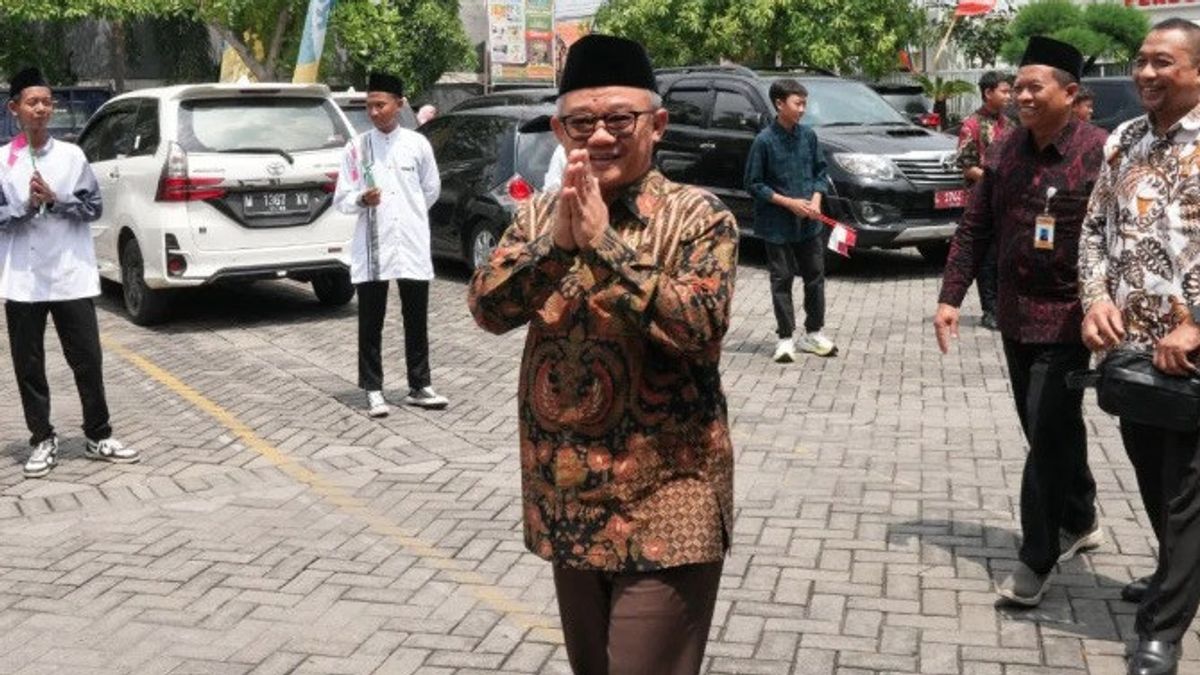


JAKARTA The government's commitment to make the education sector a priority is questioned after the Ministry of Basic and Secondary Affairs (Kemendikdasmen) was also affected by budget efficiency of up to IDR 8 trillion. This situation, according to the National Coordinator of the Ubaid Matraji Indonesian Education Monitoring Network (JPPI), could have a major impact on the educational situation.
The Ministry of Education and Culture's budget cuts are included in the consequences of the 2025 budget efficiency policy. This is based on the issuance of Presidential Instruction Number 1 of 2025 concerning spending efficiency in the implementation of the State Revenue and Expenditure Budget (APBN) and the Regional Revenue and Expenditure Budget (APBD) for Fiscal Year 2025.
There was a cut in the budget for ministries and institutions of IDR 256.1 trillion from the initial allocation of IDR 1,160.1 trillion for 2025. In addition, the transfer budget to the regions was cut by IDR 60.5 trillion from the initial allocation of IDR 919.9 trillion.
Minister of Basic and Secondary Education (Mendikdasmen) Abdul Mu'ti ensured that the budget efficiency instructed by President Prabowo Subianto would not interfere with strategic programs in the field of education.
"Alhamdulillah, for strategic programs related to school operational assistance or BOS, then PIP (Indonesia Smart Program), then also the teacher certification allowance, everything remains in accordance with what we have planned," he said, citing Antara.
Abdul Mu'ti ensured that all of these programs would remain and be given to those who were entitled to 2025.
In addition, he said that the reduced budget at the Ministry of Education and Culture was in the sector of official travel, ceremonial events, and procurement of goods related to printing and so on.
"In principle, we agree with that decision, and we are trying our best to reduce the budget in this ministry so that it does not reduce the services we provide to the entire community," he said.
As is known, the Ministry of Education and Culture must make efficiency of 23.95 percent or Rp8.03 trillion from the initial budget of Rp33.5 trillion.
Coordinator of the Indonesian Education Monitoring Network (JPPI) Ubaid Matraji said, when the education sector is included in budget efficiency even though there are several other ministries or institutions that are not touched by efficiency, the government's commitment to fixing education is questionable.
"The uncut ministry or institution shows this is considered important by the president, and vice versa," Ubaid said during a conversation with VOI.
"If the Ministry of Education and Culture's budget is cut by IDR 8 trillion, it means that the education sector does not include productivity. This will definitely have a major impact on the educational situation," he continued.
The efficiency of the budget in the education sector, said Ubaid, contradicts the 13-year compulsory education program that is being prepared by the Ministry of Education and Culture. This program requires all Indonesian children to receive educators from Kindergarten (TK) to High School (SMA).
In order to realize this, the education sector actually needs additional budget for additional infrastructure, such as the construction of schools. The existence of schools is a parameter of the capacity of students. According to Ubaid, currently, the number of schools is proportional to the level of education.
There are millions of Indonesian children dropping out of school, many schools are damaged, especially in areas. Even in Jakarta alone, public schools can only accommodate 30 percent of students," said Ubaid.
"Now if the school is not enough, how do you want to study for 13 years? That's why the budget should be increased," he added.
Ubaid's statement is in line with the report of the Center for Education and Policy Studies (PSPK) published in 2023. The report shows 32 regencies/cities that still lack capacity at the Tsanawiyah Junior High School/Madrasah (MTS) level. This condition allows children to drop out of school.
On the other hand, PSPK also found 273 regencies/cities whose capacity needs can be met by public schools.
While the rest or about 46 percent of the total requires the existence of private schools to meet the capacity needs of students.
Ubaid Matraji regrets that President Prabowo Subianto has really cut the Ministry of Education and Culture's budget of Rp. 8 trillion, because this is contrary to the mandate of the Constitution. Whereas the education sector is included in the mandatory expenditure or expenditure of 20 percent of the state budget in accordance with the mandate of the 1945 Constitution article 31 paragraph (4).
By cutting the education budget, Ubaid predicts that the number of children dropping out of school will be even greater, because access to schools is increasingly difficult. Not to mention the possibility of dismissal of honorary teachers in public schools as happened in 2024.
SEE ALSO:
-
 | BERNAS
Pemangkasan Anggaran Brutal, Pertumbuhan Ekonomi Delapan Persen Hanya Mimpi
12 Februari 2025, 20:00 -
 | BERNAS
Pembatasan Media Sosial Terus Digodok, Penting untuk Libatkan Suara Anak
10 Februari 2025, 20:15
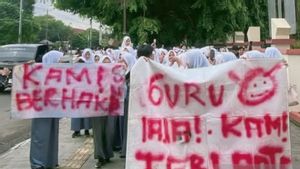
At that time there was a polemic when hundreds of honorary teachers in Jakarta were unilaterally dismissed. The education office in Jakarta assessed that the recruitment was carried out by schools without a tiered recommendation process at the education office. On the other hand, the central government is organizing the recruitment of state civil servants.
"There will definitely be a bigger number of honorary teachers than last year because there is no budget," said Ubaid.
"If it continues, the last impact is that the inequality of education is getting bigger," he said again.
Ubaid hopes that the government really understands the issue of education in Indonesia so that it is willing to review the budget efficiency decisions at the Ministry of Education and Culture.
The English, Chinese, Japanese, Arabic, and French versions are automatically generated by the AI. So there may still be inaccuracies in translating, please always see Indonesian as our main language. (system supported by DigitalSiber.id)
Most Popular Tags
#Prabowo Subianto #donald trump #Febrie Adriansyah #8791 #giias 2026Popular


