
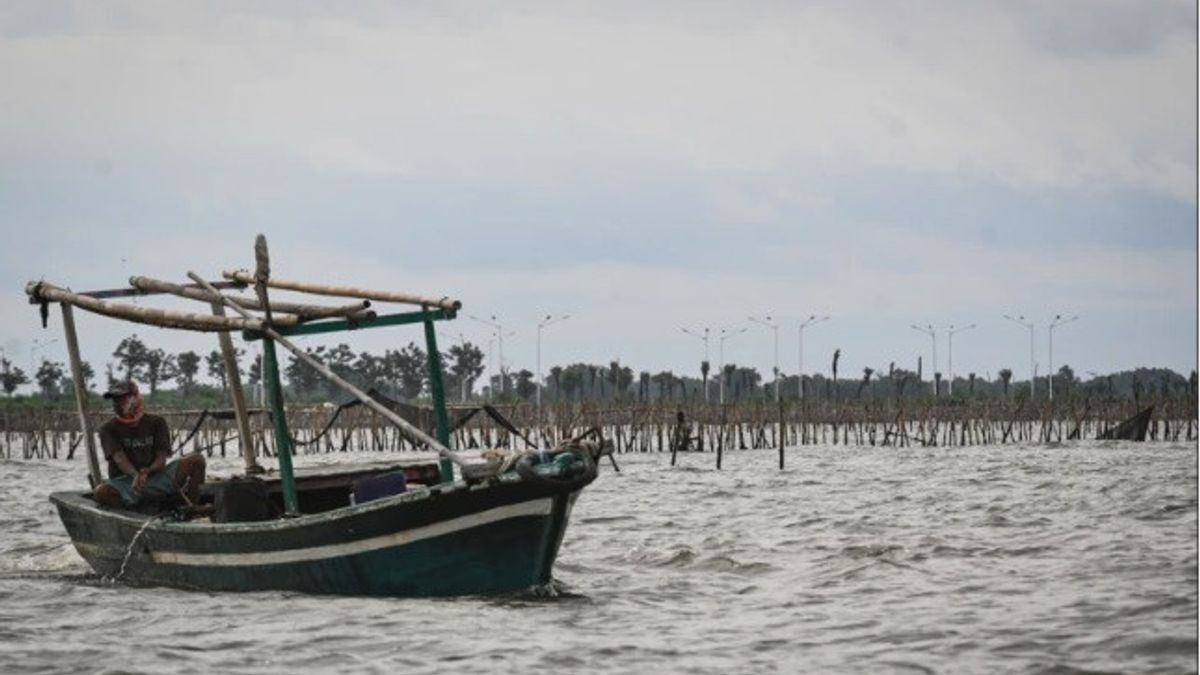


JAKARTA The installation of the sea fence, which until now is unknown who is the mastermind, on the coast of Tangerang Regency, Banten, has become a heated debate. Not only threatens ecological balance, but also the lives of the surrounding community which rely heavily on marine resources.
The bamboo fence that was locked in the coastal area of 30.16 kilometers became a hot topic of conversation.
One of the problems is the conflict of interest between the private sector who pursue economic and coastal benefits that require access to the sea. Not to mention the potential for ecological damage due to the fence which stretches more than 30 km.
Investigate a calibaration, residents have complained about this seagaring since August 2024. Although it has been reported by residents, there has been no significant action from the government until finally the fence installed extends to 30.16 km.
When this case went viral again at the end of last year, the government finally moved. The Ministry of Maritime Affairs and Fisheries (KKP) has sealed the fence.
Even though it stretches out eye to 30 km and disturbs fishermen, the local and central governments admit that they do not know who is mixing the sea.
The existence of a sea fence that stretches up to tens of kilometers has become a hot topic of conversation lately. A number of people accused the fence as part of a reclamation plan for the development of Pantai Indah Kapuk (PIK) 2 which is included in the 2024 National Strategic Project (PSN).
Agung Sedayu Group as PIK 2 developer was cornered. However, they denied responsibility for the existence of the six-meter-long bamboo fence.
However, the impact of sea fencing in Tangerang cannot be underestimated. From an ecological point of view, sea fencing in Tangerang carries serious risks. Coastal ecosystems, such as mangrove forests and coral reefs, play an important role as a natural habitat for various marine species as well as natural protection from natural disasters.
"The changes in the environment there are quite large, mangroves are lost, marine ecosystems are disrupted," said Dwi Sawung, National Spatial Planning and Infrastructure Campaign Manager for the Indonesian Environment (Walhi) Dwi Sawung to VOI.
Dwi also told how the construction of PIK 1 since the 1990s had a big impact on the environment. In fact, it is said that Dwi, Walhi has warned about the potential danger of PIK 1 development.
"PIK 1 has been destroying mangrove forest areas in Angke since the 1980s. The habitat for apes has also decreased," he said.
"At that time Walhi had warned that this construction would sink the airport toll road, and it was true that it happened," added Dwi.
Dwi said, what is predicted to happen at this time will also happen later, if the development of PIK 2 continues to be carried out by reclamation which has a negative impact on the environment, as experienced when protesting against PIK 1 tens of years ago.
The construction of bamboo fences on the coast of the Tangerang Sea is not only felt by biodiversity, but also by people who depend on the sea as a source of livelihood. With the disruption of marine habitats, the catch of fish that are the source of their livelihood has drastically decreased.
Socially, this case shows a conflict between public and private interests that leads to losses for small communities. Fishermen who previously easily accessed fishing areas, now have to face obstacles in the form of distances to catch fish.
Whereas as is known together, traditional fishermen have limited capital and technology.
"For the surrounding community, especially fishermen, they are difficult to go to sea, the fuel used is also more because the road is blocked by the bamboo fence," Dwi explained.
SEE ALSO:
-
 | BERNAS
Angin Santa Ana dan Perubahan Iklim, Duet Penyebab Kebakaran Besar di Los Angeles
14 Januari 2025, 08:00 -
 | BERNAS
Kebakaran Dahsyat di Los Angeles: Bencana Termahal dalam Sejarah Amerika Serikat
13 Januari 2025, 11:00


"If the direklamasi, the settlements that are now becoming more vulnerable so that they are vulnerable to flooding, the local community is forced to be expelled because the place is uncomfortable," he added.
Loss of access to marine resources has significantly reduced fishermen's income, exacerminating the welfare of coastal communities. Not only that, sea fencing also threatens the economic sustainability of coastal communities as a whole.
This was agreed by a fisherman from Karang Serang Village, who admitted that he had to turn long while looking for fish in the middle of the sea. The fence also makes it difficult for fishermen to get small fish by the sea. As a result, income from the results of fishing decreased.
Member of Commission IX of the House of Representatives, Riyono Caping, agrees with the significant impact on local communities due to the sea fence. Data from the Marine and Fisheries Service of Banten Province shows that around 3,888 fishermen and 502 cultivators are affected, meaning that around 21,950 people are economically affected.
Meanwhile, the Indonesian Ombudsman estimated the loss of fishermen for the last five months due to the sea fence reaching Rp9 billion. This loss is calculated based on the difficulty of access for fishermen caused by the sea fence.
The English, Chinese, Japanese, Arabic, and French versions are automatically generated by the AI. So there may still be inaccuracies in translating, please always see Indonesian as our main language. (system supported by DigitalSiber.id)
Most Popular Tags
#Prabowo Subianto #donald trump #Febrie Adriansyah #8791 #giias 2026Popular


