
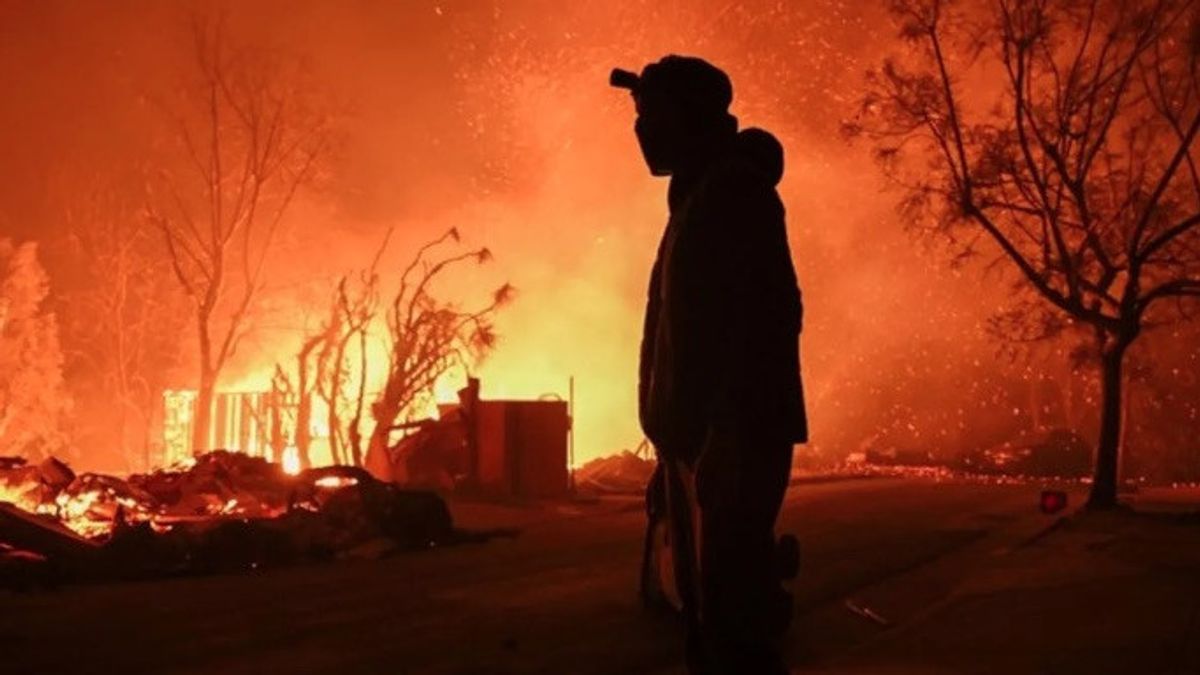


JAKARTA Angin Santa Ana can have an impact that disrupts daily life in Los Angeles and parts of Southern California. When Santa Ana occurs and is accompanied by forest fires, the wind can cause fires to spread very quickly.
The massive fires that hit the Los Angeles area of California since last week have killed at least 24 people, more than 12,000 buildings were destroyed, and hundreds of thousands of people were forced to flee.
Not yet known for certain the cause of this fire, but a number of observers called climate change a factor, while the winds of Santa Ana made it difficult for firefighters to beat the red rooster.
Citing the fire coverage at Pacific Palisades, Los Angeles, California has burned more than 23,000 hectares of land and has only managed to control 11 percent of the fire. Meanwhile, the second largest fire that occurred in another region, Eaton, scorched 57 square km of the region and firefighters increased control to 27 percent.
The combination of a very dry climate and strong offshore winds known as the Santa Ana wind have created conditions that trigger fires.
According toUSA Today, the wind of Santa Ana is a strong wind that drives dry air from the interior to the beach. The wind is forced to go down to a place that is introduction and heating up. The wind is usually blown away by the westrah, from Nevada and Utah to Southern California.
No one really believes where Santa Ana's name comes from. However, according to a number of sources, it comes from Ana's Relaxed canyon in Orange County, Southern California. Santa Ana's wind is often also called demon's wind' or red wind'.
The calling of the devil's wind for Santa Ana is not without reason. This wind has strong and dry characteristics, it usually has a speed of about 60 to 60 miles per hour (about 95-130 km per hour). But the gust of Santa Ana's wind can also reach 100 miles per hour (160km/hour) during the worst period.
Director of the Institute of Environment and Sustainability at the University of California, Alex Hall, analogizes Santa Ana's wind processes such as big magic' or other terms for large basins (Great Basin).
A large bowl is an overview of topography. On its sides there are holes, depicting mountain trajectories.
SEE ALSO:
-
 | BERNAS
Kebakaran Dahsyat di Los Angeles: Bencana Termahal dalam Sejarah Amerika Serikat
13 Januari 2025, 11:00 -
 | BERNAS
Belajar dari COVID-19, Penting untuk Tetap Tenang dan Waspada Hadapi HMPV
11 Januari 2025, 11:55 -
 | BERNAS
Pemerintah Harus Berhati-Hati dalam Wacana Menghidupkan Kembali Ujian Nasional
10 Januari 2025, 13:15


"If there is a lot of high and heavy pressure in the bowl, you will push the air out through the holes," said Hall, reported by the New York Times.
As the air blows through the mountain gap (waterhole), the wind gets stronger, moving towards a low-pressure area on the coast of Southern California, he added.
Angin Santa Ana not only exacerbates fires through the spread of fire. On the other hand, the strong winds often become an obstacle for firefighters in an effort to tame the fire.
One of our biggest concerns, not only for the community, but also for ourselves as firefighters, is a broken power line and a power pole that falls due to strong winds and closes the highway, said the California Forestry and Fire Protection Battalion Head Jesse Torres.
Angin Santa Ana not only causes conditions that support the development of forest fires, but can also cause the scale of the damage that will occur afterward.
Observers believe Santa Ana is just one of a number of factors that caused a major fire in Los Angeles, California, United States. There are other factors that make it difficult for firefighters to conquer the red rooster, namely climate change.
Climate change, including rising hot temperatures, long dryness, and arid atmosphere, has been the main driver of increased risks and extent of forest fires in the western United States, the National Oceanic and Atmospheric Agency (NOAA) said.
Most of the western region of the US, including California, experienced a decades-long drought that ended two years ago, making the region vulnerable.
Last year, the US state experienced the hottest June and July in history and the second hottest October.
Most parts of Southern California have also not felt rain since last July, although half of the rainy season has passed. Amazing heat plus no rain to dry vegetation there. So when Santa Ana blows, dry forests are increasingly prone to fires.
In recent decades, the California forest fire season has lasted longer. The Climate Central report in 2023 said the number of days where weather conditions made forest fires more vulnerable in California more or less than in the early 1970s.
Fire season in Southern California generally occurs from May to October. But the situation in Los Angeles in January 2025 cannot be called an anomaly, because climate change can cause fires to occur at any time.
"There is no fire season. It's been a year of fire," said California Governor Gavin Newsom.
The English, Chinese, Japanese, Arabic, and French versions are automatically generated by the AI. So there may still be inaccuracies in translating, please always see Indonesian as our main language. (system supported by DigitalSiber.id)


