

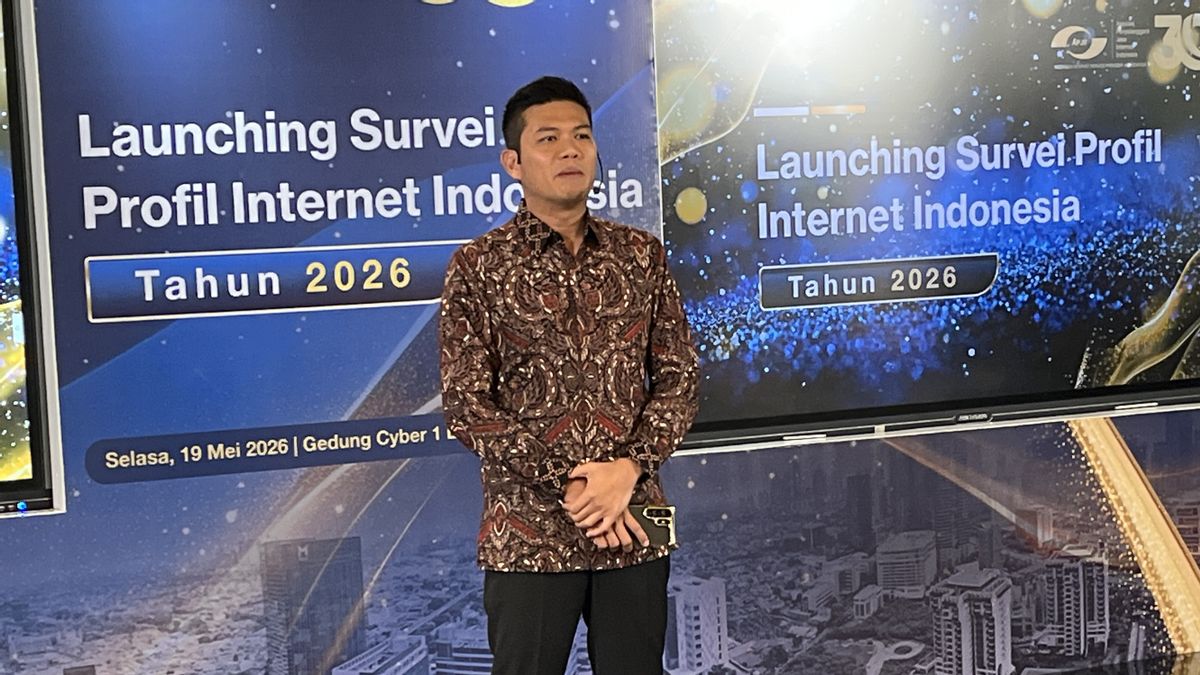


JAKARTA - The Indonesian Internet Service Provider Association (APJII) launched the results of the Indonesian Internet Profile Survey 2026 in the Launching of Survey Results held in Jakarta. This survey provides a comprehensive overview of internet penetration rates, internet user behavior, digital access patterns, cyber security levels, and the development of fixed internet services (fixed broadband) in Indonesia.
Based on the survey results, Indonesia's internet penetration rate in 2026 reached 81.72 percent, or equivalent to 235,261,078 people out of a total population of Indonesia of 287,303,234 people. This figure shows an increase compared to the previous year which was at 80.66 percent, and also shows that the internet has become a major need for the Indonesian people in various sectors of life.
APJII Chairman, Muhammad Arif, said that this increase in internet penetration shows that national digital transformation continues to move progressively and increasingly inclusive.
"Internet today is no longer just an additional need, but has become part of social, economic, educational, and public service activities of the Indonesian people. The results of this survey show that the national digital transformation continues to grow and needs to be supported by the equalization of infrastructure, improvement of service quality, and strengthening of people's digital literacy," said Arif at the APJII Secretariat at the Cyber Building, Kuningan, South Jakarta, Tuesday, May 19.
In terms of territory, explained Arif, Java Island still contributes the largest contribution to national internet users with a penetration rate of 85.95 percent and a user contribution of 58.24 percent. Meanwhile, the Kalimantan region recorded a penetration of 80.40 percent and a user contribution of 6.20 percent, Sumatra of 78.24 percent and a user contribution of 20.74 percent, Bali and Nusa Tenggara of 78.14 percent and a user contribution of 5.26 percent, Sulawesi of 72.58 percent and a user contribution of 6.62 percent, and Maluku and Papua of 69.74 percent and a user contribution of 2.94 percent.
"This data shows that the equalization of internet access continues to develop, although there is still a digital gap between regions that needs to be a common concern," he explained.
Then in terms of demographics, continued Arif, the penetration of the internet by men was recorded at 83.95 percent with a contribution rate of 50.03 percent, while women were 79.79 percent with a contribution rate of 49.97 percent, which shows that the gender gap in internet access is getting smaller.
Meanwhile, based on the area of residence, urban people have a penetration rate of 84.75 percent with a contribution rate of 60.59 percent, while rural areas reach 78.18 percent with a contribution rate of 39.41 percent.
The survey also showed that the education group has a correlation with the level of internet usage. The highest penetration rate was recorded in the college education group at 92.49 percent, followed by equivalent high schools/vocational schools at 90.44 percent, equivalent junior high schools at 82.48 percent, and equivalent elementary schools at 74.84 percent.
Based on the generation group, the highest internet penetration is in the Gen Z group at 89.02 percent and Millennials at 90.34 percent, which shows the dominance of the younger generation in the use of digital technology. In terms of activity, people who work have the largest contribution to internet usage with a penetration rate of 84.9 percent.
Regarding the reasons why people use the internet, communication and social networking activities are the largest factor with a percentage of 19.9 percent, followed by digital entertainment such as streaming and games at 19.7 percent, information and news search at 19.6 percent, and e-commerce transactions and digital services at 18.7 percent. This shows that the internet has become an important part of the social and economic activities of the Indonesian people.
On the other hand, for people who are not connected to the internet, the most common reason is that they do not have a device that can connect to the internet by 34.0 percent, do not know how to use digital devices by 31.5 percent, and the price of internet quotas is still considered expensive by 17.2 percent.
The survey results also show that the main device used by the public to access the internet is still dominated by smartphones/handphones at 84.31 percent. In terms of usage duration, the majority of people access the internet for 4-6 hours per day.
In terms of digital security, the public considers the most important security feature to be online anti-fraud features (24.0 percent), followed by online gambling anti-features of 21.7 percent, and anti-pornography features of 20.6 percent. Meanwhile, the most common digital security cases experienced by the public in 2026 are online fraud of 13.6 percent and personal data theft/hack/phishing of 7.8 percent.
In addition, the APJII survey in 2026 also recorded the growth of fixed internet customers (fixed broadband). The number of people subscribing to fixed internet reached 99,515,436, with a customer growth of 3.6 percent compared to the previous year. The majority of fixed internet customers use cable/fiber internet services at 37.9 percent.
The Indonesian Internet Profile Survey 2026 was conducted by APJII in collaboration with independent survey institutions and was carried out in various regions of Indonesia to obtain a comprehensive picture of the national internet condition.
Arif said that the results of this survey are expected to serve as a strategic reference for the government, internet industry players, academics, and all stakeholders in formulating policies and strategies for the development of a more inclusive, safe, and sustainable national digital ecosystem.
"Hopefully the results of this survey will be useful not only for APJII but for APJII members and all Indonesian people who need it," he concluded.
The English, Chinese, Japanese, Arabic, and French versions are automatically generated by the AI. So there may still be inaccuracies in translating, please always see Indonesian as our main language. (system supported by DigitalSiber.id)
Most Popular Tags
#Prabowo Subianto #donald trump #2026 World Cup #Febrie Adriansyah #8791Popular


