

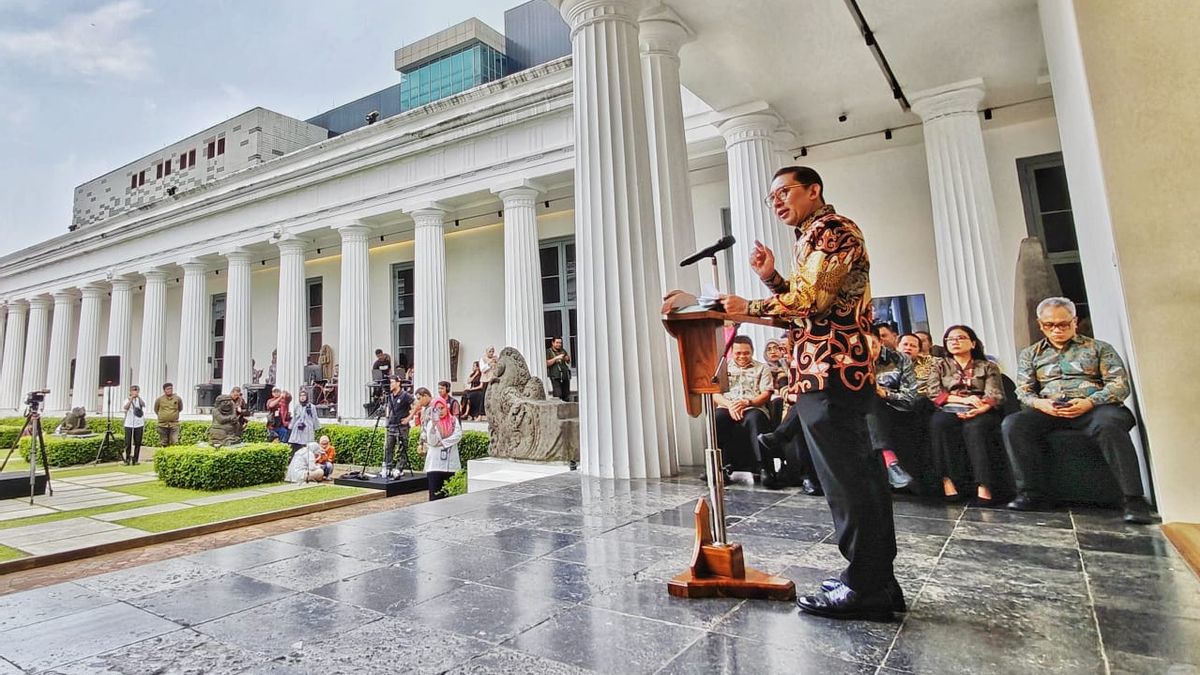


JAKARTA - Minister of Culture (Menbud) Fadli Zon considers that museums should no longer be seen as merely places to store historical objects. Museums must be public spaces, strengthening the identity of the nation, as well as driving the cultural economy.
This was conveyed by Fadli in a cultural oration at the 2026 International Museum Day at the National Museum of Indonesia, Jakarta, Monday (18/5). This year, the International Council of Museums or ICOM has the theme "Museums Uniting a Divided World" or "Museums Uniting a Divided World".
"In the midst of a world that is increasingly connected but also fragmented due to conflicts, inequalities, and polarization, museums must be present as public spaces that rebuild trust," said Fadli.
He said museums have a strategic role as a space for intergenerational, intercultural, and inter-ethnic encounters. Museums must also be able to connect young generations with the history and heritage of their civilization.
According to Fadli, the policy of Indonesian museums is based on four things. Museums must be a form of national identity, a space of citizenship that strengthens social cohesion, a space for the restoration of cultural sovereignty, and an upstream infrastructure of the cultural economy.
He said museums can be a source of knowledge and inspiration for the cultural and creative industries, ranging from films, animation, games, textiles, culinary, to digital content.
"Museums must be understood as upstream infrastructure of the cultural economy," he said.
Fadli said the global cultural sector and creative industries contributed 4.3 trillion US dollars or about 6 percent of the world economy. Therefore, Indonesia is considered to have a great opportunity to make museums part of the driving force of the national cultural economy.
Until April 2026, the Ministry of Culture recorded that there were 516 museums in Indonesia. Of that number, 373 museums have entered the National Museum Registration Number and 234 museums have been standardized as type A, B, or C.
The Ministry of Culture also prepared four priority agendas. The agenda includes strengthening museums as centers of knowledge, increasing relevance for young generations, accelerating digital transformation, and strengthening financing and cross-sector partnerships.
During the event, the Museum and Cultural Heritage Public Service Agency also launched the Museum Passport in collaboration with Paperina, a company engaged in creative products and stationery.
The Passport Museum is a travel log that allows visitors to collect stamps from museums and cultural heritage sites.
This program is aimed at attracting the public's interest, especially young people, to visit museums more often. The Museum Passport is targeted to be accessible to the public starting June 2026.
Head of the BLU Museum and Cultural Heritage, Esti Nurjadin, said museums can be a space that brings together the past and the future, tradition and innovation, and knowledge and empathy.
"Museums remind us that diversity of perspective is not a reason to be apart, but an invitation to understand each other," said Esti.
Fadli hopes that museums will become part of people's lifestyles. He invites the government, museum managers, academics, communities, the private sector, the media, and the younger generation to strengthen museums as a space for knowledge and a space for civilization.
"Visiting museums should be a new habit for the community, especially the younger generation," said Fadli.
The English, Chinese, Japanese, Arabic, and French versions are automatically generated by the AI. So there may still be inaccuracies in translating, please always see Indonesian as our main language. (system supported by DigitalSiber.id)
Most Popular Tags
#Prabowo Subianto #donald trump #firearm #8791 #giias 2026Popular


