

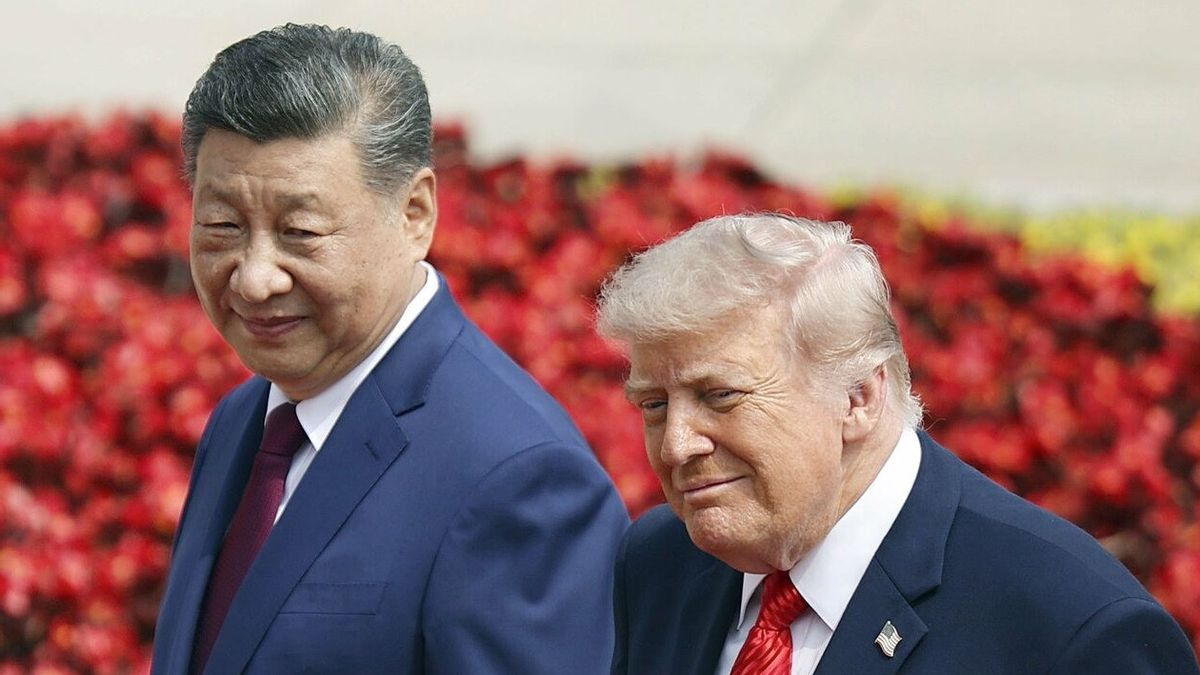


China has agreed to buy at least $17 billion worth of US agricultural products per year until 2028. The deal is one of the results of a meeting between US President Donald Trump and Chinese President Xi Jinping in Beijing.
According to a Kyodo News report quoted on Monday, May 18, the purchase commitment was listed in a White House fact sheet released Sunday. China also agreed to an initial purchase of 200 US-made Boeing aircraft for Chinese airlines.
However, the document does not mention Taiwan. In fact, the Taiwan issue is one of the most sensitive points in Washington-Beijing relations. Taiwan is a self-governing island that China claims as part of its territory.
In the two-day meeting that ended Friday, Xi warned of the potential for conflict between the world's two great powers if the issue of Taiwan is not handled properly. The absence of Taiwan in the document indicates that there are still major differences.
Outside Taiwan, Trump and Xi also agreed on several strategic issues. Both expressed a common goal for the denuclearization of North Korea. They also rejected the toll collection in the Strait of Hormuz, an important route for world energy shipments that was disrupted by the US-Israeli conflict with Iran.
The two leaders agreed that Iran should not have nuclear weapons and called for the reopening of the Strait of Hormuz. The US hopes that China, which has close ties with Iran, will use its influence to help ease the conflict in the Middle East. However, the White House document does not contain any concrete steps by Beijing.
In the economic field, the US and China formed two new forums, namely the Board of Trade and the Board of Investment. The Board of Trade will be used to manage the trade of non-sensitive goods. The Board of Investment is a government-to-government forum to discuss investment issues.
China is also said to respond to US concerns about the shortage of rare earths and other essential minerals. Rare earths are essential minerals for making high-tech products, including semiconductors, batteries, and defense devices.
Previously, Trump and Xi agreed to a one-year pause in the trade war when they met in South Korea in October. The deal eased tensions after the two countries' tariffs had jumped to three digits.
In the deal, China also delayed new export restrictions on rare earth minerals and committed to buying at least 25 million tons of U.S. soybeans per year in 2026 to 2028.
The Chinese Ministry of Commerce said the two sides had agreed in principle to reduce tariffs on products of mutual concern on an equal scale. They will also discuss non-tariff barriers and market problems on a number of agricultural products.
Beijing will also work with US regulators to lift a suspension on American beef facilities and resume importing poultry from US states free of highly pathogenic avian influenza.
Trump is scheduled to receive Xi's visit to Washington in the fall of this year. The two countries will also support each other as hosts of the G20 and APEC summits.
Meanwhile, Trump spoke by phone with South Korean President Lee Jae Myung to convey the results of his meeting with Xi. Lee welcomed the constructive discussions of the two leaders regarding the Korean Peninsula.
The English, Chinese, Japanese, Arabic, and French versions are automatically generated by the AI. So there may still be inaccuracies in translating, please always see Indonesian as our main language. (system supported by DigitalSiber.id)
Most Popular Tags
#Prabowo Subianto #donald trump #firearm #8791 #giias 2026Popular


