

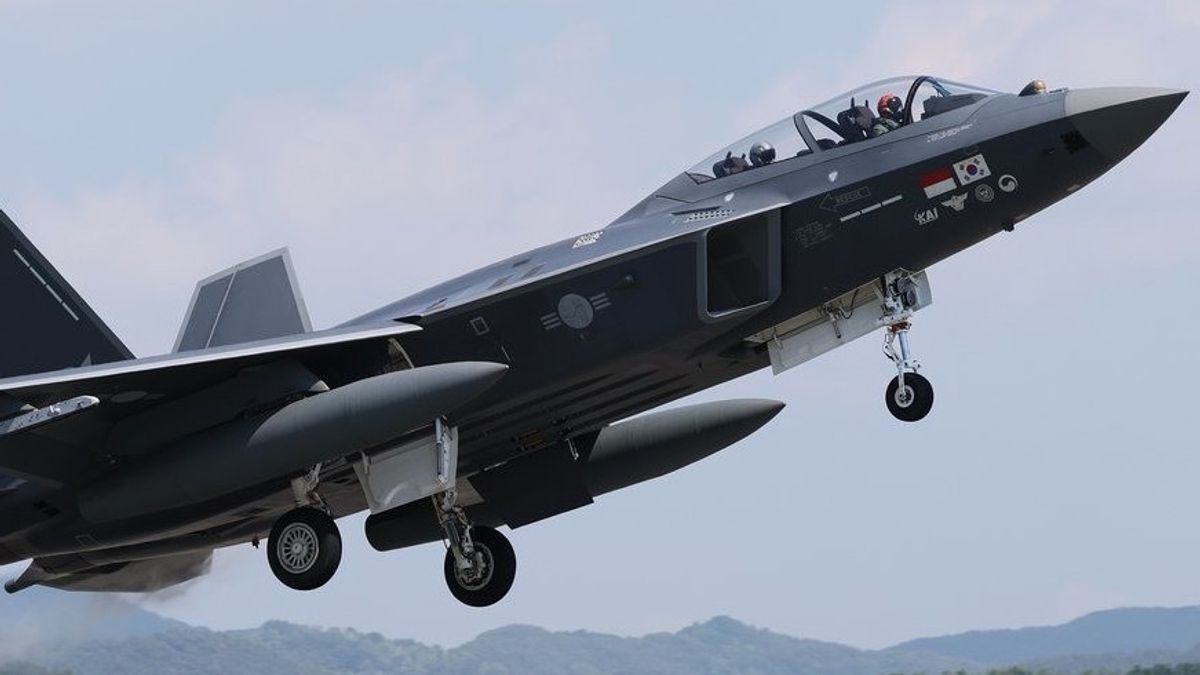


South Korea is beginning to show its ambitions in the defense industry. Citing a Kyodo News report, Friday, May 15, the domestically produced KF-21 Boramae fighter jet underwent a test flight in Sacheon, about 300 kilometers south of Seoul, Wednesday.
The gray jet sped down the runway of the 52nd Test Flight Group of the Air Force before taking off into the clear sky. The test flight was held to demonstrate the readiness and capabilities of South Korea's first fighter jet development program.
"The prototype flight was conducted to test the performance of the air-to-ground mode," said Lieutenant Colonel Jeon Seung-hyun, commander of the 281st Test Flight Squadron.
Jeon said each prototype is monitored in real time from the mission control room. The team can even hear the pilot's breath to find out if there are any disturbances or difficulties during the flight.
South Korea's ambition to make its own fighter jets has been around since 2001, when President Kim Dae-jung announced the plan. However, the project has long been stalled due to doubts about feasibility and budget.
The KF-21 Boramae program was officially launched in December 2015 with Indonesia. Boramae means "young eagle" in Korean. This supersonic aircraft is being developed to replace the retired F-4 and the old F-5 still in use.
Korea Aerospace Industries or KAI will produce the first 40 KF-21 with air-to-air capabilities for the Air Force by 2028. At least eight units are targeted to be delivered by the end of this year.
The second phase targets the production of 80 additional jets with long-range air-to-ground missiles by 2032.
Since the first prototype was launched in April 2021, mass production has begun. Currently, 20 of the first 40 jets have entered the final assembly line at KAI's Sacheon plant.
The assembly plant is 21,000 square meters, equivalent to three football fields. On one side, 20 KF-21s are assembled. On the other side, 39 FA-50 light attack aircraft are also being worked on.
"Everything is assembled here, except the engine, which is done in the hangar," said KAI official Lee Sang-hwi, as quoted by Kyodo.
KAI said the development of the KF-21 opens the way for South Korea to export its fighter jets and weapons systems.
KAI CEO Kim Jong-chool said initial talks were underway for the potential export of at least 200 units to a number of countries, including the Philippines, Malaysia, and Poland.
"I believe we can sell up to 1,000 units," Kim said.
However, the target still depends on the continuation of the second phase of production, or Block-II, which is planned to start next year. This phase is important because it is related to the development of long-range air-to-ground attack capabilities.
Kim reminded that investment barriers could affect production capacity, other preparations, and subcontractors.
"However, we believe that in the end the government and the military will decide," Kim said.
With the KF-21, South Korea is not only pursuing its own military needs. Seoul is also preparing the ground for deeper inroads into the export market for fighter jets and weapons systems.
The English, Chinese, Japanese, Arabic, and French versions are automatically generated by the AI. So there may still be inaccuracies in translating, please always see Indonesian as our main language. (system supported by DigitalSiber.id)
Most Popular Tags
#Prabowo Subianto #donald trump #2026 World Cup #Febrie Adriansyah #8791Popular


