

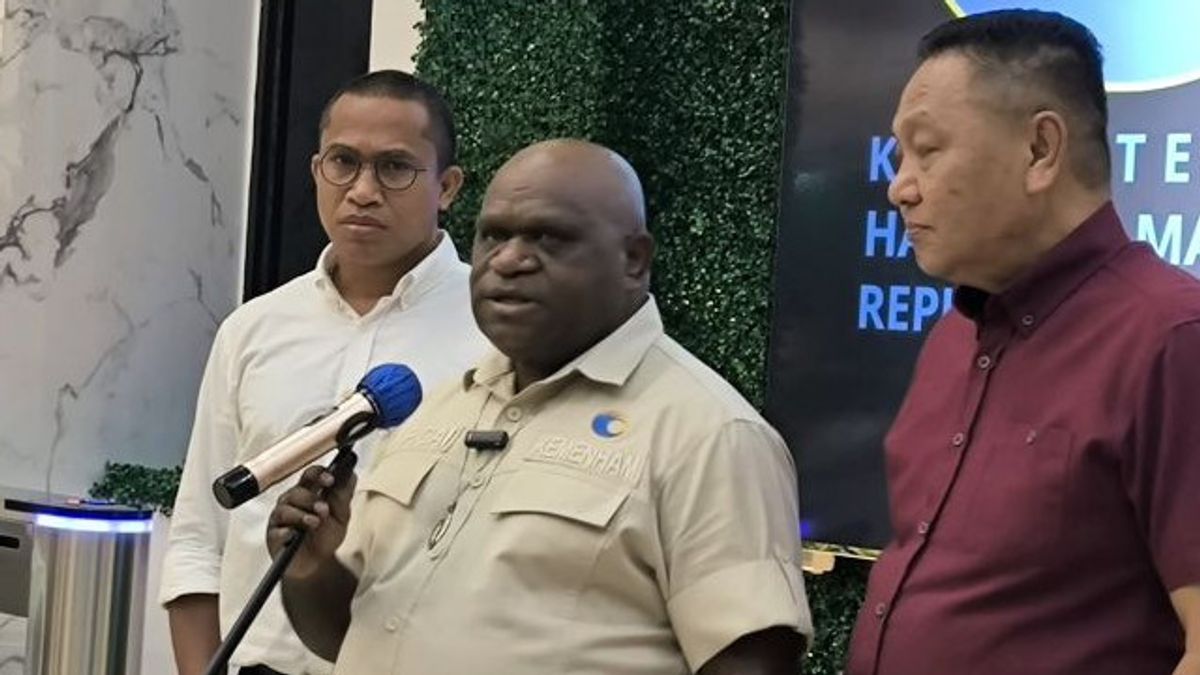


JAKARTA - Human Rights Minister (HAM) Natalius Pigai emphasized that the government does not have the authority to determine who has the status of a human rights defender (HAM), because this is the domain of civil society in accordance with international standards.
He said that state intervention in determining the status of human rights defenders is contrary to the global human rights protection system which involves mechanisms such as the UN Human Rights Council, the Office of the UN High Commissioner for Human Rights, to the Universal Periodic Review.
"The intervention to determine the status of human rights defenders is not correct. In accordance with international standards, the human rights protection system, yes, both the human rights protection system in this context are from the UN Human Rights Council, then the office of the UN High Commissioner for Human Rights, then the Special Rapporteur (UN Special Rapporteur), then the Universal Periodic Review (Universal Periodic Review)," said Pigai as quoted by ANTARA, Monday, May 4.
Pigai said in this context, the government should not regulate or enter the civilian area.
Therefore, he said, it is very unlikely that the government will enter to regulate, let alone determine the status of human rights defenders.
He emphasized that the role of the government was in the aspect of regulation and protection, not the classification of actors.
"The government's obligation is to present legislation that ensures protection for human rights defenders who fight without pay for the public interest, for the good and peacefully. That is what we will ensure that there is definite protection for human rights defenders," he said.
He explained that the determination of criteria for human rights defenders will be carried out by civil society together with independent institutions such as Komnas HAM, Komnas Perempuan, the Child Protection Commission and the Disability Commission.
According to him, this principle is in line with the 1998 UN resolution on human rights defenders and strengthening the protection of activists, including women.
"Thus, the government does not determine the status of human rights defenders, the status of activists. It is very unlikely, because we know the international regulations, especially the UN resolution related to human rights defenders in 1998, as well as human rights defenders for women activists in 2013, it states that the state should not intervene," he said.
Pigai added that the government was also preparing to strengthen legal protection through a revision of the Human Rights Law, including guarantees of immunity for human rights defenders in carrying out their duties.
"States are obliged to protect them and ensure their protection. Therefore, in the draft Human Rights Law, we have emphasized that those who are in the process of defending, those who need help by fulfilling certain criteria without being paid for the public interest, not by violence, are definitely not subject to criminal prosecution," he said.
This step is part of efforts to strengthen the human rights protection ecosystem based on the role of the state as a facilitator, not a determinant of the legitimacy of actors.
The English, Chinese, Japanese, Arabic, and French versions are automatically generated by the AI. So there may still be inaccuracies in translating, please always see Indonesian as our main language. (system supported by DigitalSiber.id)
Most Popular Tags
#Prabowo Subianto #donald trump #Febrie Adriansyah #8791 #giias 2026Popular


