

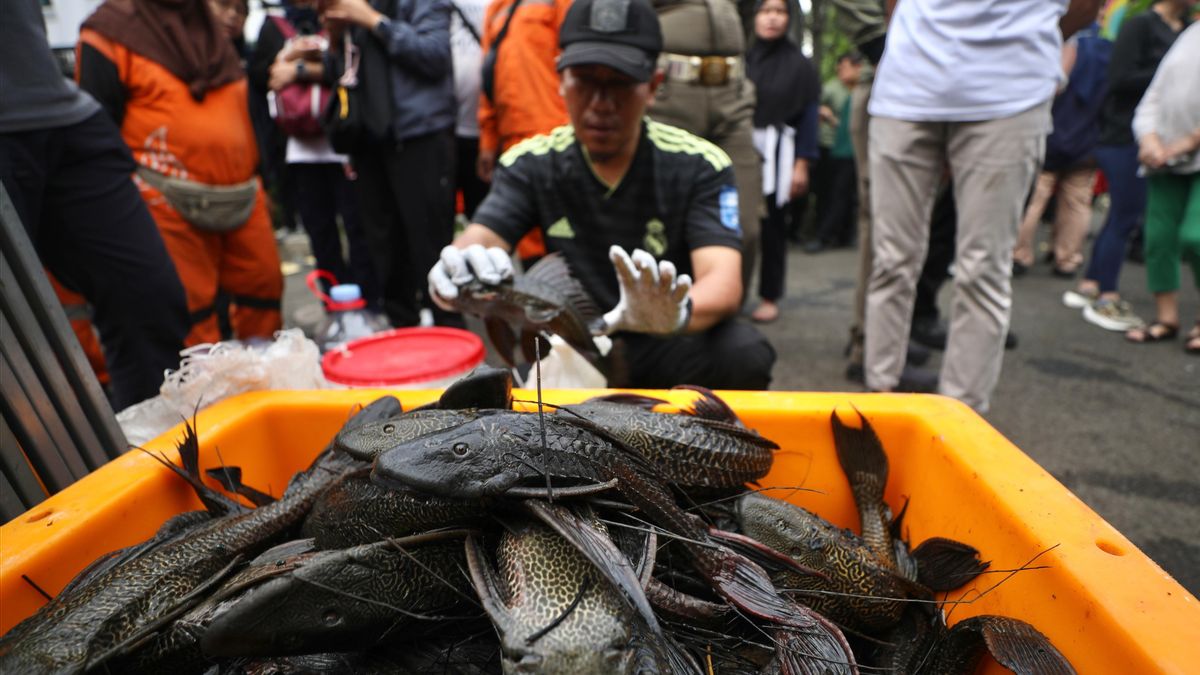


JAKARTA - The DKI Jakarta Provincial Government (Pemprov) responded to criticism from the Indonesian Ulema Council (MUI) regarding the method of destroying sapu-sapu fish, which was considered not to have taken into account the welfare of animals.
Head of the DKI Jakarta Food, Maritime, and Agriculture (KPKP) Department, Hasudungan Sidabalok, admitted that the practice of burying live sapu-sapu fish in large numbers was still happening in the field.
"The incident of burying a large number of sweepers is difficult to avoid even though some of them were turned off before being buried," Hasudungan said in a short message, Monday, April 20.
Hasudungan explained that the DKI Provincial Government is currently evaluating the method of handling the results of the sweep-sweep fish catch to be more in line with the applicable rules, including religious aspects and animal welfare.
According to Hasudungan, cross-party coordination is being carried out to formulate a more appropriate approach.
"The DKI Jakarta Provincial Government is coordinating with academics, research institutions, practitioners and the central government to formulate the most effective and efficient method in terms of the destruction of the results of the sweep-sweep fish catch," he said.
This effort was carried out following the spotlight on the practice of burying fish in a live condition which was considered not to reflect the principle of animal welfare. The Provincial Government emphasized that the method used in the future is expected not to conflict with religious values while paying attention to the humanitarian aspect of animals.
"This is so that it does not violate religious principles and is in accordance with animal welfare," said Hasudungan.
Previously, the Indonesian Ulema Council (MUI) Fatwa Commission highlighted the method of destroying sapu-sapu fish carried out by the DKI Jakarta Provincial Government, especially the practice of mass burial allegedly carried out while the fish was still alive.
Secretary of the MUI Fatwa Commission, KH Miftahul Huda, assessed that the method was contrary to the basic principles of Islam, especially regarding the value of love and animal welfare.
He said there were two principles violated in the practice, namely rahmatan lil 'alamin and animal welfare. Burying fish alive is considered to contain elements of torture because it slows down the process of death.
"This method is considered to cause unnecessary suffering," said Miftah.
However, MUI does not question the purpose of the policy to control the fish. The step is considered to have a value of maslahat because it aims to maintain the environment.
According to him, the control of the mop-mop fish or pleco is indeed necessary because it has the potential to damage the river ecosystem and threaten the existence of local fish.
"That is in line with the maqāṣid syariah, which is in the category of modern ecological ḍharūriyyāt," he said.
The English, Chinese, Japanese, Arabic, and French versions are automatically generated by the AI. So there may still be inaccuracies in translating, please always see Indonesian as our main language. (system supported by DigitalSiber.id)
Most Popular Tags
#Prabowo Subianto #donald trump #Febrie Adriansyah #8791 #giias 2026Popular


