

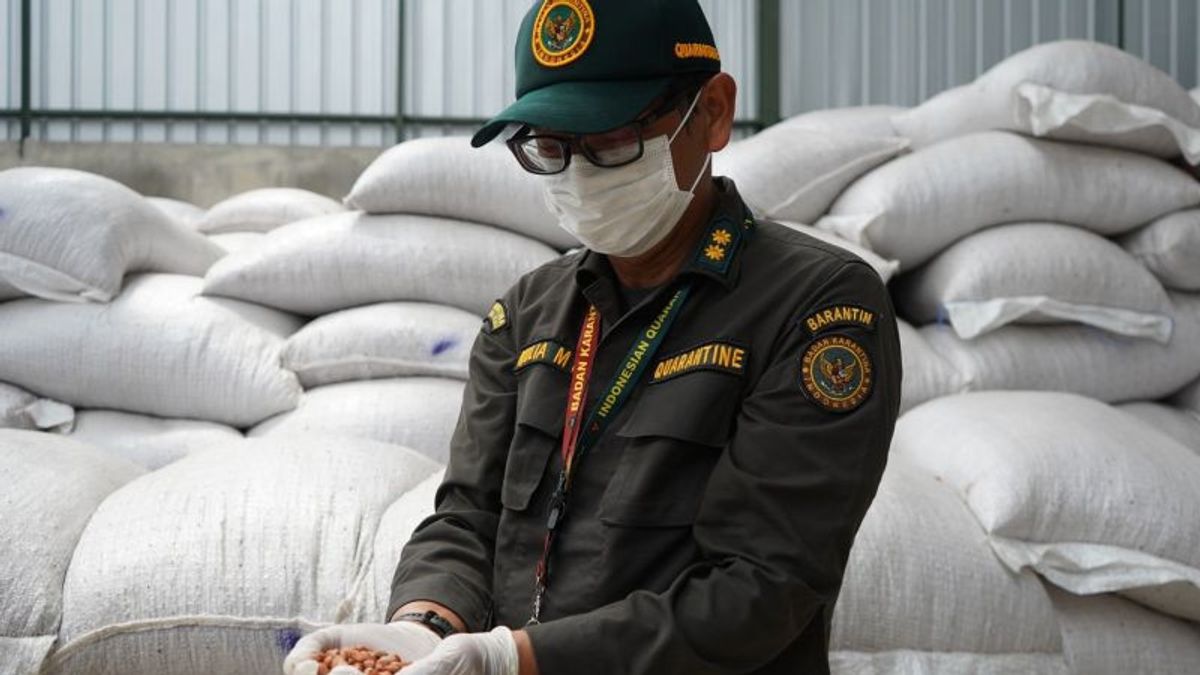


Jambi - The Animal, Fish and Plant Quarantine (Quarantine) Office of Jambi has rejected the entry of 40 tons of imported peanuts from Malaysia because they were detected to contain high aflatoxins.
"Groundnuts contain aflatoxins that exceed the maximum threshold of 20 µg/kg and aflatoxin B1 exceeds the Maximum Residue Limit (BMR) which is 15 µg/kg," said Head of Jambi Quarantine Sudiwan Situmorang in Jambi Wednesday, quoted by Antara.
Based on the results of the reference laboratory test (CEMARAN AFLATOKSIN TOTAL), the product was found to exceed the maximum level of 20 micrograms per kilogram (20 µg/kg) set by the Indonesian Food and Drug Administration (BPOM).
"This rejection is a preventive measure so that commodities that do not meet food safety and quality do not circulate in the community," said Sudiwan.
Sudiwan further explained that Barantin plays a leading role in preventing the entry and spread of carriers that are at risk to food safety and quality.
The quarantine action is a tangible form of the presence of quarantine in protecting the community from potential food hazards that do not meet standards.
The commodities entered through the Dagang Port, Tungkal Ulu District, West Tanjung Jabung Regency, Jambi Province.
Based on the document, Malaysia is listed as the supplier country, while the country of origin of the peanuts is India.
The Jambi quarantine has rejected the sending country on Tuesday (24/2) yesterday and previously had submitted a Note of Non-Compliance or Notification Non-Compliance (NNC) to the country's authorities.
"Supervision of imported commodities is carried out through document inspection, physical inspection, and laboratory testing to ensure compliance with food safety standards applicable in Indonesia, this is done to prevent health disorders for humans and the environment," said Sudiwan.
The results of the Laboratory of the Animal, Fish, and Plant Quarantine Standard Testing Center (BBUSKHIT), the aflatoxin B1 (AFB1) level in commodities was 52.0114 µg/kg, far exceeding the BMR, which was 15 µg/kg. The total aflatoxin in the commodity reached 60.0659 µg/kg, while the maximum threshold was 20 µg/kg.
AFB1 is a mycotoxin that is a major concern in food safety at the national and global levels. Being carcinogenic, AFB1 can cause serious health disorders, such as liver damage, decreased immune system, to the risk of liver cancer if consumed above the established threshold.
"Supervision of contamination in this commodity is an important step to ensure the quality and safety of food and we appeal to business actors to always ensure that each commodity that is transported has met the requirements for safety and quality in accordance with applicable regulations," said Sudiwan.
Previously, in early February, the Riau Quarantine also rejected 80 tons of imported peanut commodities from Malaysia that did not meet food safety standards. This is in line with the goal of the Quarantine to continue to strengthen the supervision of commodity traffic, especially those that are high risk of carrying contamination.
The English, Chinese, Japanese, Arabic, and French versions are automatically generated by the AI. So there may still be inaccuracies in translating, please always see Indonesian as our main language. (system supported by DigitalSiber.id)
Most Popular Tags
#Prabowo Subianto #donald trump #2026 World Cup #Febrie Adriansyah #8791Popular


