

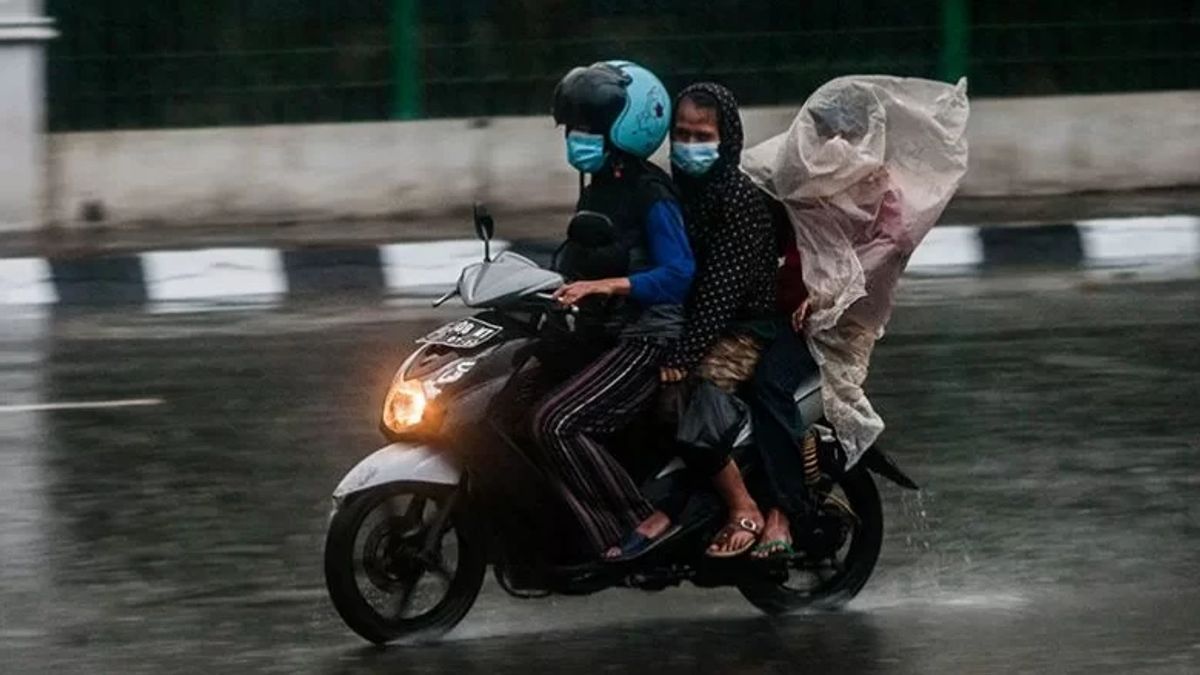


JAKARTA - The Meteorology, Climatology and Geophysics Agency (BMKG) predicts that most major cities in Indonesia are potentially hit by light to moderate rain today Sunday, February 8.
In the BMKG weather early warning system, for the Sumatra region, the major cities that are potentially hit by light to moderate rain are Medan, Pangkal Pinang, Palembang, and Bengkulu.
Meanwhile, Pekanbaru, Jambi, and Bandar Lampung have the potential to be hit by heavy rain accompanied by lightning. Meanwhile, Aceh and Padang are cloudy.
"For Java, light to moderate rain is potentially evenly distributed in Banten, Jakarta, Bandung, Semarang, and Yogyakarta. Meanwhile, Surabaya has the potential for heavy rain," said BMKG Praktirawan Wahyu Anisa in a broadcast from Jakarta, quoted by Antara.
Meanwhile, on the island of Kalimantan, the cities of Palangkaraya and Tanjung Selor have the potential for light rain. Samarinda and Banjarmasin have the potential for heavy rain accompanied by lightning. Pontianak is thick clouds.
"Meanwhile, Bali and Kupang have the potential to be hit by light to moderate rain. Mataram is covered with clouds," he said.
For Sulawesi Island, light to moderate rain is potentially occurring in Makassar, Kendari, Gorontalo, Manado, and Ternate with the potential for light to moderate rain. Mamuju heavy rain accompanied by lightning, while Palu weather is cloudy.
Moving to the easternmost region, cities such as Ambon, Sorong, Manokwari, Jayapura, Nabire, Jayawijaya, and Merauke are expected to be hit by light to moderate rain.
BMKG emphasized the importance of strengthening integrated early warning systems and cross-sectoral collaboration to reduce the risk of hydrometeorological disasters amid the increasingly visible impacts of climate change.
Acting Deputy Head of Meteorology, BMKG, Andri Ramdhani said the State of the Global Climate 2024 report from the World Meteorological Organization (WMO) recorded 2024 as the hottest year in history, with global temperature anomalies exceeding the 1.5°C threshold compared to the pre-industrial period.
"Observation data shows a consistent trend in temperature increases, both globally and regionally in Indonesia. This condition has a direct impact on the increasing intensity and frequency of extreme weather that triggers hydrometeorological disasters," said Andri.
In line with this, BMKG data over the past 16 years (2010-2025) shows a trend of increasing flood and landslide events, which continue to increase, along with the trend of rising temperatures and climate change. The region with the highest incidence rate was recorded in West Java, followed by Central Java, East Java, Aceh, and a number of other regions in Sumatra.
The English, Chinese, Japanese, Arabic, and French versions are automatically generated by the AI. So there may still be inaccuracies in translating, please always see Indonesian as our main language. (system supported by DigitalSiber.id)
Most Popular Tags
#Prabowo Subianto #donald trump #Febrie Adriansyah #8791 #giias 2026Popular


