

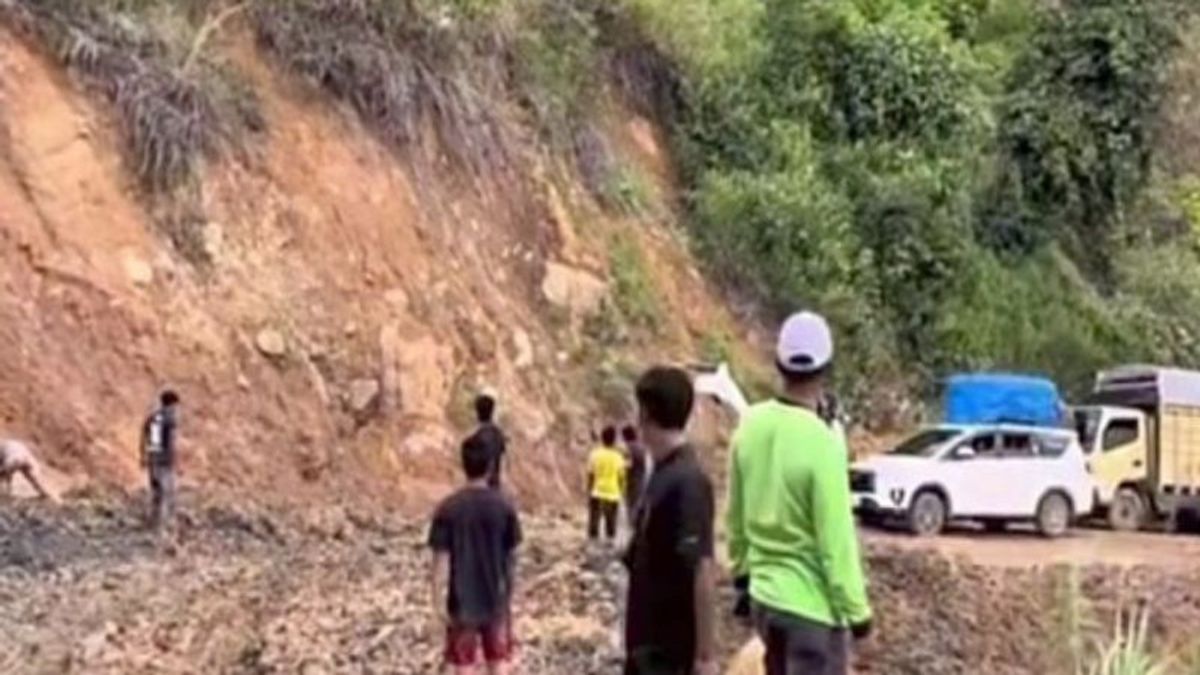


JAKARTA - The Terangun-Babahrot road connecting Gayo Lues Regency with South West Aceh (Abdya) can now be penetrated by all types of vehicles. The line is now the only vital access after the flood and landslide disaster that hit Aceh.
"If it's not through here, we are really cut off. This line is a life saver," said Terangun resident Muhammad Yusuf when met in Abdya, Friday, quoted by Antara.
The alternative route, which is more than 80 kilometers long, has become the main focus of citizen mobility, logistics distribution, and access to Gayo Lues, following the interruption of the national cross-east and central routes after the disaster.
Although the road is still filled with mud, the community can already pass through it, both with two-wheeled and four-wheeled vehicles.
The flood and landslide disasters that occurred some time ago damaged a number of strategic road sections in Aceh, including the Blangkejeren-Kutacane, Blangkejeren-Takengon, and Gayo Lues-Bener Meriah routes. This condition causes Gayo Lues to be isolated from land access.
The government together with the TNI, Polri and volunteers continue to strive to accelerate the repair of infrastructure and the distribution of assistance. However, the heavy terrain and extreme weather are still a challenge in the field.
Another Gayo Lues resident, Sopian, said the road had suffered damage in the Gunung Tipis area, through the Abdya border. However, the community carried out gotong-royong to ensure that the road could still be used by vehicles.
For the Gayo Lues community, the Terangun-Babahrot road is not just an alternative road, but a symbol of resilience and the spirit of mutual cooperation in the midst of limitations.
"Since the disaster, our residents have been going down to Blangpidie every day to buy basic necessities. This line is now crowded, vehicles from Gayo Lues and Abdya downstream travel back and forth without stopping," said Sopian.
Meanwhile, residents of Abdya who bring fish to Gayo Lues, said Kasim, the Terangun-Babahrot route is actually not the main road, but now it has become an alternative.
"This is an opportunity to rearrange the priority of infrastructure in disaster-prone areas," said Kasim.
The English, Chinese, Japanese, Arabic, and French versions are automatically generated by the AI. So there may still be inaccuracies in translating, please always see Indonesian as our main language. (system supported by DigitalSiber.id)
Most Popular Tags
#Prabowo Subianto #donald trump #firearm #8791 #giias 2026Popular


