
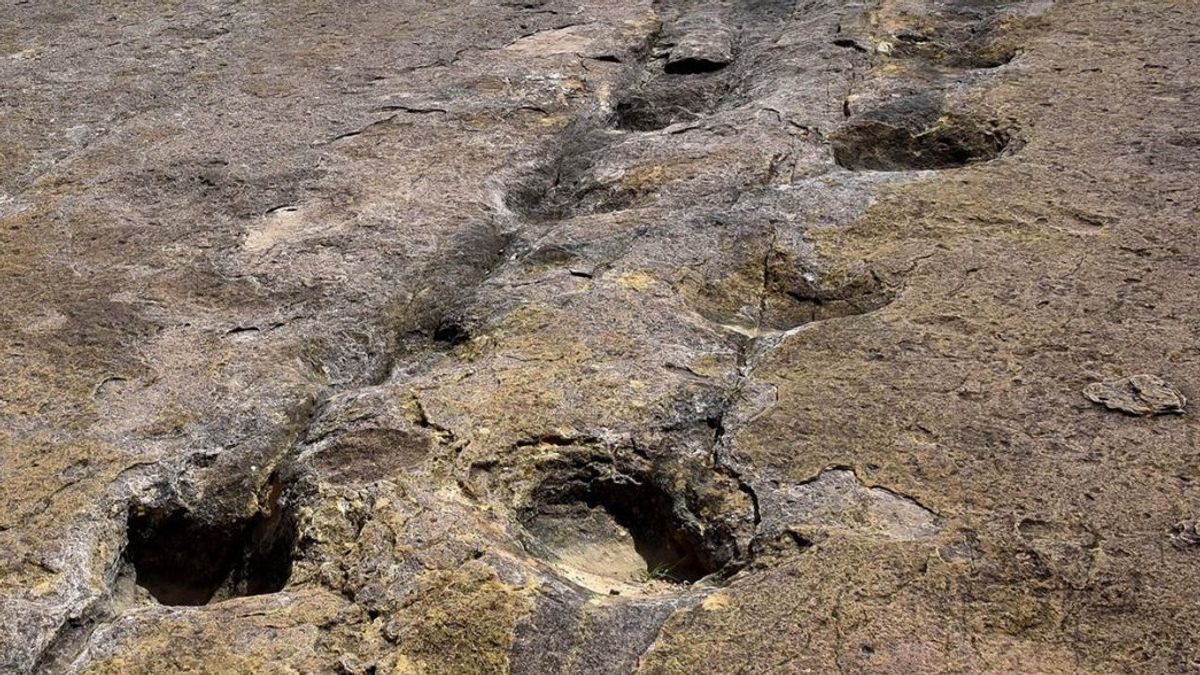


JAKARTA paleontologists managed to find tens of thousands of ancient dinosaur tracks, including footprints and swimming trajectories, at an ancient site in Bolivia, South America. This monumental discovery provides detailed evidence of a species that once crossed the ancient coastline about 115 million years ago.
Launching ABC News, Saturday, December 6, the study published in the journal PLOS One on Wednesday (3/12/2025) revealed that a total of nearly 18,000 tracks have been identified on the Carreras Pampa site inside the Torotoro National Park. The tracks cover 16,600 footprints, 1,378 swimming tracks, and several tail dragging tracks. The Carreras Pampa site, which stretches about 7,500 square meters (80,570 square feet), is now recognized as home to the world's most well-maintained dinosaur footprints and most dinosaur swimming tracks.
Most of these traces are attributed to theropods, a bipedal dinosaur group from the well-known Cretaceous Period, including Tyrannosaurus rex. The trails, which were estimated to have been made between 145 million and 66 million years ago, show how large and small dinosaurs, as well as ancient birds, moved along ancient beaches that served as their "prehistorous highway".
SEE ALSO:
-
 | BERITA
TKD Anjlok 70 Persen, Pemkab Tana Tidung Pertahankan Prioritas Pelayanan Publik
06 Desember 2025, 20:32 -
 | BERITA
Ribuan Warga New South Wales Diperintahkan Mengungsi karena Kebakaran Hutan
06 Desember 2025, 20:30

The most unique is the discovery of well-maintained dinosaur swimming tracks. The researchers suspect these tracks formed when theropods scratched the bottom of the water with their middle toe, leaving a straight or curved groove like a coma. Unlike other sites that usually display only single swimming trails, Carreras Pampa shows an alternating swimming trail between his right leg and left foot, indicating continued movement.
Trace size and depth variations also reveal a variety of species and ages that explore the region. Traces measuring less than 10 cm may be left by smaller theropods, such as Coelophysis, or by children from larger species. While traces larger than 30 cm likely belong to moderate-sized theropods such as Dilophosaurs or Allosaurs.
This research marks the first time the Carreras Pampa site has been officially studied, although paleontologists have long been aware of mass traces there. This discovery adds to Bolivia's paleontological record, which has been recognized to have one of the most extensive and diverse dinosaur track records in the world, which includes the Triass, Jura, and Cretaceous Periods.
The English, Chinese, Japanese, Arabic, and French versions are automatically generated by the AI. So there may still be inaccuracies in translating, please always see Indonesian as our main language. (system supported by DigitalSiber.id)
Most Popular Tags
#Prabowo Subianto #donald trump #firearm #8791 #giias 2026Popular


