


JAKARTA - Chairman of Commission III of the DPR, Habiburokhman, conveyed clarification regarding a number of articles deemed controversial in the Criminal Procedure Code (RKUHAP) which was ratified by the DPR yesterday.
"We are clarifying the top again, this is fake news, or actually not fake news, this is bad news, which is not right but circulating very massively in the mass media, that's why we specifically to convey this clarification," said Habiburokhman at the Parliament Complex, Senayan, Jakarta, Wednesday, November 19.
First, he straightened out that article 5 related to investigators could make arrests, prohibits leaving places, searches, and even the detention of criminal acts has not been confirmed. According to him, the accusations of this action being carried out at the investigation stage were not true.
"In the second point in article 5 that is questioned, with this article, all can be caught in a legal trap. Through the rubber article which is still under the pretext of securing it. In the old Criminal Procedure Code, the actions that are possible to be carried out at the investigation stage are very limited, absolutely not allowed to detain. Well, the statement is not true, the arrest, detention, search and confiscation in article 5 are carried out not in the investigation stage, but in the investigation stage," explained Habiburokhman.
"Then arrests, detentions, searches must be carried out very carefully, with very strict and stricter conditions than the old Criminal Procedure Code," he added.
Second, Article 16 states that the inclusion of the undercover buying and control delivery method, which was previously only for special cases such as drugs, can be used for all criminal acts. This article is accused of opening up opportunities for entanglement or engagement and engineering of criminal acts by the apparatus itself.
According to Habiburokhman, the coalition that questioned this article did not carefully follow the discussions discussed openly and directly through the DPR's YouTube live streaming.
"This coalition is lazy, not true, because it has been emulated in the explanation section. The investigation method is extended but only for special investigations, not for all criminal acts. In the explanation of article 16, the RKUHAP states that the provisions of the investigation by means of disguise, covert purchases and submission under supervision are special investigative techniques regulated in special laws, including laws on narcotics and psychotropics," he explained.
"The recording can be seen continuously on the youtube channel. So it's clear, article 16 doesn't exist that disguises for all criminal acts are only for drugs and psychotropic substances," he added.
Third, Article 105, 112a, 124, 132a regarding searches, confiscations, wiretapping, and blocking can be carried out without the judge's permission on the grounds of urgent circumstances. Habiburokhman emphasized that this assumption is also not true.
"The search for Article 113, the confiscation of Article 119, the blocking of Article 140 must be carried out with the permission of the chairman of the court. This is not true, what is the name without permission," he said.
"Then if it is done in an urgent situation which is also limitative like a geographical location that does not allow immediate approval and is caught red-handed. Still within 2x24 hours, you must ask for the judge's approval. So for example, if someone is caught red-handed, first arrest, what is his name 2x24 hours, the judge's approval," he continued.
Habiburokhman said that the regulation regarding searches, confiscations, wiretapping and blocking in the new Criminal Procedure Code was much better than the old Criminal Procedure Code.
The five, Habiburokhman corrected the assumption that RJ could become a means of extortion in the investigation stage. "This is clearly an incorrect claim, because the restorative justice mechanism can be applied from the investigation stage to examination in court," he said.
He emphasized that the RJ concept must be carried out without coercion, intimidation, or any pressure, as regulated in Article 81. KUHAP actually provides restrictions on things that can be done in a restorative justice mechanism and must be carried out without coercion, intimidation, pressure, deception, threats of violence, torture and actions that demean humanity. This is regulated in Article 81," said Habiburokhman.
Sixth, Article 8 concerning making the police the main investigator in all criminal acts. Habiburokhman then mentioned the criticism of the new Criminal Procedure Code to make the National Police a super power. He said the 1945 Constitution (UUD) had already regulated this matter.
"The only thing that regulates that what is regulated in (Article) 30 paragraph 4 of law enforcers is the National Police, actually yes," said Habiburokhman.
"The new KUHAP uses the principle of functional differentiation: the police as investigators, prosecutors as prosecutors, judges at trial, and advocates as defenders," he added.
Seventh, regarding Article 99 and Disabilities. Habiburokhman denied accusations of discrimination through an extension of detention for persons with disabilities.
"The Criminal Procedure Code does not make provisions that provide an extension of the duration of detention based on health conditions, this regulation is exactly the same as the old Criminal Procedure Code," said Habiburokhman.
He said the provisions for detention were lighter for people with disabilities. "But it also doesn't harm people with disabilities, it's even shorter time. For ordinary people, it's 20 plus 40 days, if people with disabilities are 20 plus 30 days," he continued.
Eighth, Habiburokhman clarified the claim regarding Article 137A which is said to open up opportunities for punishment indefinitely for people with mental disabilities. He said the rule did not exist.
"Try to open Article 137, in the Criminal Procedure Code 137A ... Which Astagfirulloh. Nothing, that's why we are confused about clarifying this because we don't track this down," he said.
He added that Article 146 provides protection by regulating rehabilitation or treatment for perpetrators who cannot be held accountable for their actions.
"In fact, we regulate, (Article) 146 against perpetrators of criminal acts that cannot be held accountable because people with severe mental or intellectual disabilities as referred to in the criminal law book. Courts can take actions in the form of rehabilitation and treatment," said Habiburokhman.
SEE ALSO:
-
 | BERITA
Kasus Perundungan Kembali Telan Korban, Puan Maharani: Ini Sudah Darurat
18 November 2025, 14:58 -
 | BERITA
Prabowo Setuju, Puan Ketuk Palu: RUU KUHAP Resmi jadi UU Setelah 4 Dekade Berjalan
18 November 2025, 12:28 -
 | BERITA
Puan Maharani Ungkap Alasan DPR Belum Gesit Bahas RUU Perampasan Aset
06 November 2025, 16:13 -
 | BERITA
Kondisi Membaik, Pelaku Ledakan di SMAN 72 Jakarta Akan Diperiksa Penyidik
17 November 2025, 20:33
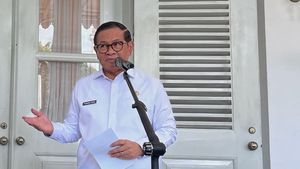
Habiburokhman emphasized that all claims on social media are untrue information. He regretted the lack of parties who directly monitored the discussion of the Criminal Procedure Code in the DPR.
"But sometimes we are a bit disappointed too, we invite them but those who attend are quiet, right... no friends at all want to oversee the discussion of this Criminal Procedure Code," he concluded.
The English, Chinese, Japanese, Arabic, and French versions are automatically generated by the AI. So there may still be inaccuracies in translating, please always see Indonesian as our main language. (system supported by DigitalSiber.id)
Most Popular Tags
#Prabowo Subianto #donald trump #Febrie Adriansyah #8791 #giias 2026Popular


