
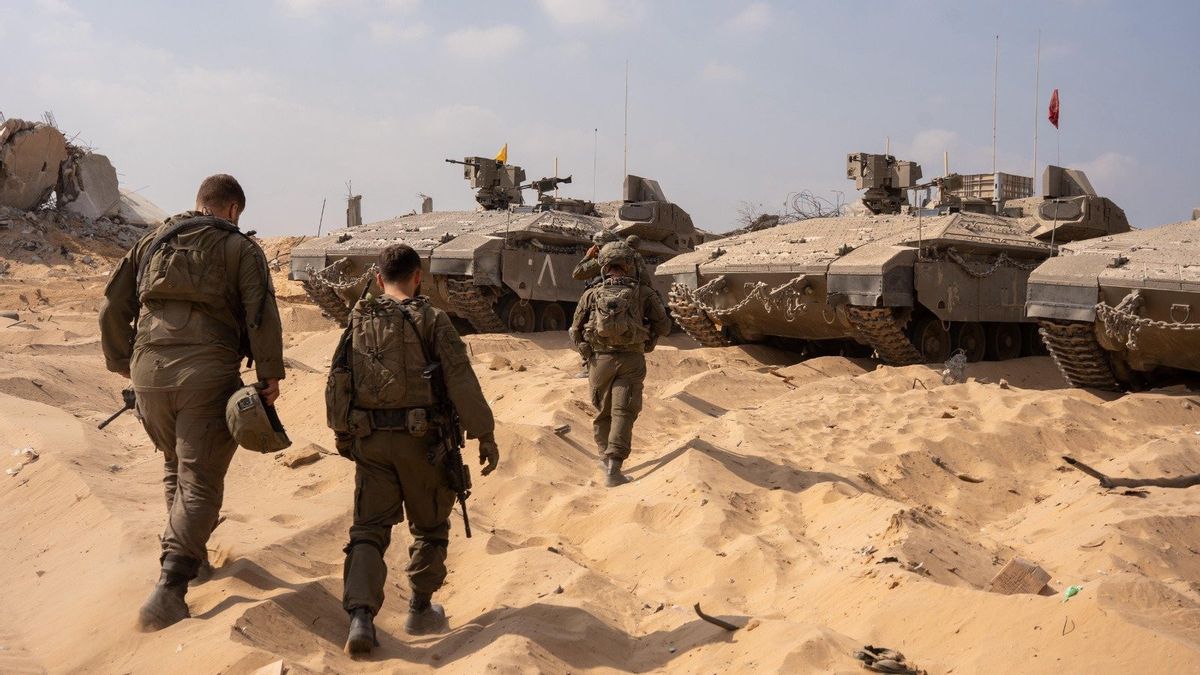


JAKARTA - Egypt is seeking assurances that proposed international stabilization forces for the Gaza Strip, postwar Palestine will not turn into occupied forces controlled by the US and Israel, several sources told The National on Monday.
Cairo's concern is one of several concerns felt by fellow Gaza mediators over a draft resolution distributed by the US to members of the UN Security Council on the formation of troops for the war-torn path.
The United States, Egypt, Qatar, and Turkey became intermediaries for the Gaza ceasefire, which took effect on October 10, halting Israel's two-year war with Hamas.
The ceasefire, along with the exchange of hostages with detainees, is the first phase of a peace plan proposed by US President Donald Trump.
The second phase, which has not yet begun, involves the formation and deployment of the Gaza Stabilization Troops (ISF). This force consists mostly of troops from Arab countries and the majority of Muslims and is tasked with maintaining security in the coastal enclave. Egypt, which borders Israel and Gaza, is widely expected to play a major role in the force.
Sources familiar with the negotiations among the four Gaza mediators said Egypt wanted to see provisions in the draft that guaranteed the troop withdrawal when its mandate ended.
Cairo also wants guarantees that the postwar government, including non-partisan Palestinian technocrats who will carry out the region's daily affairs, will not result in the termination of the enclave's ties to the occupied West Bank.
The West Bank and Gaza Strip are jointly the land of an independent Palestinian state which is expected to stand side by side with Israel, with East Jerusalem as its capital.
The two regions, basically, have separated since Hamas took control of Gaza in 2007 after a brief civil war with Fatah, a major Palestinian faction that is the backbone of the Western-backed Palestinian Authority in the West Bank.
"Egypt does not want stabilization troops to turn into occupation forces carried out secretly by the United States and Israel, or both," said one source, quoted by The National November 11.
"They ask for a clear picture of how long they will be in Gaza, the mandate, objectives, and types of weapons that will be available to its members," he continued.
According to these sources, another Egyptian concern is that the proposed Gaza troops will not be allowed to operate in the areas behind the "yellow line" that the Israeli military has drawn back as part of the ceasefire, thereby strengthening the division of the enclave and allowing Israel to control little more than 50 percent of its territory.
Egypt's concern suggests the difficulties that President Trump's plan will face, which has stalled in the first phase for a month as Hamas is unable or unwilling to hand over the bodies of all hostages who died in detention to Israel.
Another obstacle to the progress of this peace plan is the deadlock over what to do with about 200 Hamas fighters trapped in underground tunnels in several Gaza regions under Israeli military control.
The fighters are believed to have not communicated with their leadership for months. They are known to have refused to surrender to Israel and are suspected of being behind two deadly attacks against Israeli forces last month that sparked retaliatory airstrikes that killed many Palestinians.
According to the draft resolution, seen by The National in New York, the proposed troops will cooperate with Israel and Egypt, without changing their existing agreement, and along with the newly trained and selected Palestinian police.
SEE ALSO:
-
 | BERITA
Delapan Orang Tewas dalam Ledakan Mobil di Dekat Situs Bersejarah New Delhi India
11 November 2025, 06:30 -
 | BERITA
Kerangka Kerja Belum Jelas, Partisipasi UEA dalam Pasukan Internasional di Gaza Belum Pasti
11 November 2025, 05:00 -
 | BERITA
Direncanakan Kembali Jadi Kantor Presiden, Keamanan di Sekitar Cheong Wa Dae Diperketat
10 November 2025, 21:45 -
 | BERITA
Pakar PBB Sebut Tahanan Palestina di Gaza Mengalami Penyiksaan Sejak Februari 2024
10 November 2025, 21:30

The troop mandate will include stabilizing "security environments in Gaza by ensuring the demilitarization process of the Gaza Strip, including the destruction and prevention of the rebuilding of military, terror, and offensive infrastructure, as well as the permanent deactivation of weapons from non-state armed groups".
However, the sources said Egypt was against the dismantling of Hamas' forced weapons, and preferred to take over the group's collection, deactivation, and storage of heavy weapons.
The second phase of President Trump's plan to regulate the cut of Hamas weapons and the reconstruction of Palestinian enclaves. Most of the territory he built was destroyed after Israel's aggressive military campaign in response to the deadly Hamas-led attack in southern Israel in October 2023.
The English, Chinese, Japanese, Arabic, and French versions are automatically generated by the AI. So there may still be inaccuracies in translating, please always see Indonesian as our main language. (system supported by DigitalSiber.id)
Most Popular Tags
#Prabowo Subianto #donald trump #firearm #8791 #giias 2026Popular


