
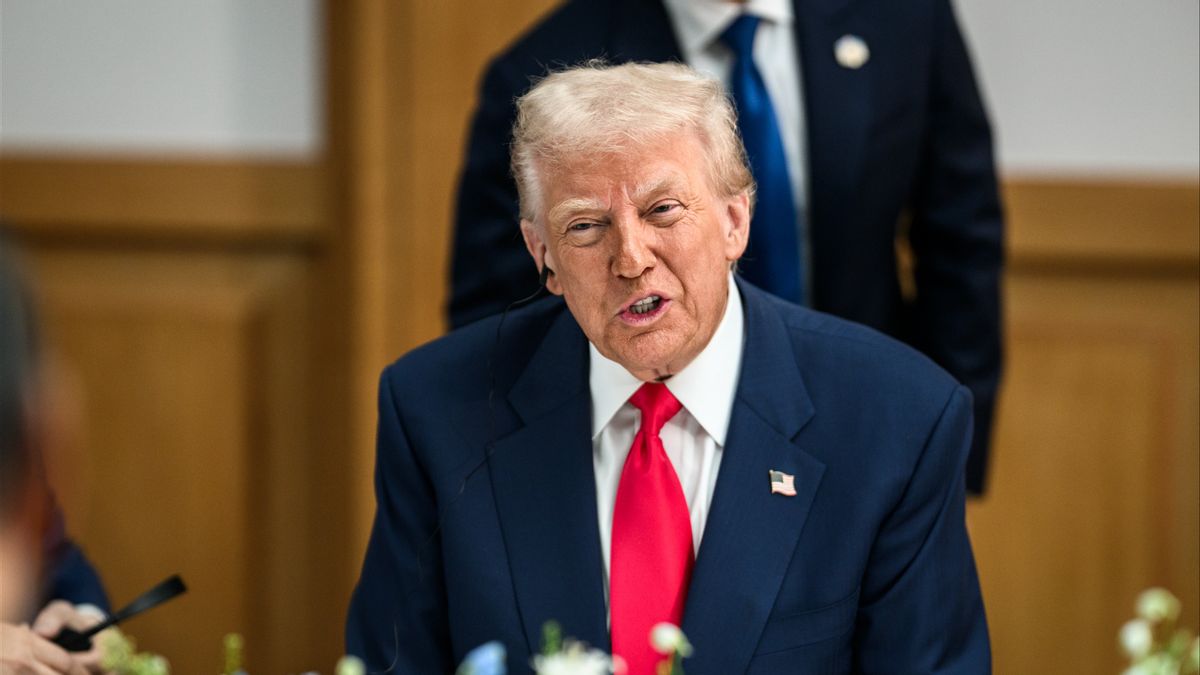


JAKARTA - US President Donald Trump will host leaders of five Central Asian countries at the White House on Thursday, as US efforts to gain influence in the region that has long been dominated by Russia and increasingly targeted by China.
Talks took place amid increasingly fierce competition for abundant Central Asian mineral resources.
Western countries are trying to diversify supply chains outside Moscow and Beijing. In particular, the US is working on a new partnership to secure important minerals, energy supplies, and land trade routes that avoid their geopolitical rivals.
Launched in 2015, the platform called C5+1 united the United States and five Central Asian countries Kazakhstan, Kyrgyzstan, Tajikistan, Turkmenistan, and Uzbekistan to advance cooperation in the fields of economy, energy and security.
Their leaders will also attend a dinner with Trump at the White House on Thursday.
Gracelin Baskara, Director at the Center for Strategic and International Studies, said the government would seek cooperation between governments, but also commercial agreements that secure US access to vital minerals.
"As China and Russia strengthen their control over the mining, processing and infrastructure systems in the region, Washington seeks to build a real foothold through targeted strategic projects," Baskaran said.
Rich in minerals and energy, the five countries remain economically bound to Russia, their former Soviet rulers, while neighboring China has expanded its influence through large-scale mining infrastructure and investments.
Together, these countries are home to about 84 million people and have reserves of uranium, copper, gold, rare earth, and other strategic minerals that are critical to global efforts to shift to a more environmentally friendly form of energy.
Kazakhstan, the largest economy in the region led by President Kassym-Jomart Tokayev, is the world's leading uranium supplier, producing nearly 40% of global production by 2024, while Uzbekistan is in the top five.
Together, they accounted for more than half of the world's uranium production of vital resources for US nuclear power, a significant US power source. Russia still supplies about 20% of American imported uranium, making diversification an increasingly pressing destination.
SEE ALSO:
-
 | BERITA
Militer Israel Gelar Serangan Udara Besar-besaran di Lebanon Selatan
06 November 2025, 22:04 -
 | BERITA
Nancy Pelosi, Eks Ketua DPR AS yang Pernah Coba Gulingkan Trump Bakal Pensiun dari Kongres
06 November 2025, 21:28 -
 | BERITA
Bakal Serang Hizbullah, Israel Minta Warga 3 Desa Lebanon Mengungsi
06 November 2025, 20:59

Under Trump, the US has implemented a multi-branch strategy to secure important minerals and reduce dependence on China, which dominates global supply chains for strategic metals including uranium, elements of rare soil, copper, and titanium.
China sometimes takes advantage of its dominance by limiting exports, which emphasizes Washington's urgency to secure alternative sources.
The English, Chinese, Japanese, Arabic, and French versions are automatically generated by the AI. So there may still be inaccuracies in translating, please always see Indonesian as our main language. (system supported by DigitalSiber.id)


