
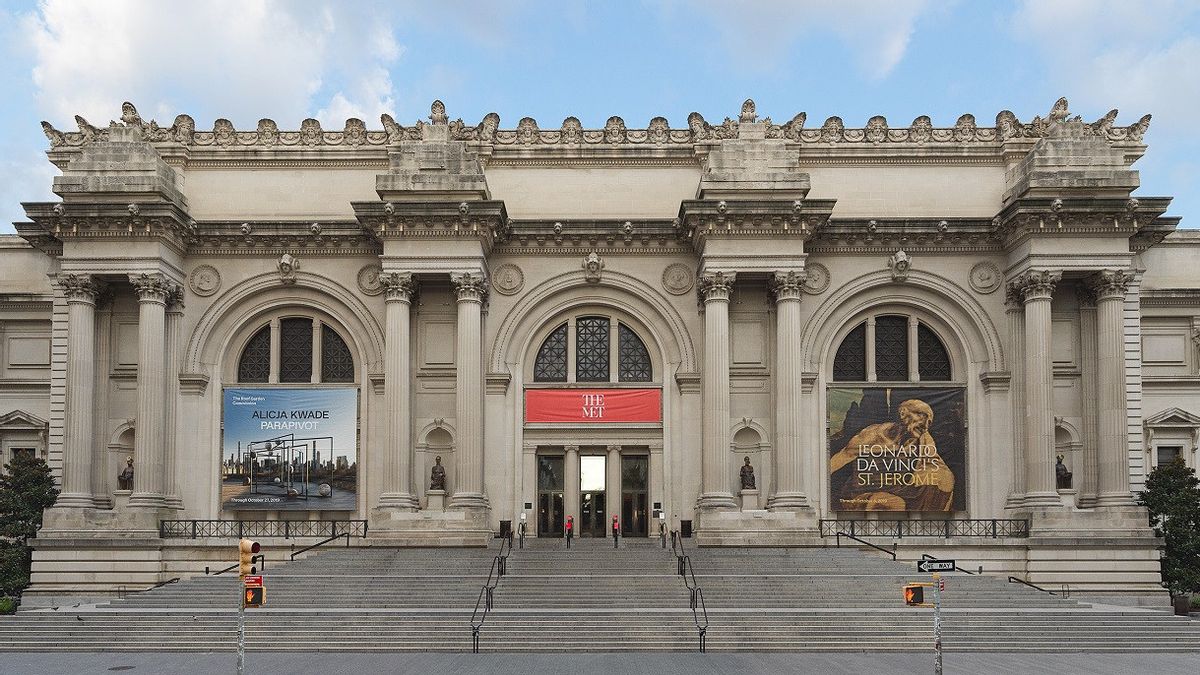


JAKARTA - Iraq managed to repatriate the 4.500-year-old ibex statue from the New York Metropolitan Art Museum (The Met), New York, United States of the latest success in its efforts to rediscover national assets and retake looted historical artifacts.
The treasure of Mesopotamia, a copper statue depicting a curly wild goat, was returned to Iraq during a ceremony at the museum in Upper East Side on Tuesday. The Iraqi Embassy in Washington said this return was "an affirmation of our natural place as the birthplace of human civilization".
"This rare work reflects the genius of our ancient civilization in metal art more than 4,500 years ago," he said, quoted from The National 1 October.
The artifact, known as the Ibex Shelter, is a copper alloy statue from the Mesopotamia Early Dynasty Period from 2600 BC to 2350 BC. This statue is tapped with shell shells, lazuli layers, and has green oxidation terma.
"This is an early example of the ritual culture of Sumeria," said Kim Benzel, the curator of the Met responsible for ancient Western Asian art, referring to the civilization founded in the Mesopotamian region between the Tigris river and Ethnic about 4,000 years ago.
The statue is also a "very, very early example, perhaps the earliest example, of a lost candle casting technique of a hollow core," Benzel said.
The process of missing wax is a casting method in which liquid metal is poured into a mold made from a wax model. After the mold is made, the wax mold melts and flows.
"This is an object that is so direct, I mean, this object really looks at you," explained Benzel.
"You feel like you're communicating with something. I'm not saying this is a holy animal, but if it's a ritual object, it seems to navigate between the human world and the holy world," he said.
The statue was purchased by the museum in 1974 and has been on display almost continuously since 1977.
"We have enjoyed and loved him so much for years," said Benzel.
These are the latest artifacts submitted by The Met to Iraq as part of the museum Cultural Property Initiative, which was launched in 2023 and includes a review of the works in its collection. Several artifacts have been returned to their homes in several countries.
In May, Iraq discovered three objects from The Met originating from the civilization of Sumeria and Babylonian from around 3000 BC to 2000 BC. Included in them is a place of Sumeria which depicts two male sheep made of abalabaster gypsum, a type of mineral and soft rock. Other objects are Babylonian ceramic statues consisting of the head of a man and a woman.
The Met and Iraq have agreed to conduct further collaborative research into the ibex statue. They have sent it for high-power scanning at the Fraunhofer Institute, a dedicated laboratory in Munich, Germany, so that researchers can better understand the casting of missing candles with hollow cores.
"Ibex in the midst of this extraordinary work of art is one of the oldest known examples of using clay cores in casting human or animal figures with wax casting lost immediately an innovative breakthrough that allows the creation of large and complex metal statues and continues to be used by artists to date," explained The Met.
"Although large-scale casting of the ancient world in the future has been extensively studied, much earlier examples of Mesopotamia have not been fully investigated to date," he added.
It is known that decades of war, instability, lack of security, and mismanagement have undermined Iraq's legacy, arts and culture.
SEE ALSO:
-
 | BERITA
42 Ribu Warga Gaza Alami Luka yang Mengubah Hidup, Seperempatnya Anak-anak
03 Oktober 2025, 18:45


After the 1991 Gulf War, when the US-led international coalition managed to fend off Saddam Hussein's invasion of Kuwait and the United Nations imposed economic sanctions on Baghdad, illegal archaeological excavations expanded, especially in remote areas where troops could not secure it.
In 2003, with Baghdad falling during the US-led invasion of Iraq that ended Saddam's regime, looters broke into the Iraqi National Museum and stole valuable artifacts, of which only a few thousand have been recovered.
The looters continue to dig in unprotected archaeological sites, which have left hundreds of artifacts emerging in overseas markets. With the help of the international community, Iraq has managed to rediscover thousands of artifacts around the world in recent years, especially from Uncle Sam's country.
The English, Chinese, Japanese, Arabic, and French versions are automatically generated by the AI. So there may still be inaccuracies in translating, please always see Indonesian as our main language. (system supported by DigitalSiber.id)
Most Popular Tags
#Prabowo Subianto #donald trump #firearm #8791 #giias 2026Popular


