

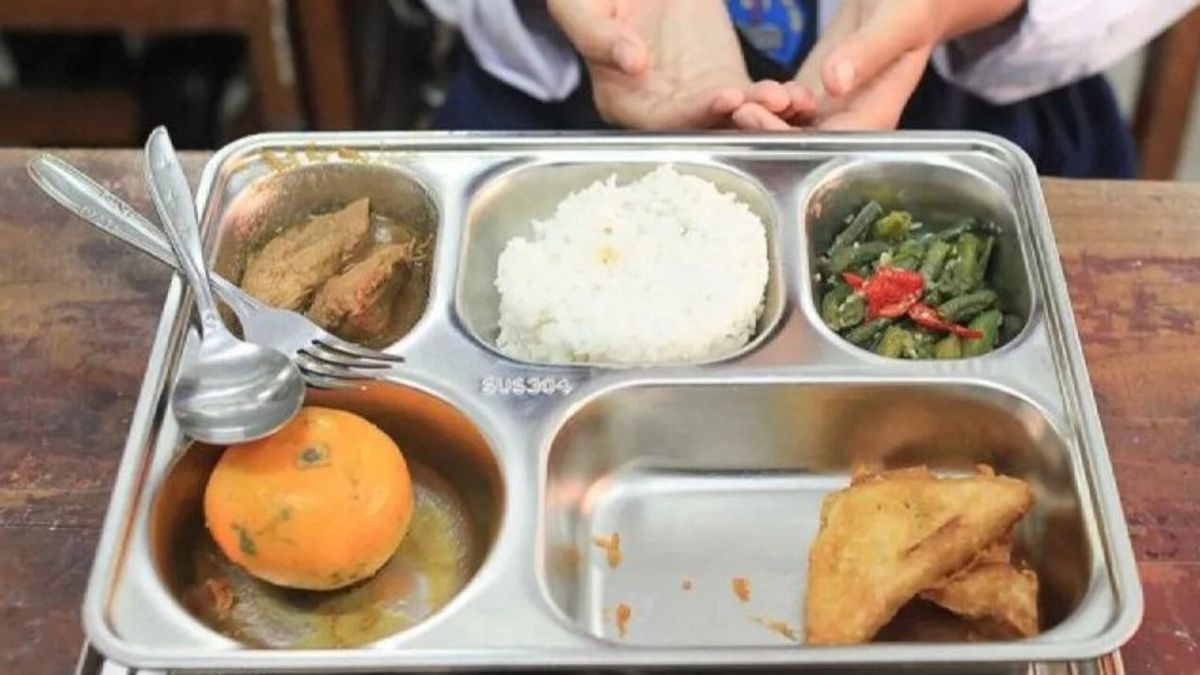


JAKARTA - DKI Jakarta's Rabithah Regional Management Ma'aid Islamiyah Nahdlatul Ulama (RMI-NU) assesses that the use of domestic products to support the Free Nutrition Food (MBG) program has many impacts on the economy.
Head of RMI NU DKI Jakarta Kiai Haji Rakhmad Zailani Kiki said, one of the impacts was increasing employment because more industries were producing, the more workers they needed.
"Purchase of domestic products can also increase state tax revenue because the proceeds from sales to MBG kitchens will contribute taxes, especially from Value Added Tax (VAT) and Income Tax (PPh) 21 employees, as well as bring in revenue for the state from the tax sector," said Rakhmad as quoted by ANTARA, Sunday, September 28.
Therefore, his party fully supports the government's steps which have decided to use domestic products to run the MBG program.
"Let's use local goods that are certain to comply with SNI standards so that they are safe for health, also meet halal principles because our local industry is definitely more accountable," he said.
Similarly, the General Secretary of the Indonesian Food Forum Producers Association (Apmaki) Ardy Susanto revealed that the domestic industry has been able to produce cooking and eating utensils as well as food containers for the MBG program.
He also ensured that cooking utensils to food routes from domestic industries already had Indonesian National Standards (SNI).
"This is also halal certified, in the production process it does not use animal lubricants. That is the commitment we can hold," said Ardy.
Ardy also said that the domestic industry was able to produce around 82.9 million cooking and eating utensils within one year to support the MBG program.
According to him, local products are thicker and stronger because they use materials with thickness from 0.4 millimeters to 0.5 millimeters, weighing between 570 grams to 680 grams.
Meanwhile, he continued, imported food containers use a material thickness of 0.3 mm to 0.38 mm, weighing between 420 grams to 470 grams.
In addition, he said, the availability of spare parts is also more secure when using local food containers.
Thus, Ardy said that if you want to buy a body or cover the food container, it can be available, while if imported products have to buy one more series and are not available for spare parts.
On the other hand, he said local food forum products guarantee the authenticity of SUS 304 raw materials with certificates that can be shown and can be in accordance with the newly published SNI forum, namely SNI 9369:2025.
It was added that local products also met the TKDN (Domestic Component Level) requirements and had a halal certificate as required by Law (UU) Number 33 of 2014 concerning Halal Product Guarantee.
Furthermore, Ardy also admitted that he agreed about the economic impact of the use of domestic products.
In addition to being able to absorb labor and increase state revenue through taxes, he said, the use of domestic products can increase investment.
This is because the more production, the more purchases, both capital and raw materials that will be produced, will increase investment in the country.
SEE ALSO:
-
 | BERITA
Kurir Paket di Bekasi Dianiaya Gegara COD Rp30 Ribu, Pelaku Serahkan Diri ke Polisi
28 September 2025, 12:15 -
 | BERITA
Pengelola Putar Otak agar Keberlangsungan Bandung Zoo Bukan Sekadar Tempat Rekreasi
28 September 2025, 12:13 -
 | BERITA
Dukungan 2 Periode: Kecemasan Jokowi, Gibran dan Relawan Ditinggalkan Prabowo
28 September 2025, 12:08
Tak hanya itu, lanjut dia, penggunaan produk dalam negeri bisa memajukan sektor industri kecil dan menengah yang menjadi tulang punggung perekonomian Indonesia selama ini.
Hal itu termasuk terjadinya hilirisasi produk baja dari hulu, penyedia bahan baku, industri menengah yang mengolah bahan baku menjadi barang setengah jadi, dan industri hilir yang mengolah bahan baku setengah jadi menjadi barang jadi sehingga nilai tambah produk baja meningkat.
SEE ALSO:
-
| BERITA
Kurir Paket di Bekasi Dianiaya Gegara COD Rp30 Ribu, Pelaku Serahkan Diri ke Polisi
28 September 2025, 12:15 -
| BERITA
Pengelola Putar Otak agar Keberlangsungan Bandung Zoo Bukan Sekadar Tempat Rekreasi
28 September 2025, 12:13 -
| BERITA
Dukungan 2 Periode: Kecemasan Jokowi, Gibran dan Relawan Ditinggalkan Prabowo
28 September 2025, 12:08
Not only that, he continued, the use of domestic products can advance the small and medium industry sector, which has been the backbone of the Indonesian economy so far.
This includes downstream steel products from upstream, raw material providers, medium industries that process raw materials into semi-finished goods, and downstream industries that process semi-finished raw materials into finished goods so that the added value of steel products increases.
The English, Chinese, Japanese, Arabic, and French versions are automatically generated by the AI. So there may still be inaccuracies in translating, please always see Indonesian as our main language. (system supported by DigitalSiber.id)
Most Popular Tags
#Prabowo Subianto #donald trump #Febrie Adriansyah #8791 #giias 2026Popular


