
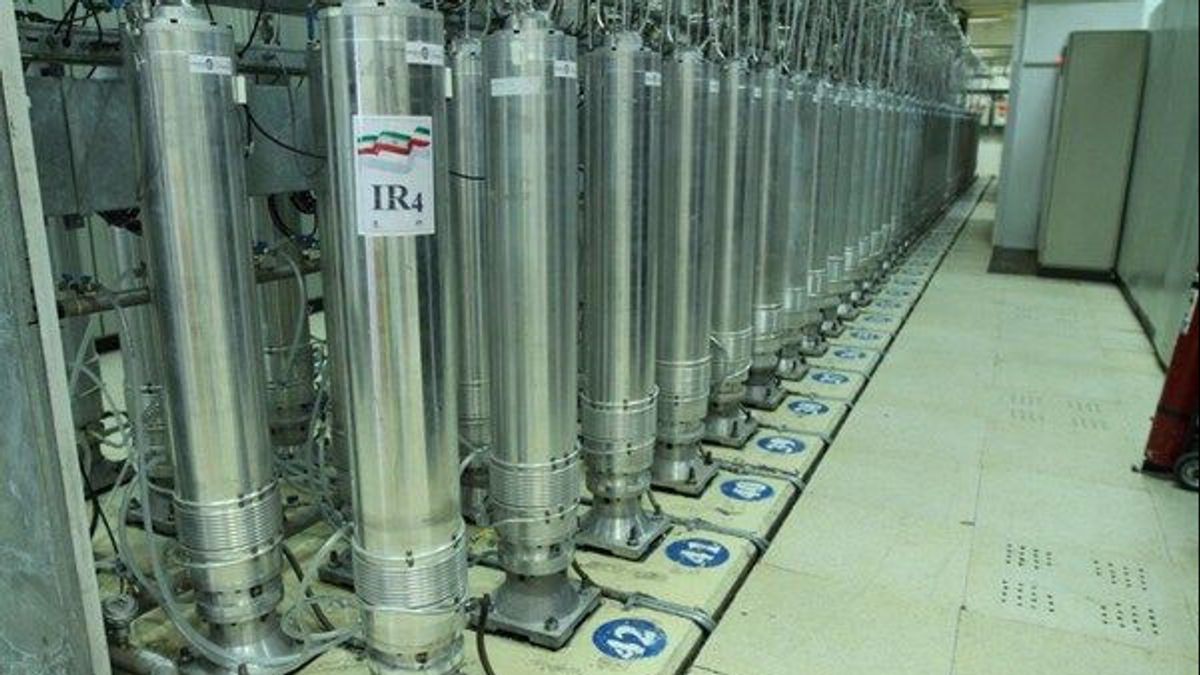


JAKARTA - Iran and the UN nuclear watchdog said on Tuesday they had reached an agreement to continue inspections at locations, including those bombed by the United States and Israel, but gave no further details.
The agreement reached between International Atomic Energy Agency (IAEA) Head Rafael Grossi and Iranian Foreign Minister Abbas Araqchi at a meeting in Cairo, Egypt will in principle pave the way for the full resumption of inspections disrupted by military attacks on Iran's nuclear facilities in June.
However, diplomats warn the details are critical, and neither Grossi nor Foreign Minister Araghchi provide any details in a joint press conference regarding their agreement that includes what the IAEA calls "modality" about how inspections can proceed.
"In Cairo today, (I) agreed with the Iranian Foreign Minister on practical modalities to continue inspection activities in Iran," Grossi tweeted on social media X.
"This is an important step in the right direction," he said.
The deal comes amid continued threats from European countries to reimpose broad sanctions against Iran that have been lifted under the 2015 nuclear deal between Iran and major countries.
The European countries - France, Britain and Germany (E3) - have started the so-called "snapback" process which will last until the end of this month.
They said they would only delay completion if Iran allowed further inspections, reported its highly enriched uranium stock, and held nuclear negotiations with the United States.
The framework agreement reached on Tuesday aims to address the first two terms, but it's not yet clear whether or not it can be reached enough at this month's deadline to satisfy the European side and ward off snapshots for a while.
Tehran warned the West that the deal would be null and void if sanctions were reinstated.
"I need to emphasize: if there is an act of hostility against Iran including the re-implementation of UN Security Council resolutions that have been canceled Iran will consider these practical steps null and void," Foreign Minister AragCHI said in a statement, referring to the resolution of sanctions.
Although Iran's enrichment site has been badly damaged or destroyed, it remains unclear what is happening to its stock, which includes enriched uranium to 60 percent purity, just one step away from about 90 percent of the quality of weapons.
SEE ALSO:
-
 | BERITA
Presiden Palestina Kecam Serangan Israel yang Menyasar Petinggi Hamas di Qatar
10 September 2025, 10:15 -
 | BERITA
PM Orban Sebut UE Manfaatkan Konflik Ukraina untuk Menciptakan 'Amerika Serikat Eropa'
10 September 2025, 10:00 -
 | BERITA
Presiden Trump Sebut Serangan Israel ke Qatar Merupakan Keputusan Netanyahu
10 September 2025, 08:30 -
 | BERITA
Pejabatnya Tidak Ada yang Tewas dalam Serangan Israel di Doha, Hamas: Langkah Pengecut
10 September 2025, 07:00 -
 | BERITA
Indonesia Kecam Serangan Israel ke Doha Sebagai Pelanggaran Keras Hukum Internasional
10 September 2025, 06:15
Iran had enough enriched material to that extent before the attack, if further enriched, for 10 nuclear weapons, according to the IAEA benchmark and data from a report by the IAEA quarter that was sent to member states last week.
Earlier, shortly after the US and Israeli attacks, Iran's parliament passed a law suspending cooperation with the IAEA and stipulated that any inspection should be approved by Iran's Supreme National Security Council.
Grossi told Reuters in last week's interview the talks were aimed at aligning the new obligations imposed by Iran's new law on Tehran with Iran's longstanding obligation as a party to the IAEA-supervised Nuclear Non-Proliferation Treaty, which Grossi said remained unchanged.
The English, Chinese, Japanese, Arabic, and French versions are automatically generated by the AI. So there may still be inaccuracies in translating, please always see Indonesian as our main language. (system supported by DigitalSiber.id)
Most Popular Tags
#Prabowo Subianto #donald trump #firearm #8791 #giias 2026Popular


