

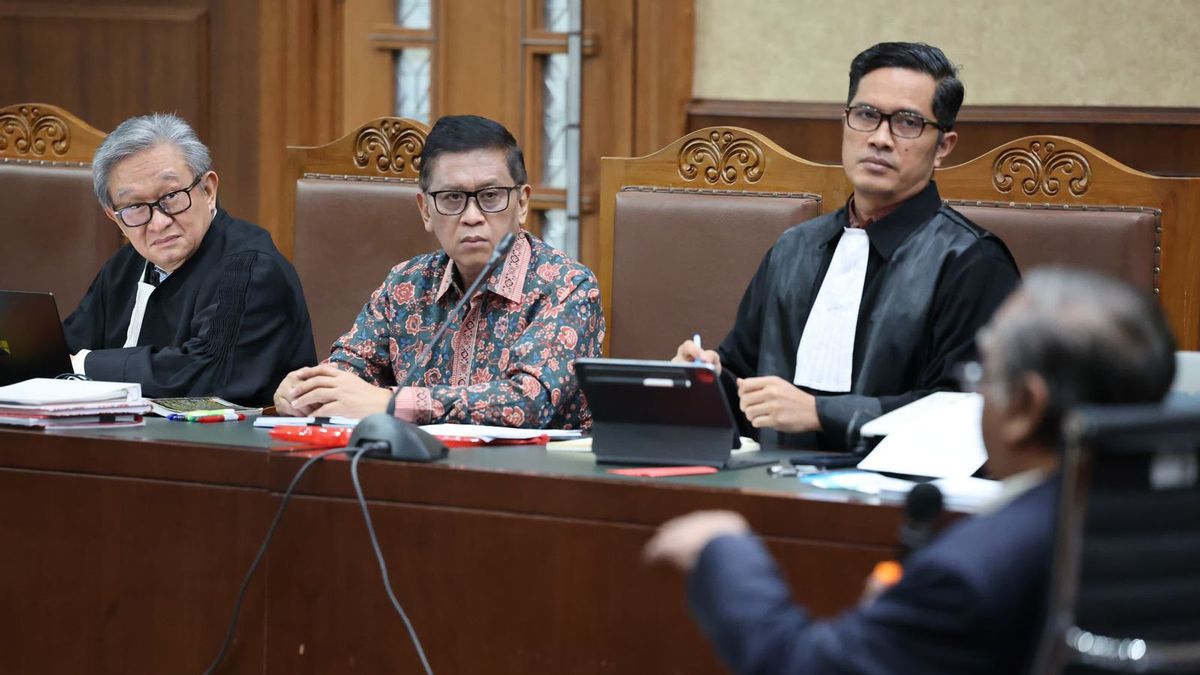


The Secretary General (Sekjen) of the PDIP, Hasto Kristiyanto, said that the demands for seven years in prison and a fine of Rp600 million against him were not the will of the Public Prosecutor (JPU), but orders from 'power'.
This was conveyed when reading the duplicate to answer the replica of the Public Prosecutor (JPU) at the trial of the alleged bribery case for the management of the replacement between the time (PAW) of the DPR for the 2019-2024 period and the obstruction of the investigation of Harun Masiku.
"I and the legal advisory team believe that the decision to file a 7-year lawsuit is not from the Public Prosecutor, but as a 'order of strength' beyond the will of the Public Prosecutor," said Hasto in a trial at the Jakarta Corruption Court, Friday, July 18.
This allegation, said Hasto, was because there were indications of influence from forces outside the Corruption Eradication Commission (KPK) that had occurred for a long time.
The influence of power is like the case of the leak of an investigation warrant (Sprindik) of the former chairman of the Democratic Party, Anas Urbaningrum, and the case of the former chairman of the KPK, Antasari Azhar.
The case of the leaking of Sprindik against Anas Urbaningrum is known to have dragged the chairman of the 2011 '2015 KPK, Abraham Samad. Meanwhile, the case that ensnared Antasari was a legal case in 2009 when he was suspected of being involved in the murder of the Director of Putra Rajawali Banjaran, Nasrudin Zulkarnaen.
"The leaking case of Sprindik Anas Urbaningrum, for example, is also a problem that befell former KPK chairman Antasari Azhar, which is very thick about how power or political power outside has affected the KPK," said Hasto.
Hasto emphasized that what Anas and Antasari experienced happened again. This time, in the case that ensnared him.
"Because that is the second dimension, the struggle for the realization of the rule of law is much more strategic, long-term, but urgent," said Hasto.
"The meaning of this struggle is also much bigger than being free from prison walls. Because the strength that plays in my case really exists," he continued.
In addition, Hasto also questioned the demand for a fine of Rp. 600 million came from the conscience of the KPK prosecutor. Because, it feels strange because there is no state loss in this case.
"This question is important, because the Public Prosecutor also has professional and ethical responsibilities. The names of the Public Prosecutors will become historical records in law enforcement that should be fair. Moreover, with a fine of Rp. 600 million, it is really very strange. This case does not have state losses. The state must also not seek profit from the legal criminalization suffered by citizens who should be protected," said Hasto.
Hasto was charged by the Public Prosecutor (JPU) with imprisonment for 7 years. In addition, the prosecutor also charged Hasto Kristiyanto with a fine of Rp. 600 million. If it is not paid, it will be replaced with a prison sentence of 6 months.
In this case, Hasto was charged together with advocate Donny Tri Istiqomah, former PDIP cadre Saeful Bahri, and Harun Masiku were charged with giving bribes of Rp 600 million to Wahyu Setiawan (KPU commissioner) in the 2019-2020 period.
SEE ALSO:




SEE ALSO:
This bribe is so that Wahyu seeks the KPU to approve the application of PAW for the South Sumatra Election Candidate (Sumsel) I on behalf of DPR members for the 2019-2024 period Riezky Aprilia to Harun Masiku.
Hasto was also charged with obstructing the investigation by ordering Harun, through the Aspiration House guard, Nur Hasan, to submerge Harun's cell phone into the water after the KPK OTT incident against Wahyu Setiawan.
Not only Harun Masiku's cellphone, Hasto is also said to have ordered his aide, Kusnadi, to drown his cell phone in anticipation of forced attempts by KPK investigators.
Hasto was charged with Article 21 and Article 5 paragraph (1) letter a or Article 13 of Law (UU) Number 31 of 1999 concerning Eradication of Criminal Acts of Corruption as amended and supplemented by Law Number 20 of 2001 in conjunction with Article 65 paragraph (1) and Article 55 paragraph (1) 1 in conjunction with Article 64 paragraph (1) of the Criminal Code.
The English, Chinese, Japanese, Arabic, and French versions are automatically generated by the AI. So there may still be inaccuracies in translating, please always see Indonesian as our main language. (system supported by DigitalSiber.id)
Most Popular Tags
#Prabowo Subianto #donald trump #2026 World Cup #Febrie Adriansyah #8791Popular


