

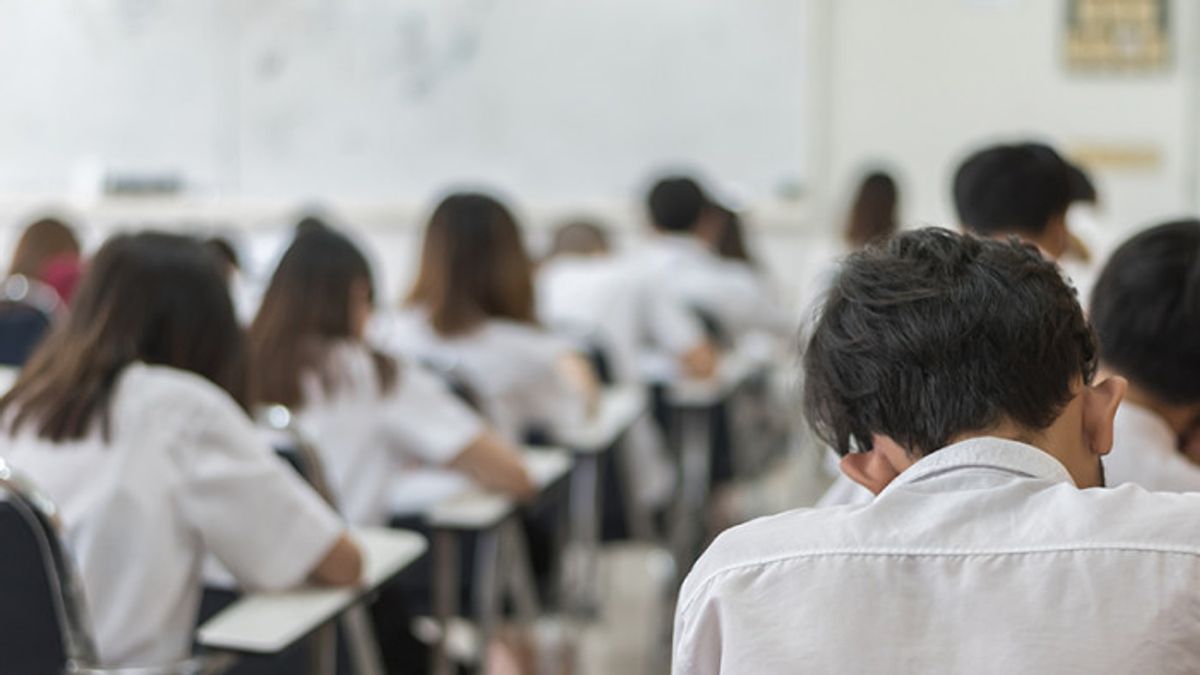


BANDUNG Deputy Chairman of the West Java DPRD, Iwan Suryawan, highlighted the big challenges in the implementation of the 2025 New Student Admissions (PPDB). Although the Constitutional Court has decided that primary education in private schools is free, its implementation is considered unclear and has the potential to cause problems in the field.
According to Iwan, the limited capacity of public schools is still a major problem, especially for underprivileged people. It is feared that this condition could encourage an increase in the number of school dropouts.
If this policy has not actually been implemented in the 2025 school year, parents who cannot afford it will have difficulty sending their children to school. In fact, West Java has always been a national barometer. The number of schools is the most, and the polemic can also be high," he said, Sunday, June 1.
This issue surfaced after the issuance of Constitutional Court Decision Number 3/PUU-XXII/2024 which granted part of the judicial review of Article 34 paragraph (2) of the National Education System Law. In its ruling, the Constitutional Court stated that the phrase "obligatory to study at least at the basic education level without charge" also applies to private schools, not only public schools.
Chief Justice of the Constitutional Court Suhartoyo emphasized that the central and regional governments are obliged to guarantee free basic education in all types of schools. However, the Constitutional Court also provides space for private schools to continue to charge, as long as it does not conflict with applicable regulations. Educational assistance for poor students will only be given to private schools that meet certain criteria.
Constitutional Justice Enny Nurbaningsih said that limiting the exemption from education costs only for public schools had created gaps. Many students from underprivileged families finally have to pay dearly in private schools because they are not accommodated in public schools.
Iwan assessed that the Constitutional Court's decision needed to be followed up immediately through policy adjustments and budgeting, especially to help finance poor students in private schools.
"PPDB will take place almost simultaneously, while the capacity of public schools is limited. There are only two options: to enter private schools or not to go to school at all," he said.
Data from the Ministry of Education and Culture Dapodik shows that out of a total of 19,628 elementary schools in West Java, 16,983 are public schools and 2,645 private schools. At the junior high school level, out of 6,169 schools, only 1,998 have state status. This means that the higher the level of education, the smaller the chance of entering public schools.
Meanwhile, the Constitutional Court policy only applies to primary education (SD and SMP). In fact, most of the current work requirements require high school or vocational diplomas. In West Java, there are 4,171 high schools with details of 1,853 countries and 2,318 private countries, as well as 2,924 vocational schools, of which only 288 are state-owned.
Iwan also highlighted the importance of supervision during the PPDB process, including preventing the practice of students being entrusted to favorite schools that are not in accordance with zoning. He encouraged the involvement of the Education Office and the Population and Civil Registration Office in the process of verifying prospective students' data.
"Don't let students who excel get eliminated because of fraudulent practices," he said.
In the midst of this situation, West Java Governor Dedi Mulyadi expressed his commitment to free education up to the SMA/SMK level, both in public and private schools.
"My target is education for at least 12 years for all children in West Java," said Dedi after a meeting with the West Java DPRD Budget Agency on May 22, 2025.
Dedi called the acceleration of public school development and the provision of subsidies to poor students in private schools as the main strategy.
"If public schools are automatically free. But those who are not accommodated and come from underprivileged families must also still be able to go to free schools in the private sector," he said.
SEE ALSO:
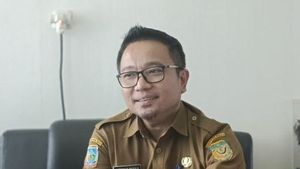

Iwan supports this step, but emphasizes the importance of close coordination between local and central governments, as well as strengthening regulations and budgets at the provincial level.
"Because West Java has the highest population and schools in Indonesia, success or failure will be in the national spotlight," he concluded.
The English, Chinese, Japanese, Arabic, and French versions are automatically generated by the AI. So there may still be inaccuracies in translating, please always see Indonesian as our main language. (system supported by DigitalSiber.id)
Most Popular Tags
#Prabowo Subianto #donald trump #firearm #8791 #giias 2026Popular


