

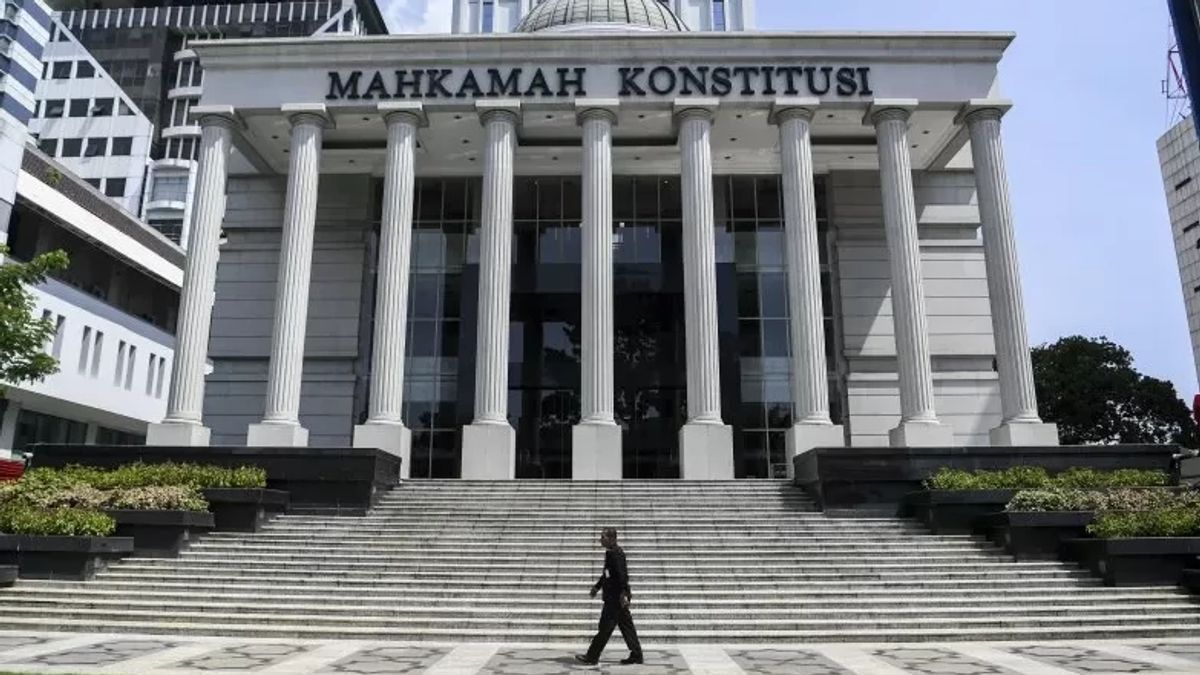


JAKARTA - The Constitutional Court has decided that articles on attacking honors or good names regulated in Law Number 1 of 2024 concerning Electronic Information and Transactions (UU ITE) are excluded for government institutions to groups of people with specific identities.
"Granted the Petitioner's petition in part," said Chief Justice of the Constitutional Court Suhartoyo reading the verdict No. 105/PUU-XXII/2024, in the Plenary Court Session Room, Jakarta, Tuesday, April 29.
In its decision, the Constitutional Court stated that the phrase other people' in Article 27A and Article 45 paragraph (4) of the ITE Law contradicts the 1945 Constitution of the Republic of Indonesia and has no conditional binding law as long as it is not interpreted except for government institutions, a group of people with specific or specific identities, institutions, corporations, professions or positions.
Article 27A of the ITE Law regulates actions that are prohibited in activities related to ITE. The article initially reads "Everyone deliberately attacks the honor or good name of others by accusing something of something, with the intention that it is known to the public in the form of electronic information and/or electronic documents carried out through electronic systems."
SEE ALSO:



Meanwhile, Article 45 paragraph (4) of the ITE Law contains criminal provisions on Article 27A. This article stipulates that anyone who violates Article 27A of the ITE Law can be sentenced to a maximum imprisonment of two years and/or a maximum fine of Rp. 400 million.
In legal considerations, the Constitutional Court stated that there was an uncertainty in the limitation of the phrase other people'' in Article 27A of the ITE Law so that the norm of the article was vulnerable to misuse. In fact, Article 433 paragraph (1) of the Criminal Code 2023 which will take effect in 2026, also using the phrase other people'' to refer to victims of defamation.
Referring to Article 433 paragraph (1) of the Criminal Code 2023, it has actually been determined that parties cannot become victims of criminal acts of defamation, namely government institutions or a group of people.
On the other hand, the provisions of Article 27A of the ITE Law are also related to Article 45 paragraph (7) of the ITE Law which states that acts of attacking honor or good name cannot be punished if the act is carried out for the public interest or because it is forced to defend itself.
This general interest, as explained in the explanation section of Article 45 paragraph (7) of the ITE Law, is in order to protect the interests of the community which are expressed through the rights of expression and democracy such as demonstrations or criticism.
According to the Court, in a democratic country, criticism is important as part of freedom of expression that is as constructive as possible, even though it contains disapproval of other people's actions or actions.
Basically, added the Constitutional Court, Article 27A of the ITE Law is a form of supervision, correction, and advice on matters relating to the interests of the community. This means that constructive criticism, in this case against government policies for the benefit of the community, is an important thing as a means of balancing or public control which must be guaranteed in a democratic state of law.
"The limitations of the right to freedom of opinion and expression will actually erode the control function or supervision which is a necessity so that there is no abuse of power, abuse of power, in the administration of government," said Constitutional Justice Arief Hidayat reading out the Court's considerations as reported by Antara.
Furthermore, the Court emphasized that Article 27A and its relation to Article 45 paragraph (5) of the ITE Law is a criminal act with a complaint offense. This means that this action can be prosecuted for complaints from victims or people affected by criminal acts or who have been defamed.
"In this regard, according to the Court, so that there is no arbitrariness of law enforcement officers in applying the phrase 'other people' Article 27A of the ITE Law, it is important for the Court to emphasize that what is meant by the phrase 'other person' is an individual or an individual,' said Arief.
Therefore, it is excluded from the provisions of Article 27A of the ITE Law if those who are victims of defamation are not individuals or individuals, but government institutions, groups of people with specific or certain identities, institutions, corporations, professions or positions.
This request for judicial review was submitted by Daniel Frits Maurits Tangkilisan, an environmental activist for the Coalition of the Indonesian Guard Lestari (Kawali) who was convicted by the Jepara District Court for his video content criticism of the condition of the pond in Karimunjawa, Central Java. He was later released by the Semarang High Court.
The English, Chinese, Japanese, Arabic, and French versions are automatically generated by the AI. So there may still be inaccuracies in translating, please always see Indonesian as our main language. (system supported by DigitalSiber.id)


