

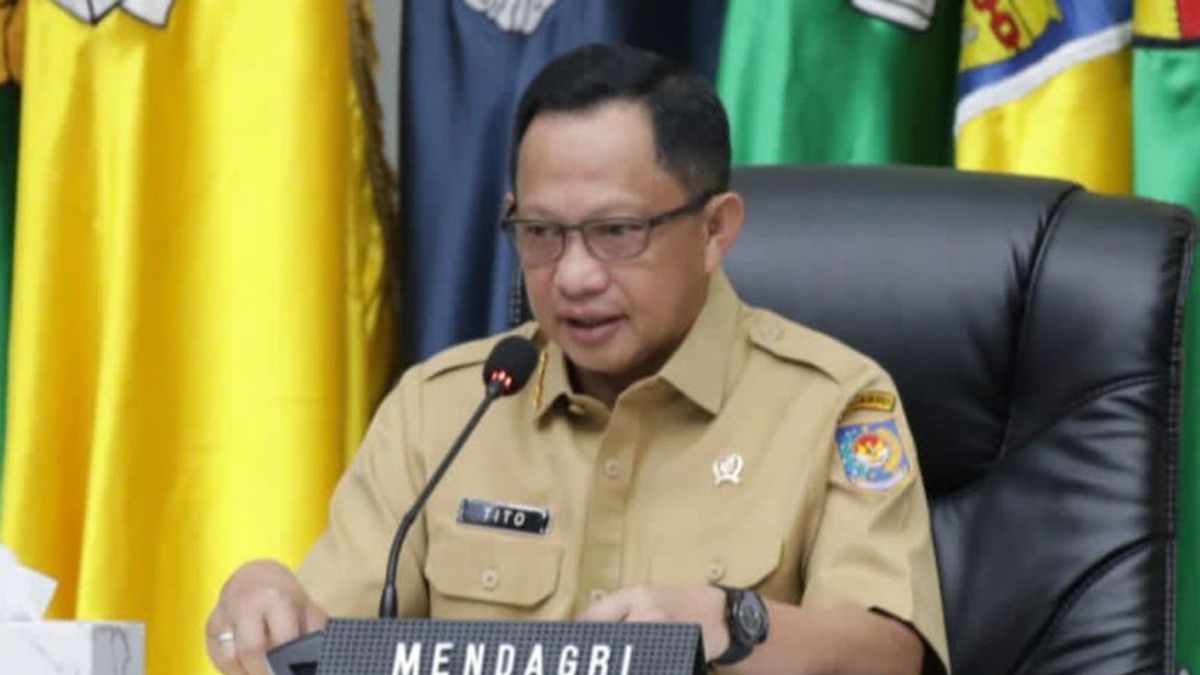


JAKARTA - Minister of Home Affairs (Mendagri) Muhammad Tito Karnavian opens the opportunity to revise Law Number 17 of 2013 concerning Community Organizations (UU Ormas).
This discourse emerged in response to the increasing number of cases of irregularities and acts of violence committed by a number of community organizations in Indonesia, which were considered to have started to emerge from their initial goals as a forum for the aspirations of civil society.
Tito said that the role of mass organizations as part of the democratic system needs to be maintained, but in practice, not a few mass organizations are transformed into groups with a coercive tendency, and even openly commit violence.
"We have seen a lot of events of mass organizations that have gone too far. Maybe there needs to be a strict monitoring mechanism. Among them, maybe financial problems, financial audits," Tito said, quoted from ANTARA, Friday, April 25.
According to him, the post-reformed 1998 Ormas Law was made in the spirit of democratization, to ensure freedom of assembly and association.
But on its way, this freedom began to be abused by a handful of parties. A number of organizations that were previously active in social activities and advocacy, have now changed their functions to pressure groups, and have even behaved like their own apparatus in the community.
One of the important aspects that Tito is in the spotlight is the weak supervision of mass organizations, especially in terms of transparency of financial funds and accountability.
He considered that the unclear flow of funds in many mass organizations opened up opportunities for misuse of public funds or the contribution of members used for activities outside the social interests of the community.
"When the mass organization funds are not audited and are not transparent, this has the potential to be misappropriated for the agenda of power, including violence and extortion. If it is systematic and there is an organizational order, it can be categorized as corporate crime," said Tito.
He added that currently there is no strong enough legal instrument to audit and take action against mass organizations as a whole when violating the legal limits. Therefore, the revision of the Ormas Law is considered important to rearrange the boundaries of organizational responsibility and tighten supervision regulations.
This statement by the Minister of Home Affairs comes along with the increasing public spotlight on the involvement of mass organizations in recent acts of violence. At least two events in recent weeks have triggered discussions about the need for supervision and reformation of mass organizations.
Deputy Chairman of the MPR Eddy Soeparno revealed that the construction of the BYD electric car factory in Subang was disturbed by a number of mass organizations. This disruption is reportedly related to unilateral demands from certain groups, who try to force involvement in projects without official procedures.
The second incident occurred in Jakarta, when four members of the United Indonesia People's Movement (GRIB) Jaya set fire to police patrol cars.
This incident is in the spotlight because it shows that mass organizations can act brutally and openly against state officials. The case is currently being handled by the police as a pure crime.
Tito stated that the discourse on revising the Ormas Law must go through a legislative process in accordance with legal procedures. The government, he said, would submit a proposal script to the DPR if it was ready. After that, discussions will be carried out openly with members of the legislature and civil society.
"If there is a proposal from the government, it will be submitted to the DPR. The DPR discusses and decides," said Tito.
SEE ALSO:


In addition to the revision of the law, Tito also emphasized the importance of law enforcement against violations committed by mass organizations. He emphasized that acts of violence should not be tolerated and must be dealt with according to the applicable law.
"If it is a crime, it must automatically be dealt with. A criminal process. It must enforce the law so that security stability is maintained," he said.
With the discourse on revising the Ormas Law, the government wants to emphasize that freedom of association is not absolute freedom. The state still has an obligation to maintain stability, public order, and prevent the birth of thuggery that takes refuge behind organizational attributes.
The English, Chinese, Japanese, Arabic, and French versions are automatically generated by the AI. So there may still be inaccuracies in translating, please always see Indonesian as our main language. (system supported by DigitalSiber.id)
Most Popular Tags
#Prabowo Subianto #donald trump #Febrie Adriansyah #8791 #giias 2026Popular


