
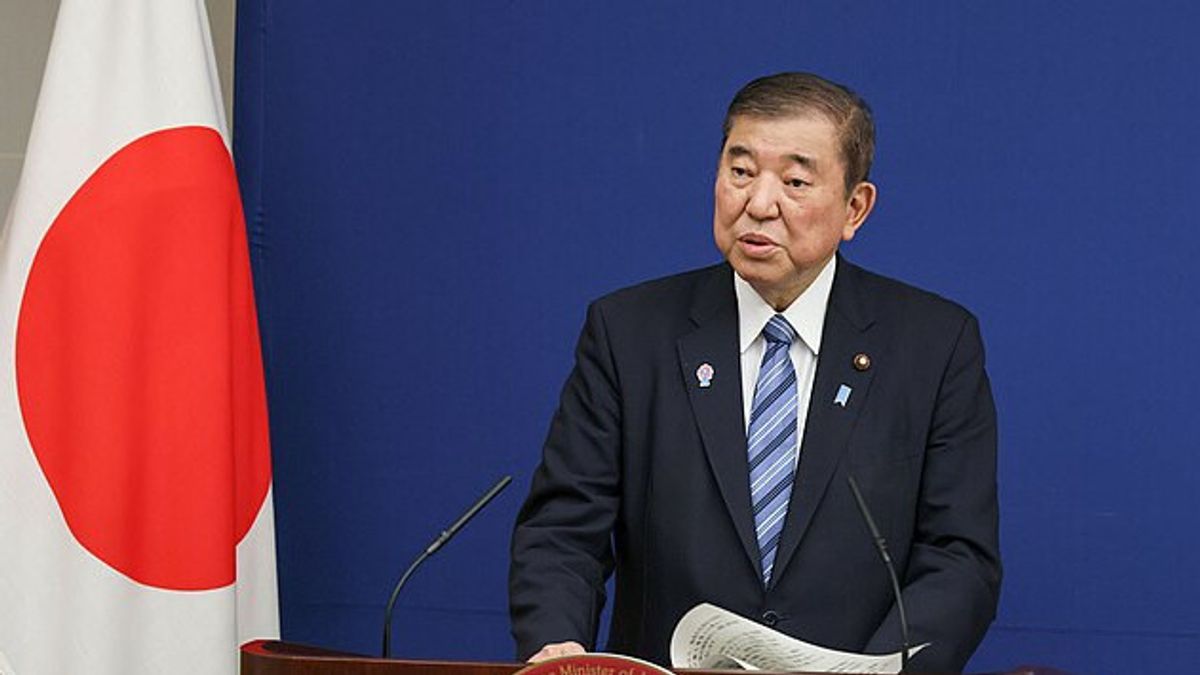


Japanese Prime Minister Shigeru Ishiba said his country had no plans to make a big concession and would not rush to reach an agreement in future rate negotiations with US President Donald Trump's administration.
Japan, an longtime US ally, is subject to a 24% tariff over its exports to the United States despite this rate, such as most Trump's "returns" rates, being postponed for 90 days.
However, the universal 10% tariff remains in effect, as does the 25% import duty for cars, which seems to be very burdensome.
The US is Japan's largest export destination and auto shipments account for about 28% of its exports there.
The two countries will start trading talks on Thursday, April 17 in Washington which is expected to include tariffs, non-tariff barriers, and exchange rates.
"I don't think we should make a big concession to finish negotiations quickly," Ishiba said in parliament.
Ishiba ruled out the possibility of imposing Japanese tariffs on US imports in retaliation.
"In negotiating with the United States, we need to understand what Trump's arguments are, both in terms of logic and emotional elements, behind his views," said Ishiba, who noted that US rates could potentially disrupt the global economic order.
Meanwhile, the Governor of Bank Jepang, Kazuo Ueda, warned about the suffering to come.
"The US tariff is likely to suppress the global economy and Japan through various channels," Ueda said at the same parliamentary session.
In addition to its large trade surplus with the US, Trump also accused Japan of deliberately maintaining a weak yen - which causes Tokyo's expectations to be under pressure to strengthen its currency - despite the widespread dollar sell-off that has pushed yen up recently.
The slow pace of Bank Jepang in raising loan costs from a very low level could also be the target of criticism in the talks, a previous source said.
Economy Minister Ryosei Akazawa, who will lead Japan's delegation, said any discussions on currency exchange rates would be held between Japanese Finance Minister Katsunobu Kato and US Treasury Secretary Scott Bessent.
"Both countries have the same view that excessive market volatility will have a negative impact on the economy," Kato said.
Any discussion on yen could extend to monetary policy and complicate BOJ's decision on how fast, and how much, low interest rates should be raised.
Akira Otani, a former prominent central bank economist who currently serves as managing director at Goldman Sachs Japan, said BOJ could consider stopping interest rates if yen approaches 130 against the dollar.
"On the other hand, the decline in yen below 160 can accelerate or accelerate future interest rates," he said.
Dollars fell 0.62% to 142.62 yen on Monday.
SEE ALSO:
-
 | BERITA
Pengusaha Mehul Choksi Buronan Penipuan Bank India Ditangkap di Belgia
14 April 2025, 17:36



Japan has historically tried to prevent its currency from rising too high, as strong yen is detrimental to its export-dependent economy.
However, the weaker yen has been a bigger problem in recent years as it has increased import costs and cost consumer spending.
The English, Chinese, Japanese, Arabic, and French versions are automatically generated by the AI. So there may still be inaccuracies in translating, please always see Indonesian as our main language. (system supported by DigitalSiber.id)


