

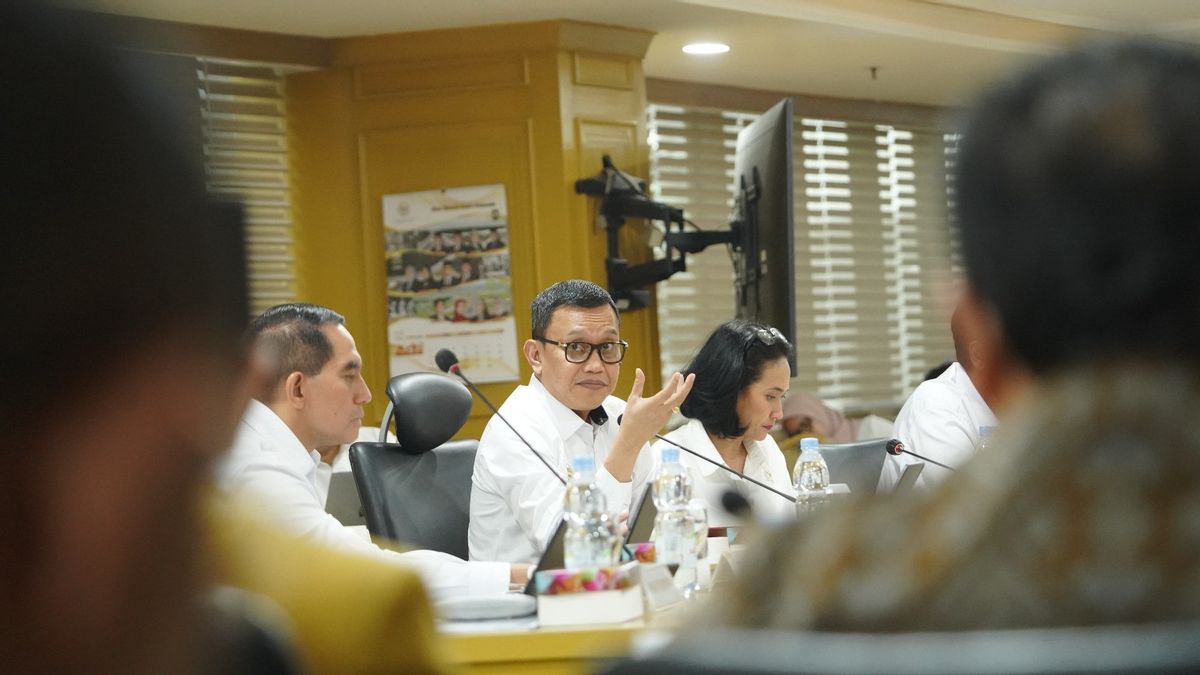


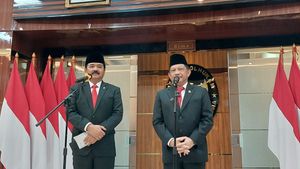
Coordinating Minister for Political and Security Affairs (Menko Polkam) Budi Gunawan said the government would simplify the administrative system and requirements to become official or legal migrant workers.
This is done so that people do not intend to choose as illegal immigrants (illegal) who are not registered with the government.
The simplification of administrative provisions will be carried out by the Coordinating Decree for the Protection of Indonesian Migrant Workers (P2MI) which was recently formed by the Coordinating Minister for Political, Legal and Security Affairs Budi Gunawan today.
"In this desk there is also a Prevention Coordination Task Force. One of the main tasks is to simplify, simplify, and monitor the movement of Indonesian citizens who will go abroad illegally," said Budi Gunawan, confiscated by Antara.
However, Budi Gunawan did not explain in detail what administrative requirements would be simplified to facilitate prospective migrant workers.
According to the man who is familiarly called BG, the community will benefit a lot if they decide to become legal migrant workers.
One of the main advantages is that it is officially registered and has received protection from the government.
BG continued, these rights cannot be owned by residents who are willing to take illegal routes to become migrant workers abroad.
At the same time and place, the Minister of Protection for Indonesian Migrant Workers (P2MI) Abdul Kadir Karding revealed four problems that would hit migrant workers, especially illegal ones.
"The average problem faced by Indonesian migrant workers, be it violence or exploitation, even human trafficking (human trafficking) the main source, one of which is because our migrant workers departed illegally or non-procedurally," said Minister Karding.
Minister Karding said the number of migrant workers departing procedurally or on official channels, to date, has reached 5.3 million people. Meanwhile, workers departing unprocedurally or illegally reached 4.3 million in 2017 based on a World Bank survey.
His ministry noted that 90-95 percent of workers who had problems were workers who departed illegally.
"So actually the key to the problem is that if we can close with this procedure, then God willing, there will be not too many problems with Indonesian migrant workers," he said.
Then, the ability becomes the second problem that migrant workers often face. This is because 80 migrant workers are individuals who were previously household workers or domestic workers.
"And of the 80 percent, 70 percent of women, and the average education is elementary and junior high schools, a little high school. So you can imagine how vulnerable or potential it is to violence," said Karding.
SEE ALSO:
The third problem is language and the fourth problem is mental, because not a few migrant workers have just moved abroad and want to return to their homeland.
Karding further said that his ministry had taken a number of steps to prevent non-procedural departures from continuing to increase.
The areas that are of special concern are areas that are the largest contributors to the origin of migrant workers, namely East Java, West Java, Central Java, NTB, Lampung, and Medan City, North Sumatra.
Second, encouraging socialization so that workers go legally because the level of awareness of the importance of leaving according to the new procedure reaches 40 percent. Third, maximize prevention and protection through a quick reaction team.
"Fourth of course we will collaborate and we are grateful that the Coordinating Minister (Polkam) today initiated the formation of a desk (coordination of PMI protection). We hope that this Decree will later become a collaborative forum and our synergy to participate in dealing with issues related to the quality of our protection or governance of protection," explained Karding.
The coordination desk for the protection of migrant workers is a coordination team initiated by BG and aims to maximize the protection of Indonesian migrant workers.
The Dec is chaired by the Ministry of Protection of Indonesian Migrant Workers and involves the Ministry of Foreign Affairs, Ministry of Immigration and Corrections, Bareskrim Polri, TNI, and the Attorney General's Office (AGO).
The English, Chinese, Japanese, Arabic, and French versions are automatically generated by the AI. So there may still be inaccuracies in translating, please always see Indonesian as our main language. (system supported by DigitalSiber.id)
Most Popular Tags
#Prabowo Subianto #donald trump #2026 World Cup #Febrie Adriansyah #8791Popular


