

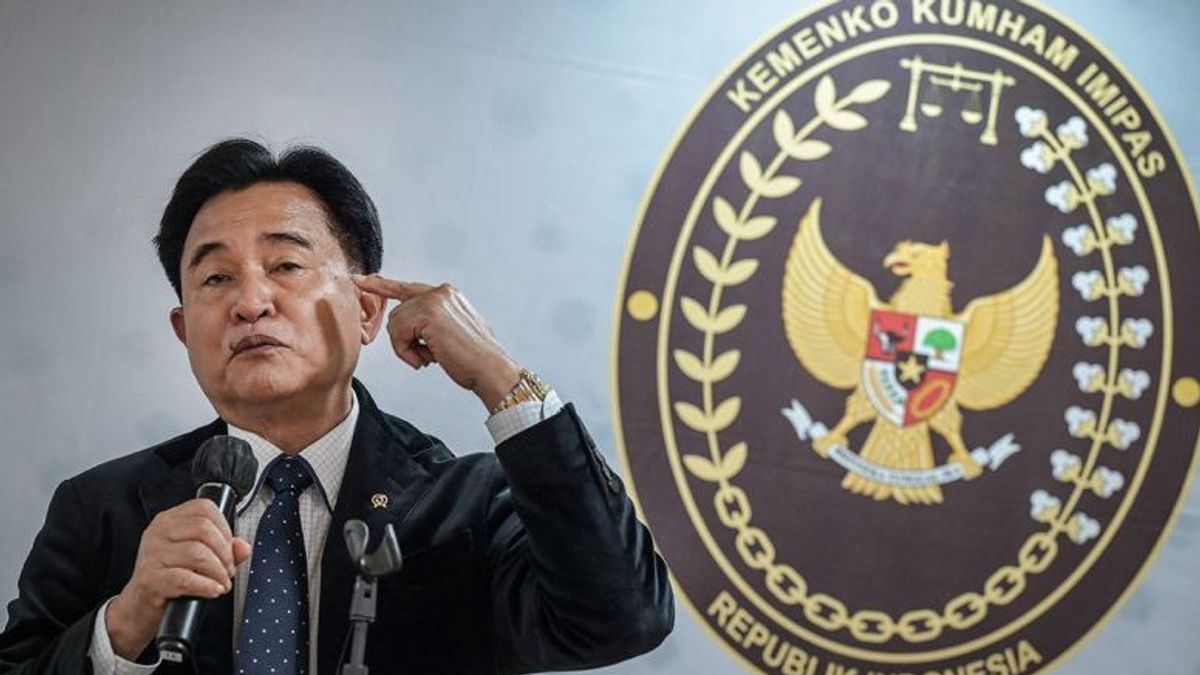


Coordinating Minister for Law, Human Rights, Immigration and Corrections (Kumham Imipas) Yusril Ihza Mahendra said the Law (UU) on the Transfer of Prisoners was designed so that the exchange and transfer of prisoners had a strong legal basis, not just the President's discretion.
"This transfer and exchange of prisoners is beneficial for the protection of Indonesian citizens (WNI) abroad, humanity, and human rights, as well as maintaining good relations between countries," said Yusril as quoted by ANTARA, Monday, March 10.
He explained that two drafts of the Draft Law (RUU) on the Transfer and Exchange of Prisoners, including the academic paper, had actually existed two years ago, which was prepared by the Ministry of Law and Human Rights (Kemenkumham) at that time.
However, he continued, the two drafts had not yet been finalized to be submitted as a bill to the House of Representatives (DPR).
Currently, Yusril said that the existing draft is being studied further by his party to be perfected by considering the development of diplomacy and the latest law.
Yusril also gave an example in the current draft, a prisoner of foreign nationals (WNA) who was sentenced to death should not be transferred to his country of origin.
Meanwhile, in practice, the Indonesian government has transferred drug convict Mary Jane to the Philippines and drug convict Serge Atloui to France, both sentenced to death by Indonesia.
In Indonesia, he continued, the implementation of the death penalty has also changed with the enactment of the National Criminal Code (KUHP).
In the regulation, prisoners sentenced to death should not be executed immediately, but there is a probationary period of 10 years in prison.
If within 10 years the inmate shows deep regret for his actions, the Coordinating Minister said that his death penalty could be changed to life imprisonment.
"Several countries have even abolished the death penalty. So it is very likely that even death penalty convicts can be transferred to their home countries," he said.
SEE ALSO:
-
 | BERITA
Rencana Serangan ke Sinagoge Sydney Australia Rupanya Palsu, Tak Ada Detonator
10 Maret 2025, 16:30




Yusril emphasized that the two bills still emphasize the principle of acknowledgment of the court decisions of each country, so that if it is transferred, the remaining sentence of prisoners must be served in the country of origin.
Furthermore, the authority to provide guidance to prisoners, including providing remission, clemency, and parole is delegated to the country of origin.
He said, there are also other principles that will be emphasized in the two bills, namely reciprocal transfer or exchange of prisoners, meaning that Indonesia is reciprocal between Indonesia and other countries.
"The implementation of these two laws will later be stated in the form of agreements, agreements, or bilateral technical arrangements," said Yusril.
The English, Chinese, Japanese, Arabic, and French versions are automatically generated by the AI. So there may still be inaccuracies in translating, please always see Indonesian as our main language. (system supported by DigitalSiber.id)
Most Popular Tags
#Prabowo Subianto #donald trump #Febrie Adriansyah #8791 #giias 2026Popular


