

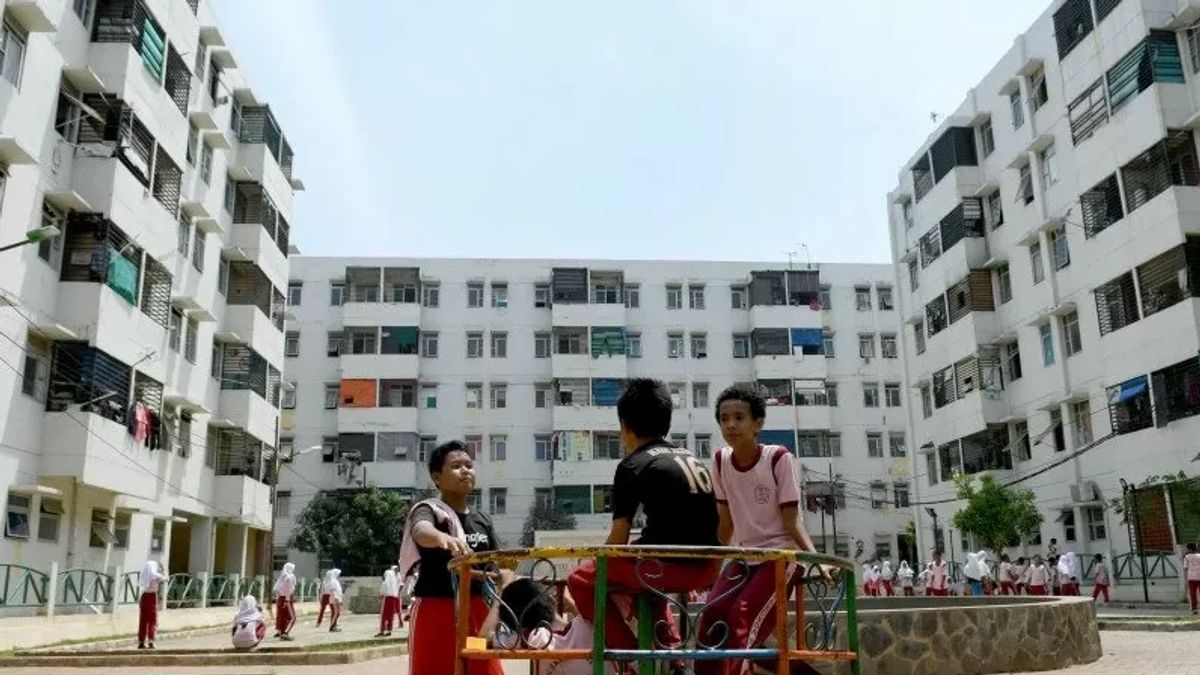


JAKARTA - The DKI Jakarta Public Housing and Settlement Areas (DPRKP) have recorded that many residents of flats in Jakarta are in arrears. As of January 31, 2025, 17 thousand units were recorded with a total arrears reaching Rp95.5 billion.
"We are arrears as long as he stays in the flats. Some are in arrears of up to 50 to 58 months. If they are in arrears, the data will continue to be disclosed," said DKI Jakarta DPRKP Secretary Meli Budiastuti to reporters, Thursday, February 6.
Based on the records of the DKI DPRKP, the dismissal includes residents of the category of sub-district residents who are programmed and in the general category.
For programmed residents, arrears were recorded at 7,615 units with a total arrears of Rp. 54.9 billion consisting of arrears in residential leases of Rp. 27 billion, rental fines of Rp. 9.3 billion, electricity of Rp. 567 million, and water of Rp. 18 billion.
Meanwhile, in the general category, arrears in 9,416 units with a total arrears of Rp40.5 billion consisting of arrears in residential leases of Rp28.2 billion, rental fines of Rp4.9 billion, electricity of Rp98.1 million, and water of Rp7.22 billion.
Meli admitted that according to the rules, residents who were in arrears would be subject to administrative sanctions, ranging from warnings, warnings, sealing, to forced emptying.
However, the DPRKP DKI Jakarta Flats Management Unit (UPRS) finds it difficult to execute forced emptying of residents who are in arrears. This is because the residents are programmed to argue that they actually don't want to live in the flats if their previous residences are not evicted or relocated.
"Finally, they are still in arrears, road administrative sanctions but they are not executed, and that also invites other general (category) communities. The general public, even though they intend to live there, but there are also those whose income may be mediocre," explained Meli.
"When they get a letter to forcibly vacate it, they sometimes make complaints to council members. So, we can't apply that," he added.
SEE ALSO:
-
 | BERITA
KPK Sebut Hasto Sepakati 'Biaya' Pengurusan PAW, Siap Menalangi Rp900 Juta
06 Februari 2025, 14:55 -
 | BERITA
Pemprov DKI Bakal Batasi Jangka Waktu Penghuni Rusunawa Hanya 6-10 Tahun
06 Februari 2025, 13:24 -
 | BERITA
Presiden Ancam Reshuffle Kabinet, Komisi II DPR: Menteri Prabowo Harus Tingkatkan Kinerja
06 Februari 2025, 15:56



Therefore, the DKI Provincial Government will see the economic capacity of the flats by referring to the Socio-Economic Registration (Regsosek) data.
If deemed capable, they will be forced to vacate their homes when they do not pay off their arrears.
"We will gradually prioritize the general public first, because they are at their own will to live in the flats. If he deserves to be assisted, then we will continue to maintain it. But if he is not worthy of being defended by arrears, of course we will carry out the execution," he added.
The English, Chinese, Japanese, Arabic, and French versions are automatically generated by the AI. So there may still be inaccuracies in translating, please always see Indonesian as our main language. (system supported by DigitalSiber.id)


