

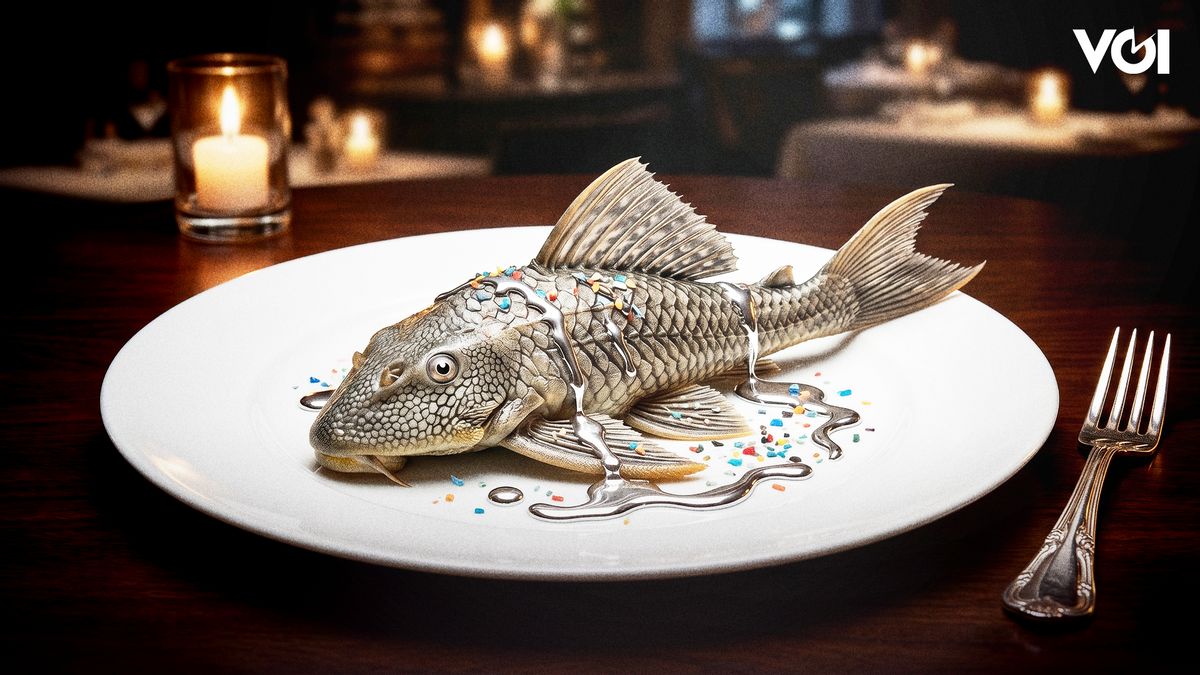
JAKARTA - The mop-mop fish which has the Latin name (Hypostomus plecostomus) comes from South America, especially tropical areas such as Brazil. This fish was originally brought into Indonesia through the ornamental fish trade.
Researcher of the Limnology and Water Resources Research Center (PRLSDA) of the National Research and Innovation Agency (BRIN) Triyanto explained that the entry of the mop-mop fish into this country through the ornamental fish trade. Where this fish community is then released into the public waters, either intentionally or not, until it eventually develops into an invasive species in Indonesian rivers, including the Ciliwung.
"This fish originally entered Indonesia through the ornamental fish trade. However, many of them were then released into the public waters, either intentionally or unintentionally, until they eventually evolved into invasive species in Indonesian rivers, including the Ciliwung," he said. Triyanto.
Triyanto added that this abundant fish population could be a sign of deteriorating river water quality. He reasoned that these fish have a high level of adaptation and are able to survive in degraded water conditions.
"The fish is swept away because its life force is very high, its adaptation rate to poor water quality, so it can live. But at a certain range, when the water gets worse, this fish will also be affected and even die," he said.
The DKI Jakarta Provincial Government (Pemprov) has held a mass and simultaneous cleaning of sapu-sapu fish in five administrative city areas on Friday (17/4) morning. The mass cleaning step was taken following laboratory findings that showed the content of dangerous heavy metals in the fish's body had exceeded the safe threshold.
"On Friday morning, all five cities in Jakarta simultaneously held an event for cleaning the fish sweepers," said DKI Jakarta Governor Pramono Anung at the DKI Jakarta City Hall, Monday (20/4).
DKI Provincial Government Asked to Be Sensitive to the Root of the River Problem
The DKI Jakarta Provincial Government recently celebrated the success of the arrest of around 7 tons of sapu-sapu fish from the capital's waters. In the digital public space, this achievement is perceived as a decisive step in addressing the river problem. However, behind the euphoria, there is a fundamental problem that has not been touched: is this approach targeting the root of the problem, or just managing symptoms?
The mop-mop fish is not the only fish that can survive in polluted waters. In the perspective of environmental science, organisms like this can serve as bioindicators - storing chemical traces of heavy metals, microplastics, and waste residues that accumulate in their bodies. This means that mop-mop fish have the potential to become an important instrument in tracking sources of pollution.
Unfortunately, this potential has not been optimally utilized. Mass arrests without following scientific analysis of the pollutants in the fish's body actually eliminate the opportunity to identify the perpetrators of pollution. In this context, the mop fish should be treated as "ecological forensic evidence", not merely a pest that is destroyed.
On the other hand, the narrative that the absence of natural predators is effective for catfish also needs to be reviewed. A number of studies show that certain species, such as bagrid catfish (Hemibagrus wyckioides) and marble gabus (Oxyeleotris marmorata), are able to prey on the early stages of catfish in certain conditions. In Indonesia, local predators such as toman (Channa micropeltes) once played an important role in maintaining the balance of the river ecosystem, before their populations declined due to excessive fishing pressure and pollution.
This shows that the main problem is not the absence of natural control mechanisms, but the damage to the ecosystem that makes the mechanism no longer function. Therefore, a more sustainable approach is to restore the food chain through habitat restoration and the protection of local species, not the introduction of foreign predators that could potentially cause new problems.
In addition to scientific approaches, river restoration policies also need to take into account local knowledge. Betawi communities and riverbank communities who have lived for decades have what can be called a living ecological memory - a collective memory of past river conditions. This information can help identify changes in the composition of biota and serve as a reference in ecosystem restoration efforts.
The Director of the Jakarta Institute, Agung Nugroho, further stated that it was important to change the way of looking at rivers. So far, river restoration has often been positioned as a burden on the budget. In fact, international experience shows that a healthy river can be an economic asset. "The restoration of Cheonggyecheon Stream in Seoul, for example, not only improves the quality of the environment, but also encourages an increase in property values and investment in the surrounding area," he told VOI, Sunday, April 19.
He added that the learning opened up space for the development of new policy instruments in Indonesia, such as river ecology certification. This system can link environmental quality with economic incentives, including in property licensing, green bond-based financing, and improving the competitiveness of cities in a global context.
In the end, the issue of sapu-sapu fish cannot be separated from the larger issue, namely the weak enforcement of regulations against industrial pollution. Making this species a "main enemy" risks diverting attention from the responsibilities of actors who contribute directly to river damage.
"Mass arrests may be necessary as a short-term measure to control the population. However, this step should not be perceived as the main solution. Without systematic efforts to identify and crack down on sources of pollution, as well as to restore the river ecosystem as a whole, the same problems will continue to recur," he said.
A healthy river is not only determined by how many specific species can be eliminated, but by the extent to which water quality can be restored, biodiversity restored, and environmental governance consistently enforced.
"Within this framework, the mop-up fish should not be seen solely as a problem, but rather as an indicator - even a reminder - that there is still a huge unfinished homework in urban environmental management," he said.
The English, Chinese, Japanese, Arabic, and French versions are automatically generated by the AI. So there may still be inaccuracies in translating, please always see Indonesian as our main language. (system supported by DigitalSiber.id)


