

JAKARTA - The issue of the possible outbreak of World War III often feels far from Indonesia. Indeed, the relatively safe geographical location, free foreign policy, and non-bloc tradition make Indonesia seem to be outside the vortex of global conflicts. Warming the world due to the arrogant attitude of President Trump, who acts as if the King of France Louis XIV, as if the law is me.
Therefore, Susilo Yudhoyono, worried about the threat of World War III looming over the current global conditions. The fear of a global conflict breaking out was also felt by the 6th President of the Republic of Indonesia, Susilo Bambang Yudhoyono.
International Law Expert, Hikmahanto Juwana, assessed that international organizations, including the United Nations (UN), were powerless to hinder Trump's ambitions which could potentially undermine the world order. That is what is feared to break out in World War III.
However, history teaches, world wars never fully respect geographical boundaries. When global rivalries heat up, crucial questions arise: how prepared is Indonesia, especially in terms of military equipment?
Quantitatively, Indonesia has a considerable military force in the region. The Indonesian Army is supported by hundreds of combat tanks, field artillery and rockets, as well as large infantry forces. The Indonesian Navy has warships of various classes - frigates, corvettes, submarines - designed to guard the Nusantara strategic sea lanes.
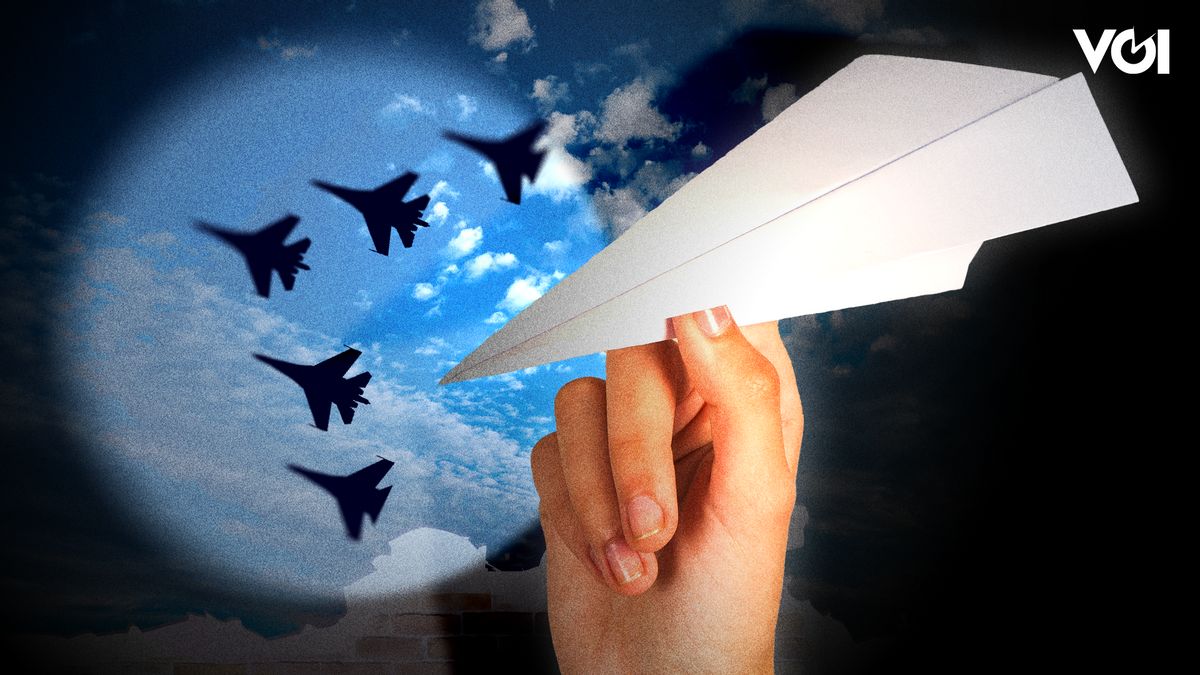
Meanwhile, the Indonesian Air Force is strengthened by 4th and 4.5th generation fighter jets such as F-16, Sukhoi, and Rafale which have begun to arrive gradually. On paper, this gives the impression of adequate readiness, and Indonesia gradually increases its weapons strength.
However, readiness to face modern warfare is not only determined by the number of alutsista, but by the integration of systems, combat readiness, and logistics sustainability. At this point, Indonesia's challenges are clearly visible. Some alutsista are still old, the result of cross-country acquisitions with different systems, making it difficult to interoperate. Dependence on imported spare parts is also a serious vulnerability if global conflicts cut off international supply chains.
In the context of World War III, which is likely to be a hybrid and high-tech war, Indonesia's challenges are increasingly complex. Threats no longer come solely in the form of physical invasions, but through cyber attacks, satellite disruption, economic blockade, and information warfare.
In this realm, conventional military equipment such as tanks and warships is not always the main determinant. The readiness of cyber defense systems, integrated radar, layered air defense, and intelligence capabilities are the key.
"From the war between Israel and Iran, we need to immediately organize ourselves, about the domination of the Indonesian sky, one day it can burn," the airspace sovereignty. That sends a message that the airspace must be guarded," he said.
Indonesia so far is still more prepared for territorial defense and low-to-medium intensity conflicts, not high-escalated global wars. The universal defense doctrine gives an advantage to national resilience, but it has not been fully offset by the modernization of state-of-the-art technology-based alutsista and a truly independent defense industry.
Thus, Indonesia's readiness to face the possibility of World War III does not lie in the ambition to fight, but in the ability to survive, maintain sovereignty, and prevent its territory from becoming a venue for conflict. Indonesia's military equipment is sufficient to show deterrence in the region, but has not been designed to be directly involved in global wars.
In the end, Indonesia's strongest weapon may not be the number of its fighter jets or submarines, but rather a combination of active diplomacy, strategic geopolitical position, and national resilience. A world war, if it does happen, will test not only iron and machines, but also policy directions: whether Indonesia is able to remain standing as a sovereign state in the midst of a global storm, without being dragged into the pawns of major powers.
According to a professor of international relations, Connie Rahakundini Bakrie, the conflict in the Middle East seems to be getting hotter! Most recently there have been attacks by the US & UK on Yemen, especially the Houthis. But it doesn't stop there, the Houthis have started to defend themselves by attacking US & UK ships.
Israel-Iran retaliate, the Middle East is on fire & hot. America joins the war to make the situation more alert. On paper, the traces of World War III are becoming clearer. Echoing loud protests, the world is worried that the war will spread. Previously, the majority of the world's citizens' response was unusual. They cheered when Iranian missiles made Israel in ruins.
But Tel Aviv is in Gaza & feels the pain of the Palestinians. A temporary ceasefire is imposed. It is considered a determinant, how will the allies react? The meeting between Trump and President Xi Jinping hopefully can ease the conflict and tension.
The English, Chinese, Japanese, Arabic, and French versions are automatically generated by the AI. So there may still be inaccuracies in translating, please always see Indonesian as our main language. (system supported by DigitalSiber.id)


