

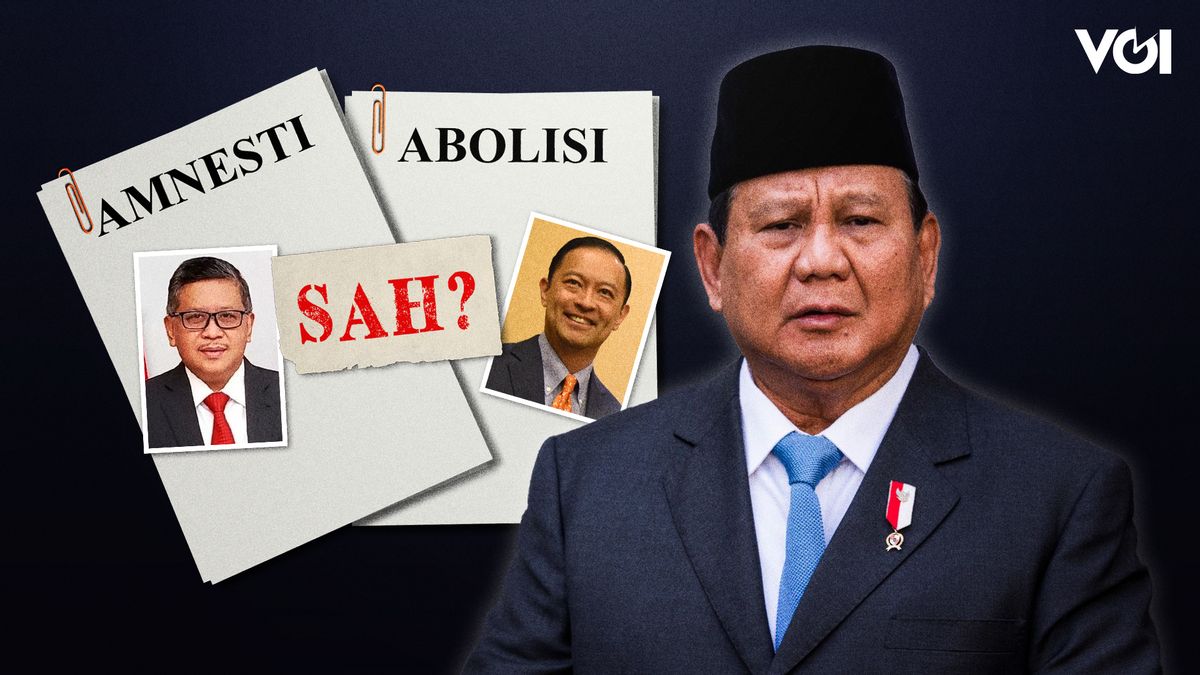
JAKARTA – President Prabowo Subianto, with the approval of the Indonesian House of Representatives (DPR RI), granted amnesty to Thomas Trikasih Lembong (Tom Lembong) and Hasto Kristiyanto, convicted in the sugar importation case, and Hasto Kristiyanto, convicted in the bribery case involving the replacement of a member of the House of Representatives (DPR).
With this abolition and amnesty, Tom and Hasto finally breathed free on the evening of Friday, August 1, 2025. Previously, Tom was sentenced to 4.5 years in prison for the sugar import corruption case. Hasto was sentenced to 3.5 years in prison for the bribery case involving the replacement of a member of the House of Representatives (DPR), which also implicated former General Elections Commission (KPU) Commissioner Wahyu Setiawan.
While surprising, President Prabowo's decision to grant amnesty and amnesty does not violate the constitution. The academic text of the Draft Law on Clemency, Amnesty, Abolition, and Rehabilitation, drafted by the National Legal Development Agency, states that amnesty is a pardon or remission of punishment granted by the head of state to an individual or group of individuals who have committed a specific crime.
Meanwhile, according to the Dutch Central Dictionary of the Great Indonesian Language, abolition itself means the elimination of a criminal event. This term was originally used to refer to the abolition of slavery in America. However, abolition also refers to the right to remove all consequences of a court decision or to drop criminal charges against a convict, as well as to suspend the sentence once the decision has been carried out.
In short, granting amnesty means removing all legal consequences of a criminal offense against the recipient. Granting abolition, on the other hand, eliminates prosecution against that person. Under Emergency Law Number 11 of 1954, abolition was granted to individuals who committed crimes arising from the political conflict between the Republic of Indonesia and the Netherlands before December 27, 1949.

Meanwhile, Article 14 paragraph (1) of the 1945 Constitution authorizes the president to grant pardons and abolitions. This article states that the granting of amnesty and abolition by the president must take into account the considerations of the House of Representatives (DPR). Based on available data, at least eleven Indonesian presidents, from Soekarno to Prabowo, have granted pardons and amnesties.
1. Presidential Decree Number 303 of 1959 (September 11, 1959) concerning the granting of amnesty and abolition to individuals associated with the DI/TII rebellion of Kahar Muzakar in South Sulawesi.
2. Presidential Decree Number 449 of 1961 (August 17, 1961) concerning the granting of amnesty and abolition to those involved in the Daud Bereuh rebellion in Aceh.
3. Presidential Decree Number 2 of 1964 (January 4, 1964) concerning the granting of amnesty to parties associated with the Republic of South Maluku (RMS) rebellion. Several separatist figures were granted amnesty to end the political conflict.
4. Presidential Decree No. 63 of 1977 granted amnesty to thousands of Fretilin followers in East Timor.
5. Presidential Decree No. 80 of 1998 (May 25, 1998) granted amnesty and pardon to Muchtar Pakpahan and Sri Bintang Pamungkas by President B.J. Habibie.
6. Presidential Decree No. 123 of 1998 (August 15, 1998) granted amnesty and pardon to several convicts of certain crimes, such as political activists.
7. Presidential Decree No. 159 of 1999 (December 10, 1999) granted amnesty to activists opposed to the New Order, such as Budiman Sudjatmiko, by President Abdurrahman Wahid/Gur Dur.
8. Presidential Decree Number 91 of 2000 concerning the granting of amnesty to Jauhari Mys (Azhari), Fauji Ibrahim (Monier), Kleemens Rom Sarvir, and Leseren Dampari Karma, and Presidential Decree Number 93 of 2000 concerning the granting of amnesty to Sawito Kartowibowo by President Abdurrahman Wahid/Gus Dur.
9. Presidential Decree Number 22 of 2005 (August 30, 2005) concerning the granting of general amnesty to 1,200 individuals and amnesty to groups involved in the Free Aceh Movement, granted as part of the Helsinki peace agreement.
10. Presidential Decree Number 24 of 2019 (July 21, 2019) concerning the granting of amnesty by President Joko Widodo to Baiq Nuril, a victim of sexual violence criminalized under the ITE Law. This amnesty is historic because it was the first time amnesty was granted to a civilian individual in a non-political and non-group context.
11. Presidential Decree Numbers 17 and 18 of 2025 (August 1, 2025) concerning the granting of abolition to Tom Lembong and amnesty to 1,116 people, including Hasto Kristiyanto.
Based on this data, only the amnesty to Baiq Nuril was unrelated to political issues, while other grants of abolition and amnesty were always related to political cases. According to Muhammad Fatahillah Akbar, a criminal law expert from the University of Gadjah Mada (UGM), it is perfectly natural that abolition and amnesty are always politically tinged. This is because proposals for abolition and amnesty must be approved by the House of Representatives (DPR), which is a political institution. This differs from granting a pardon, which requires the consideration of the Supreme Court, a judicial institution.
"Article 14 paragraph 2 states that amnesty and abolition are submitted to the DPR because they are inherently political. There are political considerations involved, so they go to the DPR. This is different from pardons, which are considered through the Supreme Court," he said.
Regarding the granting of abolition and amnesty to Tom Lembong and Hasto, Professor of Legal Law at Trunojoyo University, Madura, Prof. Dr. Safi', SH, MH, believes that President Prabowo wants to emphasize a profound message, especially to law enforcement officials, including the Corruption Eradication Commission (KPK), the prosecutor's office, the police, and the courts, which must be impartial.
"The President wants to convey that, going forward, law enforcement officials must no longer be used as political instruments by parties with political interests and who wish to exploit them. The law enforcement process must be free from political revenge," he said.
He explained that granting abolition and amnesty to Tom Lembong and Hasto is a constitutional right of the president as head of state, as stipulated in Article 14 of the 1945 Constitution. However, from a public justice perspective, President Prabowo's decision represents a very progressive step in ensuring that law enforcement is free from political interests.
Furthermore, the cases implicating Tom Lembong and Hasto have been fraught with political interests from the outset. This is what fueled public opinion that Tom Lembong and Hasto were entangled in legal cases for political gain, given that both were known to be opponents of the previous government, President Joko Widodo.
"That's what the public saw: the authorities were using legal instruments to attack their political opponents, in this case Tom Lembong and Hasto. President Prabowo wants to dispel that perception," said Safi'.
Abolition and Amnesty for Tom Lembong and Hasto Are Unhealthy for Democracy and the Eradication of Corruption

A different opinion was expressed by Jember University political observer Muhammad Iqbal, who argued that the practice of criminalization followed by pardons, such as abolition and amnesty, as in the cases of Tom Lembong and Hasto Kristiyanto, as an attempt to control the opposition, is unhealthy in a democratic era. "If such practices continue, the opposition will become weak when faced with power," he added.
According to him, the motive for granting abolition to Tom Lembong and amnesty to Hasto Kristiyanto is more based on President Prabowo Subianto's political consolidation efforts. As the ruler, Prabowo does not want any disruptions in his administration. "The idea of granting abolition can be interpreted as an attempt to instill a policy of indebtedness or dampen the pace of Anies' political movement. Essentially, Prabowo doesn't want any pebbles in his shoe," Iqbal added.
Similarly, granting amnesty to Hasto Kristiyanto is seen as an attempt to embrace the Indonesian Democratic Party of Struggle (PDI-P), which still holds significant power and influence, especially in parliament. Prabowo certainly hopes that granting Hasto amnesty will discourage the Indonesian Democratic Party of Struggle (PDIP) from taking a hardline stance or obstructing government programs that require House approval.
"Mr. Prabowo could be said to be engaging in transactional politics so that PDIP can join a total coalition in parliament. If that's true, then we can say goodbye to Indonesian democracy," Iqbal stated.
YLBHI Executive Director Muhamad Isnur also views the agreement between the government and the DPR as a farce, seemingly demonstrating political bartering, where law enforcement has become a tool for power politics to gain support and political stability. "We see how the law, which supposedly serves as the supreme authority in this country, has been completely obliterated, and the power politics played by political parties have become the true supreme authority," he concluded.
According to him, this incident is "dangerous" in the context of law enforcement for corruption crimes, especially because the trial attempted to raise the issue of obstruction of justice. This will leave law enforcement institutions, such as the Corruption Eradication Commission (KPK) and the Attorney General's Office, feeling uncertain because the president easily grants abolitions and amnesties.
Isnur emphasized that this decision strongly signals that the Prabowo administration is not serious about enforcing anti-corruption, as the judiciary is easily interfered with, even though it is the president's prerogative.
Lakso Anindito, Chairman of IM57+, called this amnesty and abolition a bad precedent for law enforcement in this country and a betrayal of the president's promise to eradicate corruption. "In the future, politicians will not be afraid to engage in corruption because resolutions can be achieved through political agreements," he concluded.
"This action must be rejected en masse because if allowed to continue, it will result in the collapse of the rule of law and a shift towards rule by law in law enforcement in this country," Lakso asserted.
The English, Chinese, Japanese, Arabic, and French versions are automatically generated by the AI. So there may still be inaccuracies in translating, please always see Indonesian as our main language. (system supported by DigitalSiber.id)


