

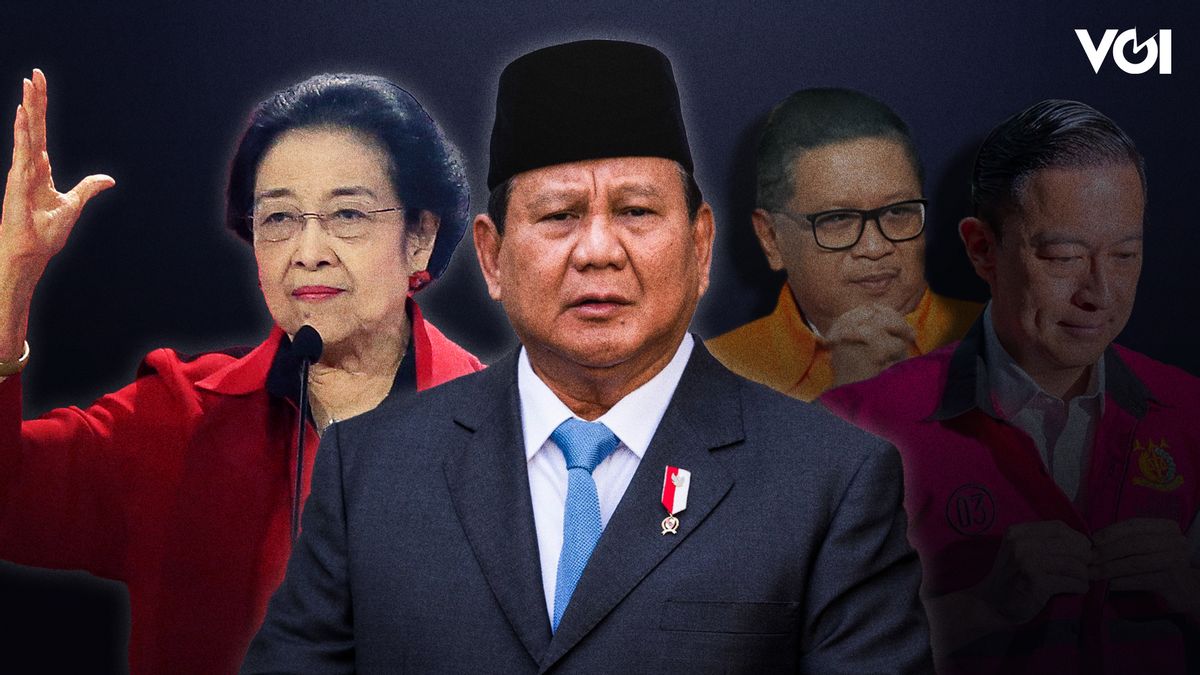
JAKARTA - Six days ago, the Indonesian House of Representatives (DPR RI) and the Ministry of Law announced their approval of President Prabowo Subianto's proposal to grant abolition to Tom Lembong and amnesty to Hasto Kristiyanto. Both are convicted corruption convicts who were released on the evening of August 1, 2025.
"We have held a consultation meeting, and we have provided our considerations and approval from the results of that meeting," said Deputy Speaker of the House of Representatives (DPR RI) Sufmi Dasco Ahmad last Thursday.
In a joint press conference between the DPR RI and the government, Minister of Law Supratman Andi Agtas stated that he proposed the amnesty and amnesty.
"The Minister of Law is the one who proposed the amnesty to the President. So, I signed the letter of request from the law to the President for amnesty and abolition," Supratman said, adding, "We want unity in welcoming the 80th anniversary of August 17th."
Prior to the announcement, Dasco posted a photo on his Instagram account of himself sitting with Megawati and her two children, Puan Maharani and Prananda Prabowo. He was accompanied by State Secretary Prasetyo Hadi. Both Dasco and Prasetyo wore white shirts. The post did not specify the location of the meeting. "Weaving bonds of nationality and brotherhood," Dasco wrote.

Following the meeting and the photo upload, Megawati announced shortly after that PDIP cadres must support the Prabowo Subianto administration. Megawati emphasized that the party, whose image is a white-nosed bull, is a balancing force, not an opposition or coalition.
The Facts of Political Trials
Tom, whose full name is Thomas Trikasih Lembong, is a former Minister of Trade under President Joko Widodo. He was sentenced to 4.5 years in prison for corruption involving Rp 194.72 billion in sugar imports from 2015-2016. Hasto Kristiyanto was sentenced to 3.5 years in prison for bribery and obstruction of justice in the Harun Masiku case.
As PDIP Secretary General, Hasto allegedly bribed a General Elections Commission (KPU) commissioner to secure Harun's seat in the fifth-place South Sumatra 1 electoral district in the 2019 legislative election.
The Executive Director of the Indonesian Legal Aid Foundation (YLBHI), Muhamad Isnur, views the agreement between the government and the House of Representatives as a "farce" involving political bartering.
"The law enforcement process has become a tool for power politics to gain political support and stability," Isnur said in a written message.
"We see how the law, which supposedly serves as the commander-in-chief in this country, has been completely obsolete, and the power politics played by political parties has become the real commander-in-chief. The political bartering is very evident," he said.
Meanwhile, Feri Amsari, a constitutional law expert from Andalas University, assessed that Article 14 paragraph 2, concerning the granting of amnesty by the president, is closely linked to political interests.
"The construction of Article 14 paragraph 2 is related to political interests. The president has the right to grant amnesty and abolition, taking into consideration the House of Representatives," Feri said.
Feri added that the granting of amnesty and abolition is deeply politically charged, given its historical context. The bespectacled man continued by explaining the granting of amnesty and abolition based on their historical context.

"Well, amnesty is a very political idea. If you look at history, you'll also see it in Indonesian history, where amnesty was even granted to figures connected to political interests. Usually, the perpetrators of coups, treason, and so on," Feri explained.
"Well, abolition is the same. Abolition, because its origins lie in the king's pardon for slaves, is associated with it. Therefore, it's associated with an attempt to halt the legal process. So, usually, when a legal process is underway, it's suddenly stopped. Whether it's ongoing, about to begin, or already completed, the process will be stopped," he emphasized.
Palace Denies Granting Abolition and Amnesty as Permissiveness for Corruption
The two figures who received abolition and amnesty ahead of Independence Day, Tom Lembong and Hasto Kristiyanto, were convicted of corruption. Their release is considered by some to be a permissive act of corruption in this country.
Minister of State Secretary Prasetyo Hadi dismissed President Prabowo Subianto's granting of amnesty to convict Tom Lembong in the sugar importation case and amnesty to convict Hasto Kristiyanto in the bribery case as condoning corruption.
"Indeed, his (President Prabowo's) spirit is that we need unity. This doesn't mean we will condone corrupt practices, no. But in these two cases, which are more politically charged, the President is exercising his right. Let's reduce the political uproar," Prasetyo Hadi said, as reported by ANTARA on Monday, August 4.
He also emphasized that granting amnesty and amnesty is the President's right as head of state, whose authority is regulated by the constitution.
"The President is exercising his right (to grant amnesty and abolition). That is regulated in the constitution," he continued.
Prasetyo emphasized the importance of prioritizing unity in addressing various national issues and driving development.
"We need unity. We need peace so we can build and fix all the problems facing society. We must not divert our energy to less productive things," he said.
"It's better for us to concentrate on securing our food. Thank God, our food production is increasing, but we must not let our guard down. We must continue to maintain this," he said.
The English, Chinese, Japanese, Arabic, and French versions are automatically generated by the AI. So there may still be inaccuracies in translating, please always see Indonesian as our main language. (system supported by DigitalSiber.id)


