

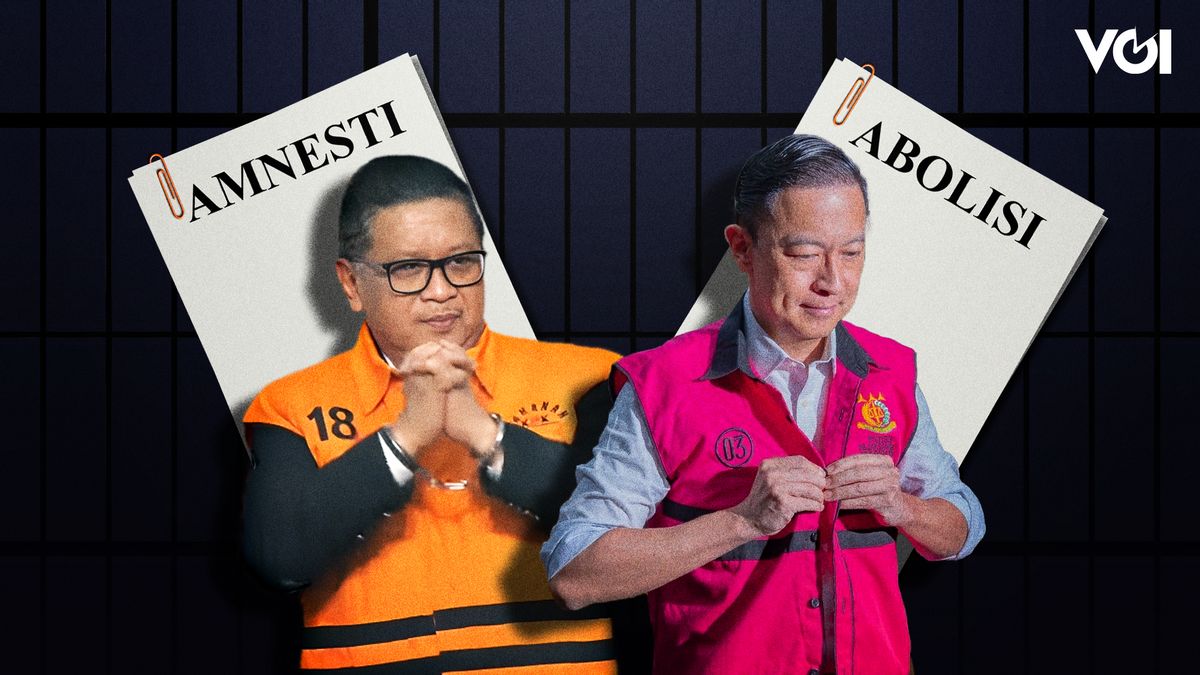
JAKARTA - The President of the Republic of Indonesia officially announced the granting of abolition and amnesty to two national political figures: Thomas Trikasih Lembong, Minister of Trade under President Jokowi, and Hasto Kristiyanto (Secretary General of PDI-Perjuangan). This decision was considered a surprise gift ahead of Indonesian Independence Day. It also drew mixed reactions from the public.
Thomas Lembong was previously implicated in a case of alleged abuse of authority in sugar export policy, which caused billions of rupiah in state losses. However, an investigation determined that the policy was implemented under political pressure during the transitional government and not solely for personal gain.
Meanwhile, Hasto Kristiyanto faces charges of obstruction of justice in a mega-corruption case involving several party cadres. He is accused of obstructing the Corruption Eradication Commission (KPK) investigation by providing misleading information and destroying evidence related to suspect Harun Masiku.
Pardon Policy: Abolition and Amnesty
Abolition was granted to Tom Lembong, who had not yet been legally tried. This means the President halted the legal process before the case was heard by the court.
Amnesty was granted to Hasto Kristiyanto, considering that the legal process had already progressed to the trial stage. With this amnesty, all legal consequences of his actions were removed.
According to Deputy Speaker of the House of Representatives, Dasco Ahmad, this decision was made based on political considerations for reconciliation and recommendations from the People's Advisory Council (DPRD). This decision was made after the President sent a letter requesting the approval of the DPR.
According to Article 14 of the 1945 Constitution, the President has the right and authority to grant pardons, amnesties, abolitions, and rehabilitations, taking into account the considerations of the Supreme Court (for pardons and rehabilitations) and the DPR (for amnesties and abolitions).
However, several legal experts stated that, in Tom Lembong's case, abolition is normatively acceptable if there is a significant element of national interest or transitional politics, such as maintaining economic stability.

According to former Coordinating Minister for Political, Legal, and Security Affairs Mahfud MD, Tom's trial was criticized for not finding mens rea (malicious intent) and not even finding any party benefiting from it. However, Tom Lembong was sentenced to 4.6 years. Despite public protests, Tom's side subsequently filed a lawsuit with the Judicial Commission for unprofessional handling of the case.
Meanwhile, in Hasto's case, the granting of amnesty sparked debate because he was suspected of obstructing the legal process, not committing a political crime. This could violate the principle of due process of law if not based on objective considerations.
Prof. Yusril Ihza Mahendra, a constitutional law expert, stated, "Amnesty should be granted for political violations or in the context of conflict, not simply because of political proximity."
This decision is seen as part of President Prabowo's strategy of reconciliation ahead of the consolidation of the new government for the 2024 elections. The government is seen as trying to re-engage elements of the old elite to maintain stability ahead of a major economic reform program. However, political observer Indra Budiman from the Indonesian Institute of Sciences (LIPI) warned, "Granting legal pardons to political figures risks reinforcing the perception of impunity and undermining public trust in the rule of law."
Public and opposition party reactions were sharp. Several anti-corruption NGOs protested in front of the Palace, viewing this decision as a form of political interference in the law.
This is especially true given the president's stated mission to uphold the law, particularly in eradicating corruption. Granting pardon to Tom Lembong and amnesty to Hasto Kristiyanto has sparked debate about the limits of the president's authority to abolish legal proceedings, especially when linked to short-term political interests.
These steps could have long-term impacts on public perception of law enforcement and the credibility of the judiciary. However, if based on transparency and accountability, pardons could be a strategic step in the national interest—as long as they do not set a negative precedent for the future.
Despite the controversy, Mahfud MD welcomed Prabowo's move. He believed the president's move was appropriate, at least providing clarity to the public, who had long longed for state action in resolving cases that violated the law. "The implementation was appropriate, and the government finally corrected it by granting an amnesty," Mahfud said.
According to Adi Prayitno, a political observer from the State Islamic University (UIN), the Tom Lembong case was deemed to have been handled without improper principles, and the judge also found no mens rea. Similarly, Hasto's case appears to have been forced. The case had been pending for a long time and had not been resolved, but it was suddenly resumed, giving the impression of an attempt to silence political opponents, thus drawing public attention to the case.
Hasto, along with 1,178 other people, received amnesty. According to Viva Yoga Mauladi, a member of the House of Representatives (DPR) from the National Mandate Party (PAN), they received amnesty as stipulated in Article 14 paragraph 2 of the 1945 Constitution, also for political and humanitarian reasons, and to maintain social cohesion and national unity, he continued.
"In accordance with the President's directive regarding amnesty, we at the Ministry of Law and Human Rights have re-verified data from the Ministry of Impassive and Anti-Corruption Assessment (IMPAS). Of the initial data of 1,669 inmates and juvenile detainees, 1,178 have passed. The remainder are still being processed," stated Minister of Law and Human Rights Supratman Andi Agtas at the Ministry of Law and Human Rights office on Friday (August 1).
Hasto Kristiyanto has been sentenced to 3.5 years in prison in connection with a bribery case involving Harun Masiku, a member of the House of Representatives (DPR), for the 2019-2024 term.
The English, Chinese, Japanese, Arabic, and French versions are automatically generated by the AI. So there may still be inaccuracies in translating, please always see Indonesian as our main language. (system supported by DigitalSiber.id)


