

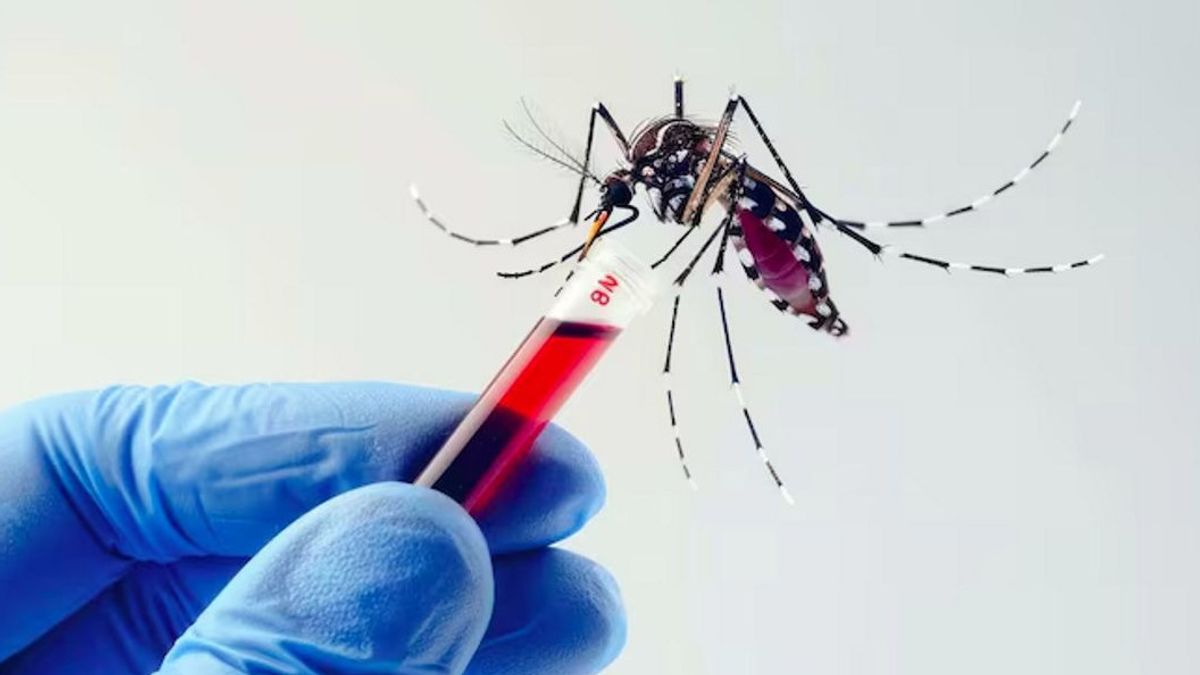


JAKARTA - Mosquito repellent containing Deet has been used to prevent bites. However, a new study shows that mosquitoes can learn to be attracted to Deet if they previously associate the substance with the opportunity to suck blood.
Citing a report by The Guardian, Sunday, May 31, this finding was published in the Journal of Experimental Biology. Deet, or N,N-diethyl-meta-toluamide, is a chemical widely used in insect repellent products.
The UK Health Security Agency recommends products with 50 percent Deet as the main choice to prevent mosquito bites.
This protection is important because mosquitoes can carry dangerous diseases, such as dengue fever, malaria, Zika, and Japanese encephalitis.
Prof Claudio Lazzari from the University of Tours, France, said anti-mosquito drugs have been considered to work because of their chemical properties. Deet can make mosquitoes stay away or interfere with the ability of mosquitoes to detect humans.
However, the results of the latest study show that mosquito responses can change due to experience.
"Our findings show that the reaction can be changed by experience," said Lazzari.
In the study, scientists observed mosquitoes trying to bite a bag containing warm blood. Still according to The Guardian, 60 percent of mosquitoes who previously sucked blood while exposed to Deet then still showed attempts to bite when only exposed to Deet.
That's a much higher number than mosquitoes who didn't get the same experience. In that group, only 17 percent showed any attempt to bite.
In another test, almost 60 percent of the mosquitoes that had previously sucked blood when there was Deet then tried to approach and bite the researcher's hand that was given Deet. On the other hand, mosquitoes that were not trained instead chose the researcher's hand that was not given Deet.
In other words, under certain conditions, mosquitoes can learn to associate the smell of Deet with the opportunity to suck blood.
Dr Nina Stanczyk from ETH Zurich, who has studied the effectiveness of Deet, considers the findings important. According to him, mosquitoes do have impressive learning abilities.
"The fact that they can associate a repellent smell with their food, and then be drawn to it afterwards, is extraordinary," said Stanczyk.
However, experts insist that the results of this study are not an excuse to stop using Deet. Lazzari said Deet did not lose its effectiveness in normal use.
"Deet does not lose its effectiveness through normal use, but only in certain laboratory conditions," he said.
Prof Francesca Romana Dani, an entomologist from the University of Florence who was not involved in the study, also assessed the small possibility that the mosquito's response to Deet would change in everyday conditions.
He said it still needed to be investigated how long the mosquito remembered sucking blood when there was Deet.
Stanczyk advised travelers to continue using anti-mosquito drugs. The most important thing, he said, is to reuse anti-mosquito drugs according to the instructions on the product label, especially when the effect starts to diminish.
So, Deet is still useful. What needs to be taken care of is how to use it. Don't forget to repeat it according to the rules.
The English, Chinese, Japanese, Arabic, and French versions are automatically generated by the AI. So there may still be inaccuracies in translating, please always see Indonesian as our main language. (system supported by DigitalSiber.id)
Most Popular Tags
#Prabowo Subianto #donald trump #firearm #8791 #giias 2026Popular


