
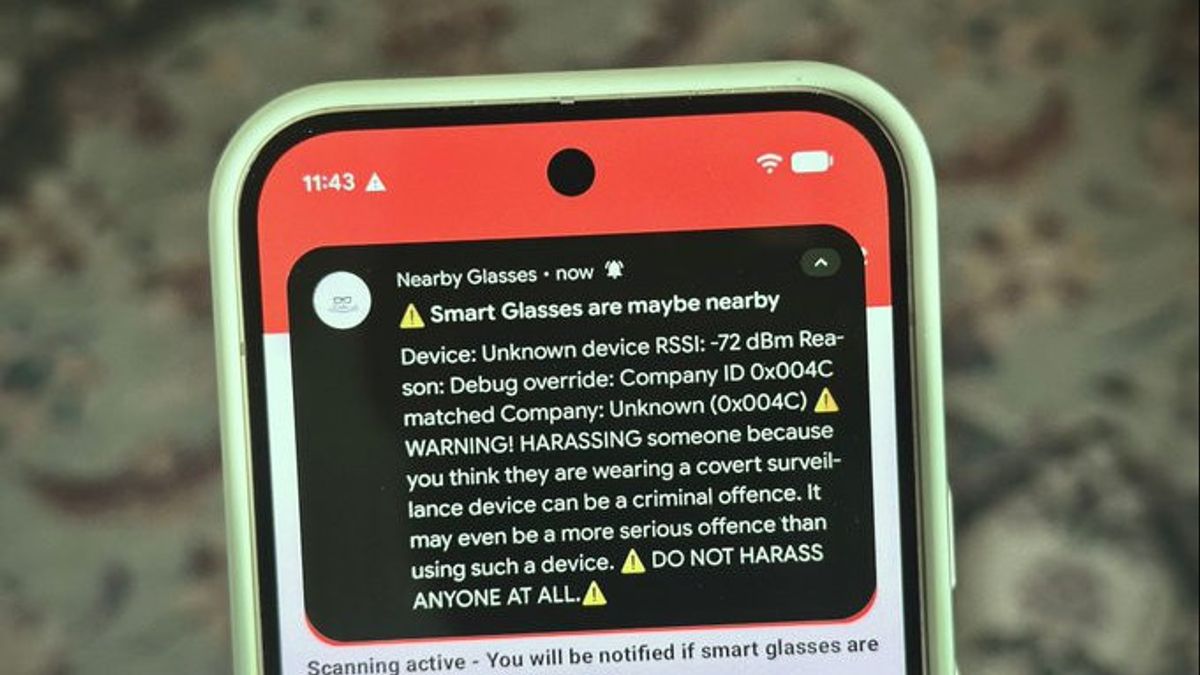


JAKARTA - In an era when cameras can be hidden behind the frame of glasses, one simple question becomes more relevant: are we being recorded without knowing it? A new Android app called Nearby Glasses tries to answer that anxiety in a fairly technical but direct way.
The app is designed to detect Bluetooth signals from always-on wearable devices, including Meta and Snap's smart glasses. By scanning the unique public identifier for each Bluetooth device manufacturer, Nearby Glasses will send notifications if it detects a device from a specific brand is around the user.
The developer of this application, Yves Jeanrenaud, said his motivation arose after reading an investigative report on the use of smart glasses in sensitive contexts, including immigration raids and unauthorized recording of sex workers. In his statement to TechCrunch, he called such devices a form of intrusion that ignores consent.
Jeanrenaud also highlighted Meta's decision to implement facial recognition features by default in its smart glasses. He called the move a "big gateway" to invasive behavior towards privacy.
Technically, how Nearby Glasses works is quite straightforward. The app constantly monitors Bluetooth signals around the user. If a signal from a device with a certain manufacturer identifier, such as Meta or Snap, is detected, the app will send an alert. Users can even add other specific identifiers to expand the detection coverage, including devices from other manufacturers.
However, this approach is not without loopholes. Jeanrenaud acknowledged the potential for false positives. For example, Meta's virtual reality headset could be detected and considered a smart glasses because they come from the same manufacturer. Even so, physically, the VR headset is much more conspicuous than ordinary glasses, so that the risk of misunderstanding can be minimized visually.
In a trial conducted by TechCrunch, the app did not detect smart glasses in the surrounding area. However, when Apple's Bluetooth identifier was added, the device was immediately flooded with notifications, possibly due to the large number of Apple devices around. This test shows that the application's detection mechanism works according to design.
The launch of Nearby Glasses comes amid growing resistance to devices that constantly record or listen. The main criticism of this technology is the processing of people's data around without explicit consent. In a social context, this is not just about gadgets, but about the boundary between innovation and privacy rights.
Jeanrenaud himself admits that his application is a technical solution to a social problem magnified by technology. He calls Nearby Glasses a resistance act that may not eliminate the problem, but at least gives one more tool for individuals who want to be more aware of their environment.
Meta and Snap have not commented on the app.
On one hand, wearables like smart glasses offer the convenience of instant documentation and increasingly sophisticated AI integration. On the other hand, the public has not fully agreed on the new norms of recording in public spaces. Nearby Glasses emerges as a reflection of that tension: technology versus technology, privacy versus convenience.
In the end, this fight is not just about Bluetooth signals. It's about how people renegotiate the limits of visibility in an era when cameras can hide in the most unsuspecting places: right in front of the eyes.
The English, Chinese, Japanese, Arabic, and French versions are automatically generated by the AI. So there may still be inaccuracies in translating, please always see Indonesian as our main language. (system supported by DigitalSiber.id)


