
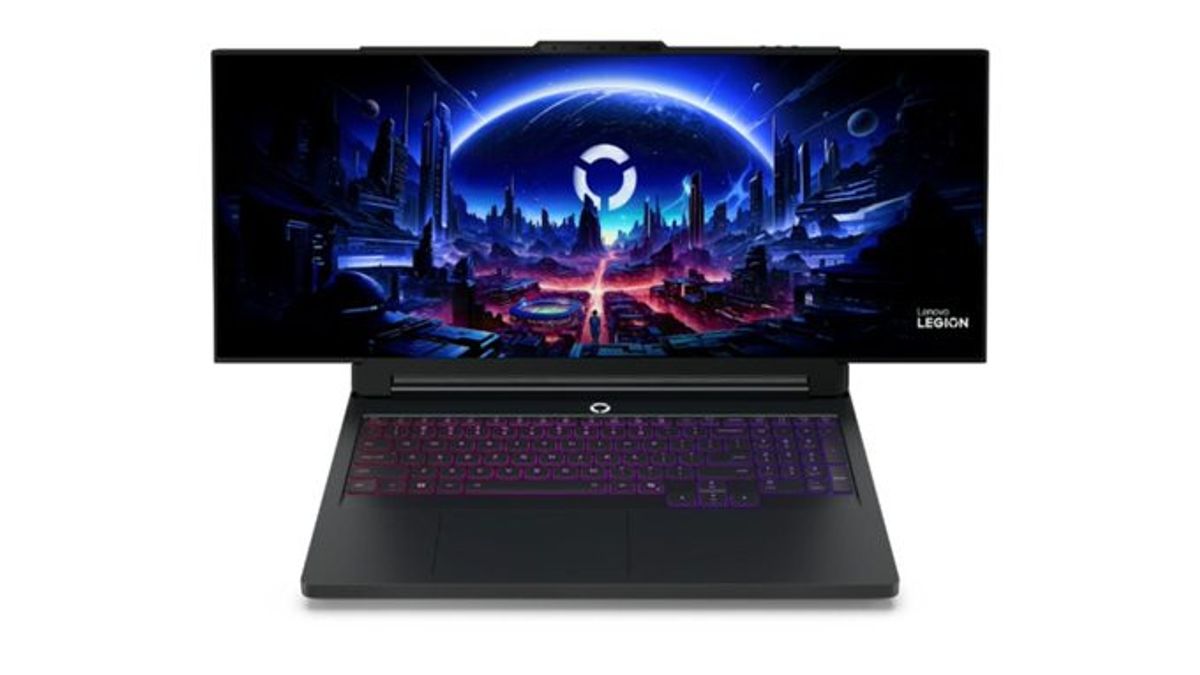


JAKARTA - Lenovo again stole the spotlight at CES with its signature approach: a crazy idea that technically makes sense. This year, the Chinese company showed off the Legion Pro Rollable, a concept gaming laptop with a roll-up screen that can change from standard format to almost ultra-wide in seconds.
Lenovo's Legion Pro Rollable continues the experiment from CES 2025, when they introduced the world's first rollable laptop. The difference is, this time the technology has been brought into the gaming realm. The 16-inch OLED screen can be rolled left or right to stretch to 21.5 inches, and even reach 24 inches for an extra wide visual experience with a 24:9 ratio. The target is clear: maximum immersion without having to carry an external monitor.
Even though it is still in the concept status, the specifications that are carried are not trivial. This laptop is based on the high-end Legion Pro 7i, equipped with an NVIDIA GeForce RTX 5090 GPU and an Intel Core Ultra processor. Lenovo has not detailed the RAM and storage capacity, but the "top spec" approach confirms that this device is aimed at heavy gamers, not just showing off technology.
Its status as a concept does mean it's not necessarily for sale. However, history offers hope. Lenovo's rollable laptop also started from a concept before it was mass-produced. That makes the Legion Pro Rollable more than just a CES stage gimmick.
Beyond the futuristic concept, Lenovo also announced a gaming product that will actually be sold this year. The Legion Go 2 comes in two versions, Windows and SteamOS, with an 8.8-inch OLED screen, up to 32GB of RAM, and up to 2TB of storage. The SteamOS version starts at $1,199, a little more expensive than the Windows version.
Lenovo also updated its line of gaming laptops such as the Legion 7a, Legion 5i, Legion 5a, to the latest LOQ series. All of them are powered by GPUs up to RTX 5060 and offer a relatively lightweight design for the gaming class. Prices start at 1,149 US dollars, with a gradual launch from April to June.
As a closing, Lenovo also showcased the AI Frame Gaming Display concept, a screen with artificial intelligence that is able to recognize the type of game, automatically highlight important areas, to provide real-time guidance when facing difficult moments. This is still a concept, but the message is clear: the future of gaming is not just about FPS, but also about AI that "plays along" with users.
CES 2026 once again shows that the line between wild ideas and real products is getting thinner. It remains to be seen which one will actually hit the market, and which one will remain a dream material for gamers.
The English, Chinese, Japanese, Arabic, and French versions are automatically generated by the AI. So there may still be inaccuracies in translating, please always see Indonesian as our main language. (system supported by DigitalSiber.id)


